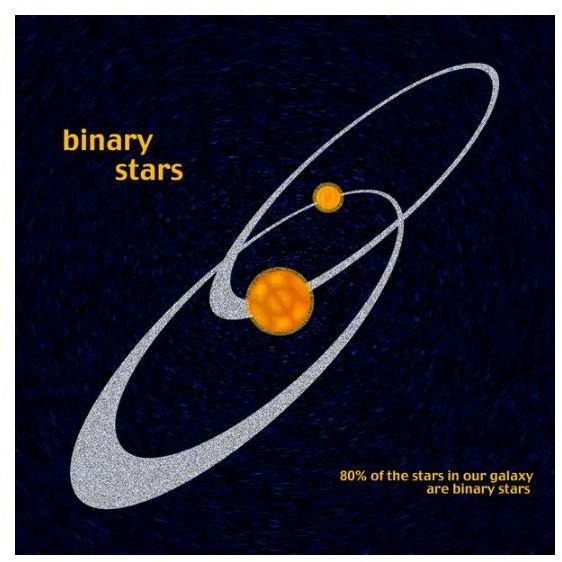
Our Sun is somewhat unusual in that it is a single as opposed to binary star. Binary star configurations are more common in the universe, and depending on the stars making up a binary system, a binary star supernova fueled by carbon can occur, pulsing out a galaxy’s worth of light in the process
Binary Stars and Supernova
Unlike the Sun, most stars are part of binary systems or multiple stars systems, but this may not be apparent without the aid of a powerful telescope. A supernova is a catastrophic explosion of an old, massive star in a binary system that has run out of fuel. Binary star supernovae are fairly common in the universe as a whole, but in our own galaxy, the Milky Way, they occur on average of once per century. The last observed supernova in our galaxy happened in 1680.
A supernova can release a whole galaxy’s worth of light. After the occurrence of a supernova, a nebula, or a cloud of bright gas, is left behind. Sometimes a neutron star is left behind after a supernova. Neutron stars have collapsed to the point that all their atoms have been crushed—the protons and electrons have combined, leaving behind only neutrons, and creating a very dense entity. In fact, a teaspoon of the material neutron stars are made of would weigh as much as a mountain.
‘Junior’ Supernova: Fueled by Helium
In 2009, scientists at UC Berkeley discovered a possible new type of supernova while reviewing data taken in 2002. The supernova, SN2002bj, is located in the galaxy NGC 1821, which is in the constellation Lepus . The type of explosion had been predicted in calculations, but not observed. This type of supernova was only about one-tenth as bright and long-lived as the typical supernova. Rather than resulting in nuclear fusion producing very bright light, this type of supernova is fueled by helium rather than the usual carbon.
The helium-fueled explosion was the result of a collapse of a binary star system. Basically, one star has enough gravity to pull the helium from the other star, causing the bigger star to reach critical mass and then explode. This type explosion can only happen in a particular type of binary star system. One star, with about the same radius of the earth, is almost all helium. It orbits so close to the larger star, that the helium detaches and becomes part of the larger star. Once this accumulated helium reaches a certain mass, there is an explosion.
Possible Supernova in Milky Way?
An observable example of this type of supernova would only occur on average around one time in 3,000 years in our galaxy. A close binary system in the Milky Way, known as T Pyxidis, is a recurrent nova, meaning that the white dwarf in the binary system has had nova (as opposed to supernova) explosions about once every 20 years. However, the last such explosion was documented in 1967. Why there have been nearly 44 years since the last explosion is not known.
There is, however, evidence that the white dwarf star in this system is increasing in mass and could go supernova at some point. If that is the case, it will eventually reach what is called the Chandrasekhar limit and instantaneously collapse, destroying the white dwarf and leaving nothing behind: no black hole or pulsar. This type explosion is the equivalent of 20 billion, billion, billion megatons of TNT, an unimaginable scale. Astronomers have recently discovered that Pyxidis is only about 3,260 light years from earth, which is far closer than previously thought. If the white dwarf star does reach the Chandrasekhar limit and collapse, the resulting binary star supernova would dump enough gamma radiation onto the earth to burn off the ozone layer completely - which will, probably, lead to the extinction of all living species.
References:
https://www.bbc.co.uk/science/space/stars/startypes/
https://imagine.gsfc.nasa.gov/docs/science/know _l2/supernovae.html
https://www.astronomy.com/asy/default.aspx?c=a&id=8944
https://www.bbc.co.uk/science/space/solarsystem/index.shtml
https://news.discovery.com/space/will-earth-really-be-wiped-out-by-a-local-supernova.html
https://www.dailynexus.com/article.php?a=19865