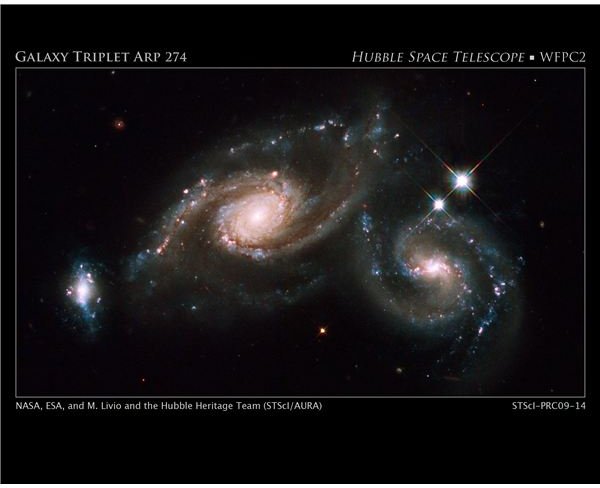
There are billions of galaxies of various types in the universe. The most beautiful are the spirals, with their elegant arms wrapping around a central core. What are these beautiful cosmic wonders?
A Family of Galaxies
The universe is populated with several types of galaxies --billions and billions of them, as Carl Sagan used to say. Most of the more visible galaxies are spirals. The Hubble space telescope has shown us incredible images of some of these wonders.
Here are some.
But not all spirals are equal.
The typical spiral consists of a central disk with two or more spiral arms rotating around the disk. These are called ‘lenticular’ galaxies because the central disk is shaped like a magnifying class. Then there are barred spirals. They may have different origins.
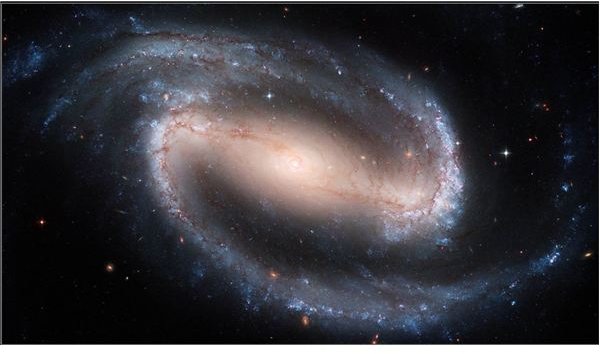
So what are spiral galaxies?
Types of Spiral Galaxies
All the spirals have spiral arms, but some have arms so tightly wound around the central core they appear almost like elliptical galaxies, which have no spiral arms. There are four basic types of lenticular spirals, as shown in this illustration.
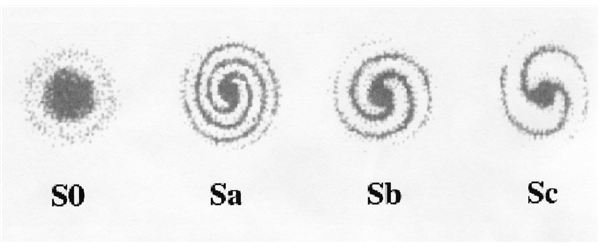
There are actually two subtypes of SOs
• S01—lenticular with no visible spiral arms.
• S03—lenticular with a lot of light absorbing dust.
• Sa—tightly wound, smooth arms.
• Sb—more defined arms.
• Sc—more loosely wound, clearly defined arms.
And there is one more type of lenticular:
• Sd—very loose arms; the arms are much brighter than the core.
Very often, from ground based telescopes, only the arms can be seen, and this type appears to a viewer as another type of galaxy.
Then there are the barred spirals.
These do not have the central bulge, but rather have a line of stars through the middle. They do exhibit a center swelling however, and most show distinct spiral arms. They are designated SBx, where x is a sub type designation. The sub types are:
• SB01—a barred galaxy with no visible spiral arms.
• SB03—barred with very tightly wound arms.
• SBa—tight but distinct arms.
• SBb—well defined loosely wound arms.
• SBc—very loosely wound arms, and dim core.
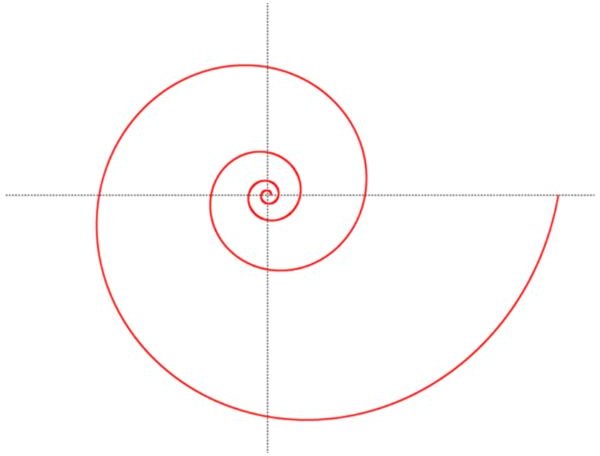
One aspect of all spirals that is intriguing is that the spiral arms are logarithmic in form—that is, they are described by the natural logarithm e, 2.71828. All things in nature are formed by this force. A nautilus’ shell, for example, is described by e.
.
At the Center of Things
What could form the bulging center and spinning arms of a lenticular spiral? Only a huge mass around which the entire galaxy was rotating. A mass sufficiently large to do that could only be a black hole.
Thanks to Hubble, we now know all spirals hide a massive black hole at their center. Our Milky Way galaxy has a black hole equal to four billion solar masses at its center. In fact, it appears the majority of galaxies have a black hole at their center.
In fact, there is controversy among astrophysicists as to whether black holes create galaxies, or galaxies create black holes.
But whichever way it is, it is the black hole that causes the stars to spin around it. And that creates something called density waves to build up. These are regions in which the stars compress into regions of high concentration. This is just the way sound propagates through air. The molecules compress into high density regions, separated by regions of low density.
In a galaxy, these density waves cause the spinning stars to move out from the center in the logarithmic spiral manner mentioned above. As this continues, spiral arms are produced.
The Many Forms of Spiral Galaxies
Spiral galaxies come in many forms. But all forms share the incredible glowing arms that define and differentiate these wonders of the cosmos from all other galaxies.
And at their center, they hide some of the most massive black holes in the universe, which may have created them.