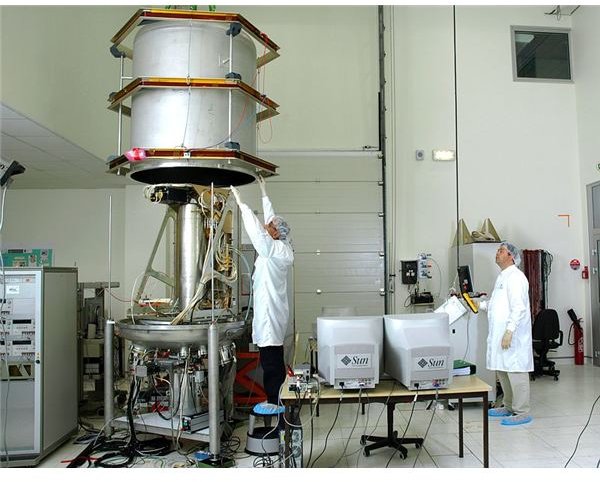
Einstein’s theory of relativity will be put to the test in a micro-gravitational environment by CNES’ PHARAO¹ project, scheduled to launch in 2013 as part of the European ACES² project. Theoretical physics, metrology, and atomic clock design all stand to benefit from this joint venture.
Fountain Clock
Physics theory should take a quantum leap in a few short years, when the speed of time and Einstein’s General Theory are evaluated by a kind of stopwatch. That “stopwatch” and heart of the PHARAO project’s mechanism, is a new kind of atomic clock called a “cesium fountain clock.” The space study will yield data accuracy much higher than what is attainable under earth’s gravitation. The clock is cube-shaped—one meter on a side; it will be tested aboard the International Space Station (ISS).
Mission Importance
Space and time are no longer considered separate entities; the three dimensions of space have become the four dimensions of space-time. The concepts and explanations of this are described by Einstein’s general theory of relativity. How accurate is that theory? PHARAO may help determine the answer. How? Gravity warps or distorts the space-time continuum. Measurements here are impeded because of earth’s gravitational field. Space can provide the needed micro-gravitational location that would simplify and improve research.
General Relativity
Part of Einstein’s general theory of relativity is “gravitational time dilation.” Time travels at different rates under different gravitational potentials, that precept states. The weaker the gravitational field is, the slower time travels. Proof of time dilation was first obtained by the team of Robert Pound and G. A. Rebka, Jr., by their famous “Harvard Tower” experiment. Their results utilized the Principle of Equivalence³, a part of Einstein’s theory. Pound and Rebka’s earth-bound test produced time differences of the order of nanoseconds. Vastly superior results are expected from PHARAO.
Additional Benefits Expected
In addition to improved data, PHARAO may suggest modifications to Einstein’s Theory. Currently, relativity is useful at the astronomical level but is sometimes at odds with quantum physics when applied at the atomic level. It would be a grand achievement if the two could be combined into one unified theory. Beyond that, additional benefits should include improvement in time measure (to 10⁻¹⁶), and in clock design.
PHARAO may be able to help with another issue. The equations for electron hyperfine structure transition (low energy shift effects involving magnetic moments and nuclear spin-spin coupling interaction) include the hyperfine structure constant, α (alpha). In 1999, the Australian team of John K. Webb at the University of New South Wales, studying quasars and redshifts, announced a slight variation in α. Although later the results came into question, the issue has yet been resolved. Is the “constant” truly constant?
Clock Function
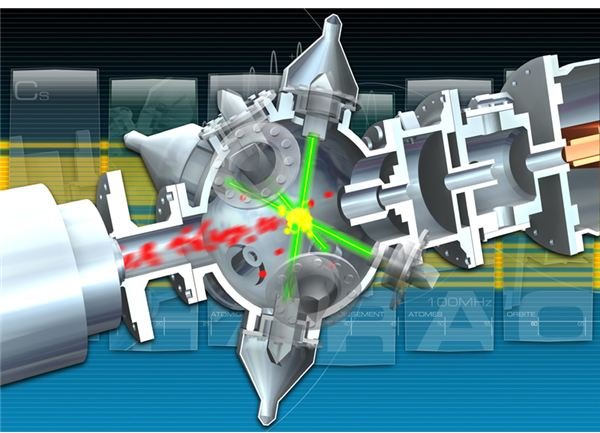
The original cesium atomic clock has been the standard of accurate time measure for about forty-three years. The fountain clock was developed during the 1990’s. How does the fountain clock work?
Cesium atoms are introduced into an envelope under ultrahigh vacuum (created via ion pump). The atoms are slowed and trapped by laser cooling techniques to within millionths of one-degree absolute zero. The atoms are then manipulated into a location where microwave radiation energizes them. The atoms then can undergo hyperfine structure transitions. NIST provides a visualization of the principles: NIST F-1 Cesium Fountain Clock.
The fountain clock is extremely accurate - especially when in a micro-gravitational environment such as that found in space. For the purposes of comparison, a hydrogen maser will be included.
Pre-Launch Testing and Concluding Remarks
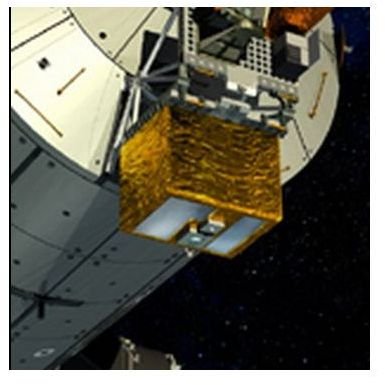
Since 2006, all of PHARAO’s Engineering Model (EM) sub-assemblies are integrated and being tested in preparation for the actual Flight Model (FM). The unit to be launched will be mounted to a CEPA⁴ and launched by space shuttle to the ISS, where a robotic arm will transfer the unit to the nadir position on the Columbus External Payload Facility.
Although CNES’ PHARAO project may be of greater interest to the scientific community than to the public at large, certainly it promises to be among the near future’s more rewarding endeavors.
Notes and References
Notes
¹ CNES stands for Centre National D’Études Spatiales; PHARAO stands for Projet d’Horloge Atomique par Refroidissement d’Atome en Orbite.
² ACES stands for Atomic Clock Ensemble in Space.
³ The principle of equivalence states that any uniformly accelerating reference frame is equivalent to a gravitational field, g = -a.
⁴ Columbus External Payload Assembly
References
CNES; “PHARAO - The Project Main Steps”
ACES - Atomic Clock Ensemble in Space
Georgia State University; “Gravitational Red Shift”
National Institute of Standards and Technology; “NIST-F1 Cesium Fountain Clock”