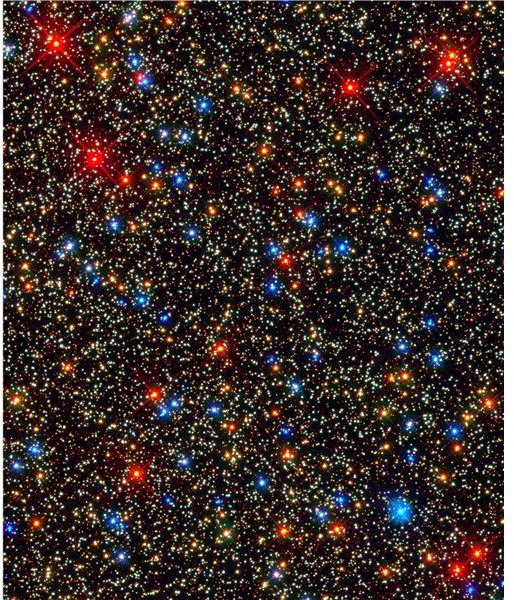
Did you know that there are about 158 globular clusters in the Milky Way, 500 in the Andromeda galaxy and roughly 10,000 in the M87 elliptical galaxy? Here are some more interesting facts and characteristics of globular clusters.
Key Facts About Globular Clusters
**
Meaning: A Globular cluster is a type of star cluster that consists of millions of stars tightly held by gravity. The word “globular” stems from the Latin word globulus, which means “a small sphere”. The stars in a globular cluster are more than 1010 years old (Population II stars ), which are known to be the oldest stars in the cosmos.
Number of globular clusters in the Milky Way Galaxy: 158 approx. (Current)
Diameter: approx. 20 to 100 parsecs
Average mass of a globular cluster (solar masses): 104 to 105
Approx. number of stars in a globular cluster: 105
Average Density of stars in a globular cluster: 0.4 stars per cubic parsec to 1000 stars per cubic parsec
Luminosity (L-solar): 104 to 106
Location in a galaxy: In a halo about a galaxy.
Color of the brightest stars in a globular cluster: Red - red giant stars typcially with an absolute magnitude of -2.
Brightest globular cluster in the Milky Way: Omega Centauri (NGC 5139 in the constellation Centaurus) with an apparent magnitude 3.7
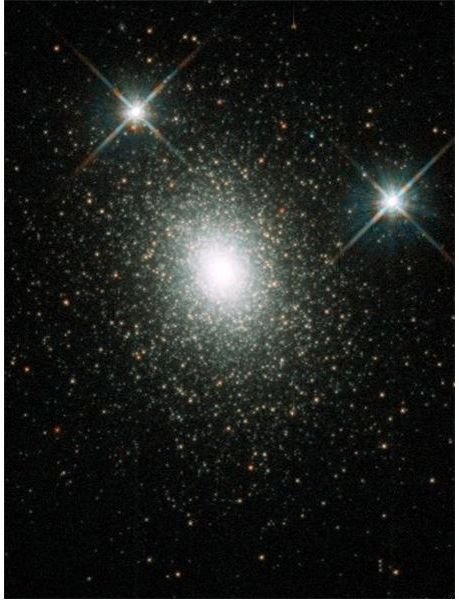
Brightest globular cluster in the local group of galaxies: Mayall II (G1) in the Andromeda galaxy with an apparent magnitude 13.7
Closest globular cluster: Messier 4 (distance: 7,000 light years)
(Image, top left: the image of the Omega Centauri globular cluster taken from the newly installed Wide Field Camera 3 (WFC3) on board Hubble. The WCF3 was installed in May 2009. Image courtesy of Nasa )
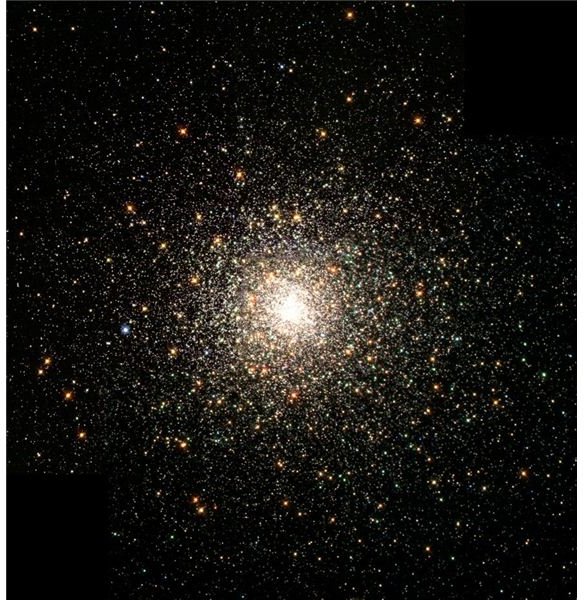
Image above: Globular Cluster M80 in the constellation Scorpius . Image courtesy of NASA.
History of Globular Clusters
-
First Globular Cluster Discovered: Messier 22 (NGC 6656) in 1665, discovered by a German amateur astronomer Abraham
 Advertisement
Ihle.
-
Omega Centauri, the brightest globular cluster of our galaxy was discovered by Edmund Halley , a British astronomer and geophysicist in 1677. Interestingly, it was first listed by Halley as a Nebula. Omega Centauri was referred as a star in Ptolemy’s catalog 2000 years ago.
Advertisement -
By 1947, there were a total of 97 globular clusters discovered and since then about 158 in total have been discovered about the Milky Way galaxy.
-
Between 1927 and 1929, American Astronomer Harlow Shapley and Helen Sawyer began classifying globular star clusters according to the concentration of stars. The clusters were categorized in classes, where the most condensed ones were classified as Class 1 and the least as Class XII. This classification is popularly known as Shapley-Sawyer Concentration Class.
Advertisement -
On April 1 2008, astronomers asserted the evidence of an intermediate-mass black hole at the core of Omega Centauri globular cluster.
(Image, top right: Image of Mayall II globular cluster, courtesy of Wikipedia )
Interesting Facts About Globular Clusters
-
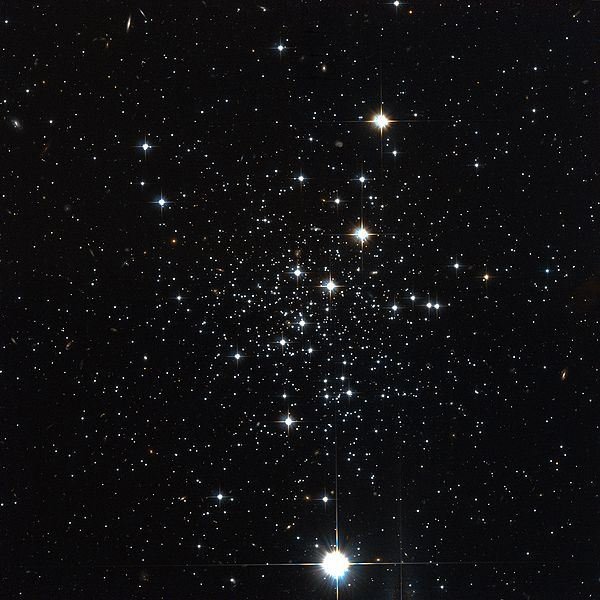
Faint globular clusters are called as Palomar globular clusters. Discovered in the 1950s by popular astronomers including Edwin Hubble and George Abell, a Palomar globular cluster can only be viewed using astro-imagers and large telescopes. There are a total of 15 Palomar globular star clusters.
 Advertisement
 -
The 47 Tucanae and Omega Centauri in the southern skies can be seen with the naked eye easily. The M13 can be viewed with unaided eyes in the northern hemisphere.
-
While there are about 158 globular clusters in our galaxy, there are about 500 in the Andromeda galaxy. Elliptical galaxies such as the M87 may contain over 10,000 globular star clusters.
( Image of Palomar 12: an example of palomar globular clusters, the faintest globular cluster in the night sky. They can be observed only via a large telescope, image courtesy of Wikipedia )
References
https://www.astro.keele.ac.uk/workx/globulars/globulars.html
https://en.wikipedia.org/wiki/Globular _cluster
https://www.encyclopedia.com/doc/1O80-OmegaCentauri.html
https://en.wikipedia.org/wiki/Omega _Centauri