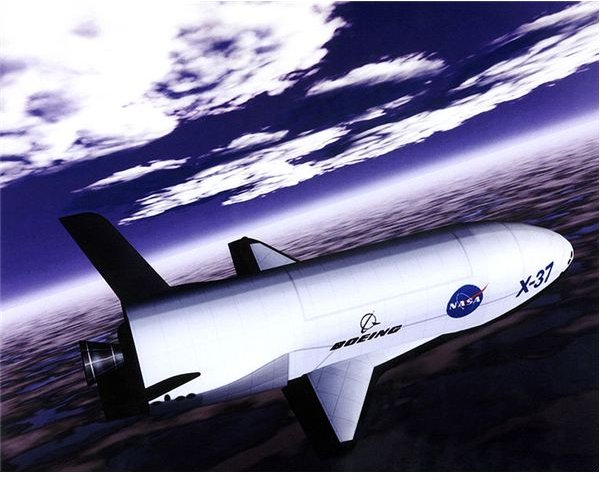
Though the Space Shuttle’s retirement looms ever nearer, the United States Air Force is pushing ahead with an effort to produce their first ever orbital spaceplane. If successful, the X-37 will fulfill the promise of the cancelled X-20 Dyna Soar.
According to numerous sources , the United States Air Force is progressing towards its planned launch of the X-37 OTV (Orbital Transfer vehicle) next year, a step that completes a journey that initially started before the Space Shuttle was even so much as a paper dream in the minds of North American/Rockwell engineers. Representing a partnership between NASA, USAF, and Boeing, this vehicle, conceptualized by Phantom Works in 1999, may finally bring the promise of a true Air Force spaceplane to fruition.
It didn’t start out that way, though - initially, the program was a NASA effort that was to ride into space nestled within the cargo bay of the Space Shuttle; the disintegration of the Space
Shuttle Columbia over Texas altered that plan and, eventually, the project gained sponsorship and a “classified” status via the Defense Advanced Research Projects Agency, then migrated on to the Air Force. Perhaps it is just as well, since the choice of a rocket-based follow on to the Shuttle program would seem to leave no place for lifting body spacecraft within NASA, at least for the foreseeable future. Now, in contrast to that same Shuttle, this new spaceplane will ascend into orbit upon a rocket, the Air Force’s own Atlas V. If the existing timetable holds, the X-37B’s first flight will be in January of next year. Carrying no crew, the demonstrator will achieve orbit, then return to Earth at an undisclosed location.
Reminescent of the ESA’s own Intermediate eXperimental Vehicle , or IXV, the X-37B will demonstrate and validate advanced technologies of interest, especially those that support hypersonic flight (flight at speeds well in excess of the speed of sound). While the exact technologies and details remain veiled, it can be hoped that the X-37 will, in time, be just as important to our efforts to advance our aeronautical understanding as its ancestor, the X-20 Dyna Soar, did - indeed, some have said that the Shuttle would not have made it into orbit, were it not for the trail, most especially in the area of thermal protection systems, that the Dyna Soar blazed. It is, then, perhaps poetic justice that the X-37B is very close in size to the Dyna Soar… or maybe it is just a matter of similar solutions to similar engineering problems and constraints.
Credits
Image courtesy of NASA