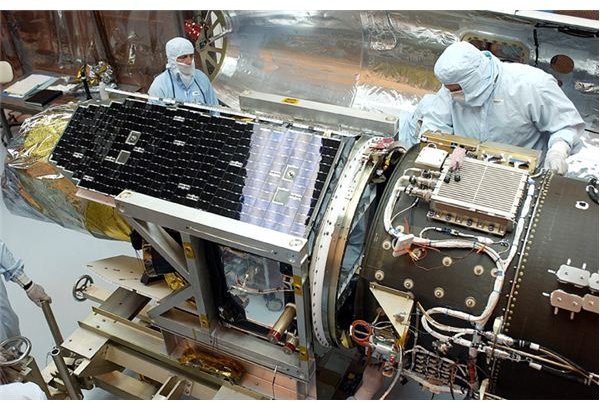
GALEX, or Galaxy Evolution Explorer is an orbiting telescope that collects radiation in the ultraviolet region of the electromagnetic spectrum. Launched in 2003, the mission was originally designed to last for two and a half years, but it is still going strong today - exploring galaxies far far away
Overview
The Galaxy Evolution Explorer, nicknamed GALEX, launched into orbit on April 28, 2003 for a 29-month mission designed to gather ultraviolet radiation data from galaxies 10 billion light years away. The data gathered represents a time period that goes 80% of the way back to the big bang.
The GALEX mission was developed as part of NASA’s Explorers Program, managed by NASA’s Goddard Space Flight Center in Maryland. It is a partnership between the California Institute of Technology and NASA’s Jet Propulsion Laboratory.
GALEX Images

The Mission
More specifically, GALEX is observing hundreds of thousands of galaxies to determine two things: how far away from Earth they are; and how fast stars are forming there. Scientists want to know the age of the stars to find ones that have only formed recently. Newer stars are the largest and hottest – so hot that they shine strongly in the ultraviolet region of the electromagnetic spectrum. The strength of radiation in various wavelengths gives clues as to the star’s chemical makeup. We already know that the pieces that make up the Milky Way formed inside of stars, but we don’t yet know when that happened beyond that. GALEX should be able to gather enough information to find out.
The Design
The Galaxy Evolution Explorer has two detectors. The far-ultraviolet (shorter wavelength) detector sees stars that are younger than 10 million years old, and the near-ultraviolet (longer wavelength) detector picks up radiation from stars less than 100 million years old.
The Technique
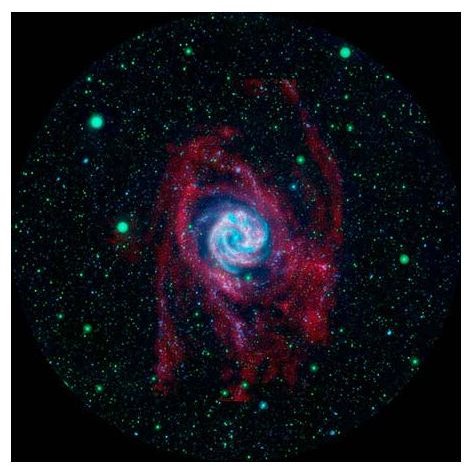
In huge young stars like those in the M33 galaxy, one of the Milky Way’s nearest neighbors, you see stars burning through their large supply of hydrogen fuel rapidly, burning very hot and emitting lots of energy in the ultraviolet region of the spectrum. These stars burn out in a few million years, which is a young age in cosmic terms. By contrast, relatively lightweight stars like our own sun live on till a ripe old age of several billion years.
Beauty in Space
In addition to the massive amount of technical data GALEX has recorded, the images themselves are astonishing in their beauty. Photos of the stars in M33 show a bright white spiral in the ultraviolet region. When combined with infrared images of M33 made by the Spitzer Space Telescope, the effect is that of a brilliant rainbow-hued spiral. The Spitzer Space Telescope was launched in August, 2003 to explore the infrared radiation in the cosmos. It too is still going strong well beyond its intended mission.
The Mission So Far
In its six years in space, the Galaxy Evolution Explorer has taken images of more than 500,000,000 (half a billion!) objects that span two-thirds of the sky. One highlight of GALEX’s mission was the detection of Mira, which is an older, Red Giant that is moving very rapidly. Mira’s tail is giving scientists new clues as to how stars die out and create new solar systems.
Summary
The Galaxy Evolution Explorer has certainly done what its name says: it has explored the evolution of galaxies beyond the Milky Way, and has put in nearly four years of overtime on the job, bringing earthbound scientists a wealth of data they can use to determine the steps in the evolution of galaxies, including our own.
References
https://www.galex.caltech.edu/about/overview.html
https://www.nasa.gov/centers/jpl/missions/galex.html
https://www.nasa.gov/mission_pages/galex/galexC-20090428.html
https://www.spitzer.caltech.edu/Media/releases/ssc2009-10/release.shtml
https://spacespin.org/article.php/90460-galex-celebrates-sixth-anniversary
https://spacenews.uuuq.com/mission/2009/05/galex.html
https://www.satnews.com/cgi-bin/story.cgi?number=885809365