Development of the vehicle that would send Apollo to the moon required new equipment and new approaches. Not only was the launch vehicle beyond anything that had preceded it, so was it’s Ground Support Equipment.
Behemoth
Even while the Saturn 1 was still abuilding, the Werner von Braun team at Marshall Spaceflight Center (MSFC) was developing the vehicle that would take man to the moon. Unlike even Saturn 1, the new vehicle would require new equipment and new approaches.
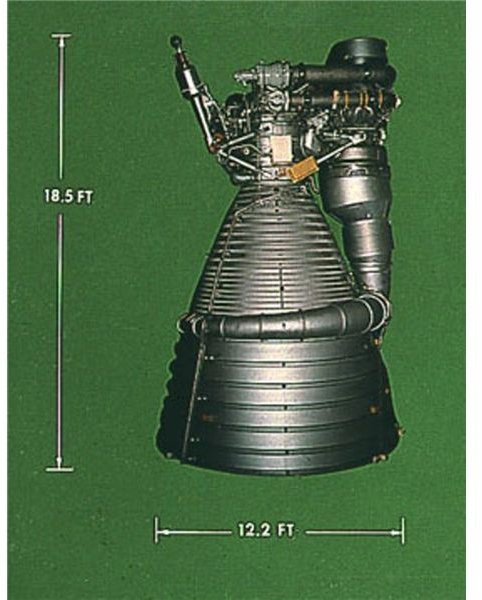
The first stage booster would need the most powerful rocket engine even built—the huge F1. It was 18.5 feet long and more than 12
feet wide at nozzle exit and would generate 1.5 million pounds of thrust itself. The booster would be powered by five, to provide a total liftoff thrust of 7.5 million pounds. This was needed, because the entire moon rocket, eventually called Saturn V, at liftoff would weigh 6 million pounds.
The five engines were arranged with a center stationary engine, with the four outboard engines gimbaled for steering.
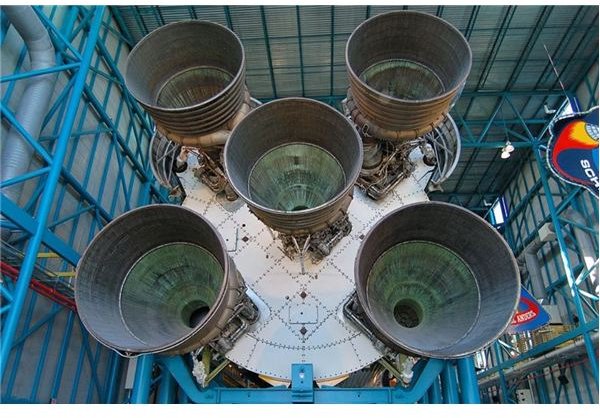
The first stage had to carry a prodigious amount of fuel to feed the five huge F1 engines. It was 33 feet in diameter and 138 feet tall. That was taller than any previous manned launch vehicle. This stage, dubbed the S1C stage, carried 4.5 million pounds of LOX and RP-1.
The second stage, the S-II, was LH2 fueled, like the S-IVB on Saturn 1. But it too had new engines, the J2, the largest LH2 engine
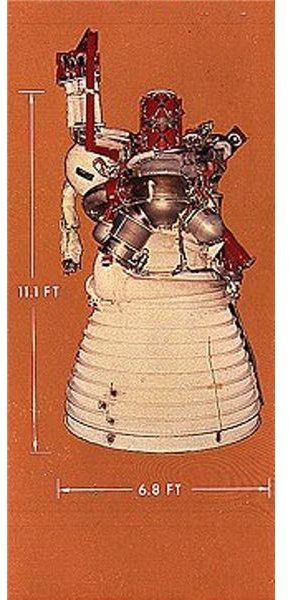
ever built at the time. The J2 was 11 feet long and close to 7 feet wide at its nozzle exit. It produced 200,000 pounds of thrust. Like the S1C stage, the SII used five J2s in the same arrangement.
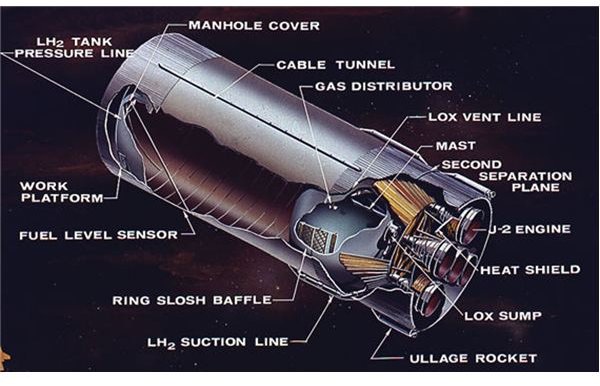
The SII was 81 feet tall and 33 feet in diameter, mating perfectly with the S1C. It held a million pounds of propellant at liftoff.
The third stage was the venerable and proven S-IVB , upgraded and modified for a lunar mission.
With the Apollo spacecraft atop the three stages, the Saturn V/Apollo stood 363 feet high.
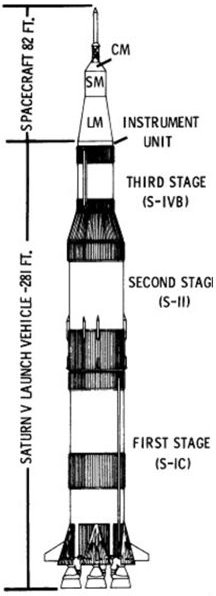
It was so big and so heavy, weighing a million pounds even empty, the previous method of assembling the vehicle on the pad was out of the question. It was not acceptable or safe to have such a behemoth sitting unprotected in the elements as assembly, checkout and launch preparations went on. A new approach had to be developed.
Giant Ground Support for a Giant
While the rocket scientists were developing the moon rocket, another part of the MSFC team was developing the equipment that would support it on the ground. And their designs for the Ground Support Equipment (GSE) were every bit as advanced and outside the box as the rocket boys. They had to be. A vehicle this size had never been handled before.
First on the menu was a place to assemble the behemoth. It had to protect the vehicle from the elements, and it would have to be huge, to hold a 363 foot tall vehicle. Thus was the design of the Vertical Assembly Building (VAB), now called the Vehicle Assembly Building, born. It was and is the building with the fourth largest cubic interior in the world. It is so big it has its own weather. Clouds often form in its upper reaches.
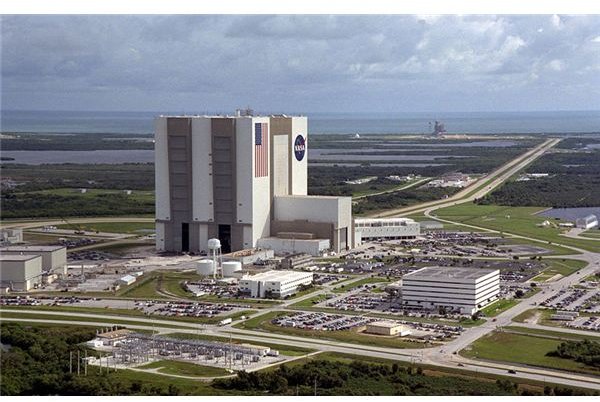
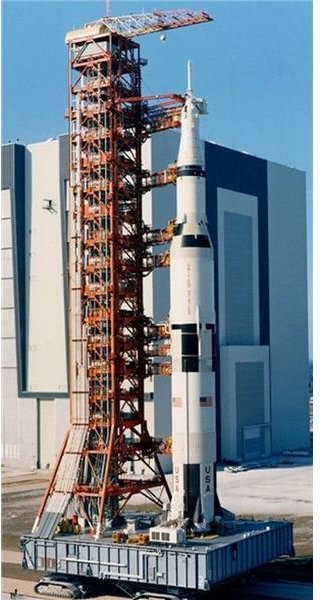
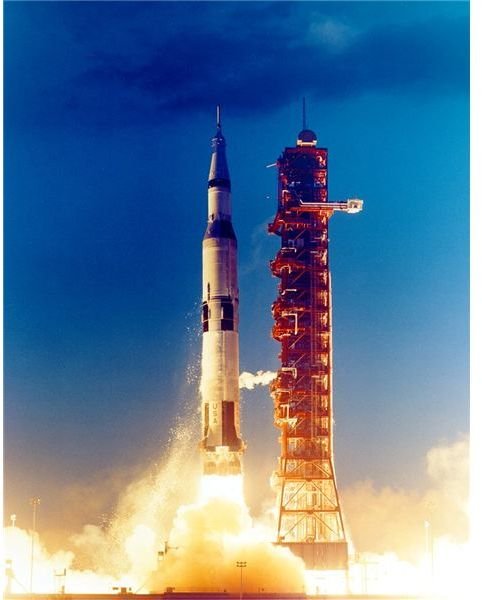
The Saturn V was assembled, standing up, here. It was assembled on the platform it would rest on at Launch Complex 39 (LC-39). This platform was and is called the Launch Umbilical Tower (LUT). It is still used, in modified form, for the Shuttle, and will be used for Ares and Constellation.
The LUT consists of the platform on which the vehicle sits on hold down arms. These both support the vehicle, and keep it from lifting off until they sense that its thrust has built up to a sufficient level for it to be released.
The umbilical tower for Saturn V held nine ‘swing arms’ which carried the electrical and propellant connections to each stage, including the Apollo spacecraft. The arm at the top provided crew access to Apollo. Just before launch, the unbilicals disconnect and the arms swing away from the vehicle.
But with all this structure and a million pound vehicle on it, engineers had one bigger challenge. Getting all that from the VAB to the launch pad. Their solution was beyond elegant, but as massive as the moon rocket itself.
They designed and developed another behemoth. A huge track driven vehicle that could carry this load the 3.5 miles to the pad and keep it level the entire trip.
The vehicle was dubbed the Crawler/Transporter. And crawl it did—top speed of one mile per hour. The trip from the VAB to the pad takes about 5 hours.
Each of its four huge tracks are individually powered by four high powered electric motors. These are powered by four 1000 kw generators driven by two 2750 hp diesel engines. And by the way, it gets one mile per 150 gallons. And the Crawler weighs as much as its cargo does fully fueled—six million pounds.

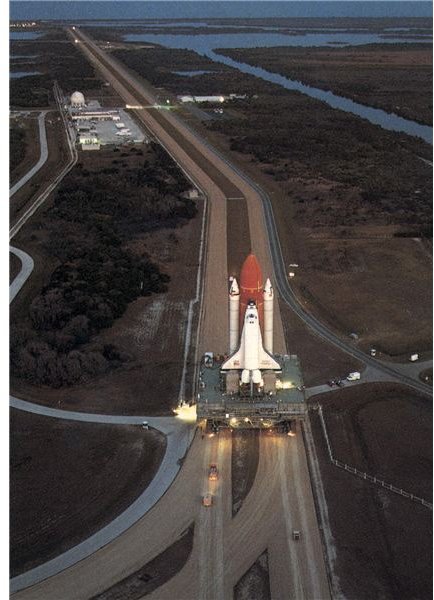
Obviously, this behemoth, even without its cargo, could not crawl on a normal road. The engineers had to design and build a special ‘Crawlerway’ to support it.
This unique road is constructed of 2.5 ft of hydraulic fill–rock fragments compacted by vibration combined with sand deposited by high pressure water–3ft of graded limestone, 1 ft of selected fill, an asphalt sealer; and 4-8 in of river rock on top to reduce surface friction. It is 130ft wide overall, with two lanes. Each lane is 40ft wide with a 50ft median.
Crawlerway Abort
The unmanned Apollo 4 was to be the first flight of Saturn V. This would be an ‘all up’ test, with all stages being fired and orbit being achieved.
But the rocket fates had other ideas. Unable to do mischief to Dr. von Braun’s Saturn I, they ignored his giant and took on the Crawler.
Engineers had designed a new type of bearing for the monster transporter. Each set of tracks had a huge truncated cylindrical bearing that bore the weight and allowed it to roll easily. The idea behind the design was that it would be more efficient than a set of giant ball bearings.
The Crawler began its slow roll to Pad 39A with its massive, skyscraping cargo. Suddenly, there was a crunching screech from one set of tracks, and the Crawler came to a halt. It would not move and was leaning to one corner. Only the leveling hydraulics kept the cargo level.
One of the bearings had crushed. The weight was too great.
There were NASA investigations, Congressional investigations, recriminations and rationalizations. It took almost a week to get the Saturn V back to the VAB. Several months were lost from the schedule while the cylindrical bearings were replaced with those formerly eschewed giant ball bearings.
Finally, on Nov. 9, 1967, Saturn V lifted off with Apollo 4.
The First Flights
The giant moon rocket performed flawlessly. Once in orbit, the S-IVB was reignited for the first time. Another success. At an apogee of 17,000 km, the Apollo spaceship separated from the S-IVB and fired its Service Module engine to take it further out. It then fired the engine again to boost its speed to 40,000 km/h to simulate reentry from the moon.
All tests were nominal.
The next Saturn V flight was Apollo 6, another unmanned flight. This one did not fare so well. There were pogo oscillations, two engines on the S-II stage shut down prematurely, and the S-IVB failed to restart in orbit. Solutions to the problems were quickly found, and after the test of the LEM on a Saturn I with Apollo 7, NASA decided it was time to aim for the moon.
Credits
F1 engine: Wikipedia https://en.wikipedia.org/wiki/File:F-1 _rocket_engine.jpg
J2 engine: Wikipedia https://en.wikipedia.org/wiki/File:J-2 _rocket_engine.jpg
Saturn V engine arrangement: Wikipedia https://en.wikipedia.org/wiki/File:Saturn _V_Rocket_Booster.jpg
SII stage: Wikipedia https://upload.wikimedia.org/wikipedia/commons/f/f5/SaturnV _S-II.jpg
Saturn V: Wikipedia https://en.wikipedia.org/wiki/File:HSV _Saturn_V.jpg
VAB: Wikipedia https://en.wikipedia.org/wiki/File:Aerial _View_of_Launch_Complex_39.jpg
LUT: NASA https://www.hq.nasa.gov/office/pao/History/alsj/a410/ap10-KSC-69PC-110.jpg
Crawler/Transporter: NASA https://mediaarchive.ksc.nasa.gov/detail.cfm?mediaid=24639
Crawlerway: NASA https://science.ksc.nasa.gov/facilities/crawlerway.html
Apollo 4: NASA https://www.hq.nasa.gov/office/pao/History/alsj/a410/ap4-KSC-67PC-435.jpg
This post is part of the series: The Apollo Program
President John Kennedy gave this country the goal of sending a man to the moon by the end of the 1960s. The result was the Apollo program, which created a new series of spacecraft, launch vehicles, and even ground support equipment.