Gamma Ray Bursts (GRB) are the most energetic events in the universe. Lasting for a few milliseconds to a few minutes, they are a hundred times as bright as a supernova. GRBs are almost certainly the most interesting astronomical phenomena discovered in the last century.
Introduction
Gamma Ray Bursts (GRBs) are extremely energetic flashes of gamma rays which last from a few milliseconds to several minutes. Since gamma rays lie in the extreme region of the electromagnetic spectrum and have a huge energy associated with their photons, the process required to produce such bursts must be highly aggressive. The randomness in the direction of these bursts reveals that they are coming from outer space, and not from within the solar system . Some GRBs are a million trillion times as bright as the Sun and can release more energy than the Sun will release in its whole lifetime. Many theories exist which explain the origin of GRBs and associate them to a variety of events.
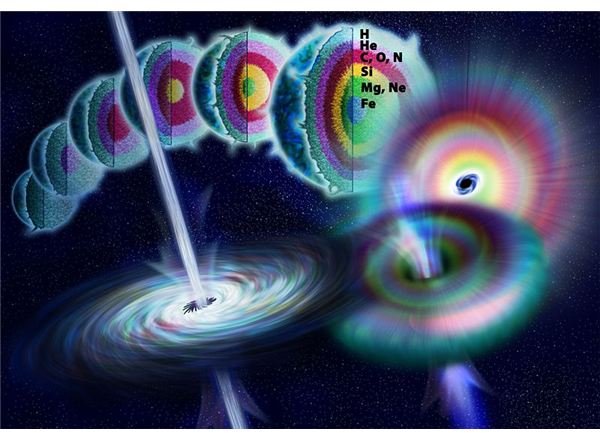
Below Right: Artist impression of a GRB and its composition (Image Credit: Nicolle Rager Fuller/NSF https://www.nsf.gov/news/news _images.jsp?cntn_id=104440&org=NSF)
The First Burst
In the 60s, the US signed a nuclear test ban treaty, along with a few other countries. To keep a check on the terms of this treaty, a series of satellites known as the Vela satellites were launched. These satellites were equipped with X-ray and gamma ray detectors. While looking at the data of Vela 4a,b , Klebesadel and Olsen noticed an event recorded on July 2, 1967. After some analysis, their team was able to determine the approximate sky positions of the bursts. This is assumed to be the first recorded observation of a cosmic Gamma Ray Burst. The team was also able to determine the sky positions for another 15 bursts.
Science Behind GRBs
The most widely accepted model for long duration GRBs is the collapsar model (also called the hypernova model). Extremely massive stars can burn the material in their core very rapidly to form elements up to iron. After this fusion energy cannot be produced and the star collapses, a black hole is formed, and the matter outside swirls into the core in the form of an accretion disk. The high energies associated with this sinking of matter produces high velocity jets, along the rotational axis of the black hole. A relativistic shock wave is formed at the front, and the velocity increases as the density of material it passes through decreases. When it strikes the surface, the shockwave bursts and releases most of its energy in the form of gamma rays.
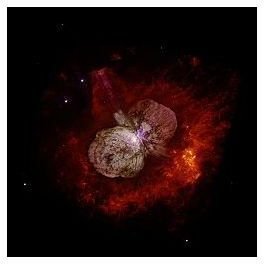
Below: Eta Carinae, a candidate for hypernova. (Image Credit: Space Telescope Science Institute NASA and Hubble European Space Agency Information Centre, ESA. https://en.wikipedia.org/wiki/File:EtaCarinae.jpg)
Current Missions
Since November 20, 2004: Swift by NASA.
Since March 16, 2006: INTEGRAL, the European Space Agency’s International Gamma-Ray Astrophysics Laboratory.
Since April 23, 2007: AGILE by the Italian Space Agency(ASI).
Since June 11, 2008: Fermi Gamma Ray Space Telescope by NASA.
References
Nasa,https://imagine.gsfc.nasa.gov/docs/science/know_l1/bursts.html
Nasa,https://imagine.gsfc.nasa.gov/docs/science/know_l2/bursts.html