Canis Major, known primarily for Sirius, the brightest star in the night sky, follows Orion faithfully across the winter sky in the Northern Hemisphere. So, why exactly did the ancients name hot, hazy summer days after a constellation seen mainly during cold weather?
Canis Major Images
Left: A constellation map of Leo (Image credit: Torsten Bronger at Wikimedia Commons, https://en.wikipedia.org/wiki/File:Canis _Major_constellation_map.png, GNU Free Documentation license.)
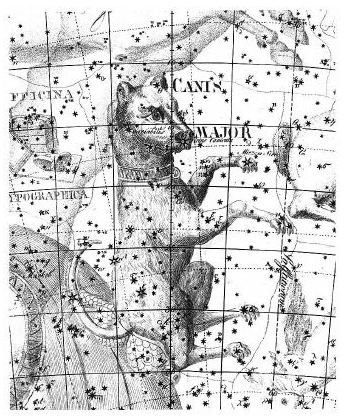
Right: Public Domain Image: Canis Major, with Sirius marking its snout, shown in the Uranographia of Johann Bode (1801).
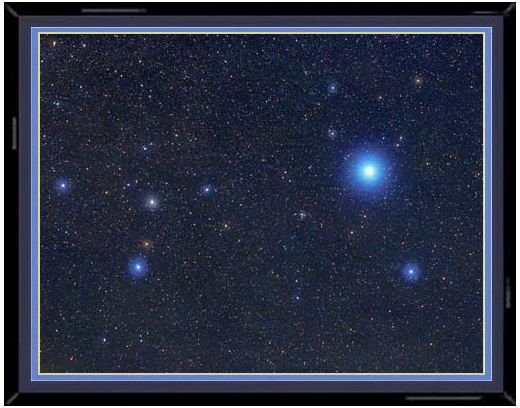
Center: This photo of the constellation Canis Major shows, enlarged in their true color, the main “naked eye” stars that make up the shape of the constellation. Image courtesy of https://www.scienceandart.com
The Facts
1. The Image of: Canis Major, the Great Dog.
2. Right Ascension: 7h
3. Declination: −20°
4. Genitive: Canis Majoris
5. Symbolism: The greater dog
6. Area: 380 sq. deg. (43rd)
7. Main stars: 8
8. Bayer/Flamsteed stars: 32
9. Stars with known planets: 3
10. Brightest star: Sirius (α CMa) (−1.46m)
11. Nearest star: Sirius (α CMa) (8.6 ly)
12. Messier objects: 1
13. Meteor showers: None
14. Bordering constellations: Monoceros, Lepus, Columba, Puppis
15. Visible at latitudes: between +60° and −90°
16. Best visible: At 21:00 (9 p.m.) during the month of February
Significant Astronomical Objects
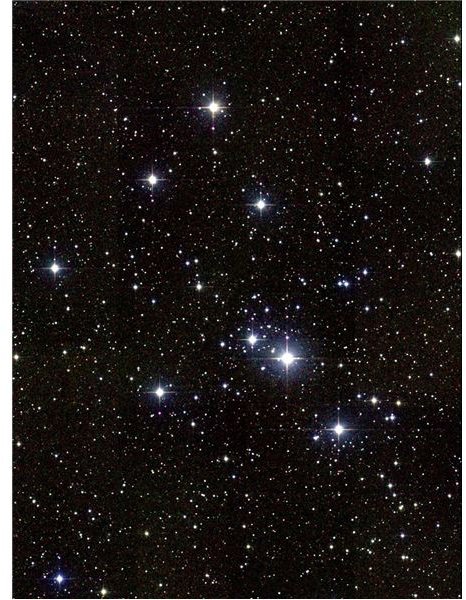
Center: M41 (Image Credit: NASA at Wikipedia Commons https://en.wikipedia.org/wiki/File:M41atlas.jpg )
1) α Canis Majoris (a.k.a. Sirius): Only 8.6 light years away with a magnitude of –1.47, Sirius (commonly referred to as “The Dog Star”) shines as the brightest star in the sky (after the Sun, of course). More than twice the mass of the Sun, it surpasses old Sol in absolute luminosity by 23 times!
2) M41(NGC 2287)****: Because Canis Major lies near the Milky Way, dust clouds obscure much deep sky objects. However, M41 is an open cluster containing 8,000 stars about 2,350 light years away.
Mythological Background
1) The heliacal rising of Sirius told ancient Egyptians the annual Nile floods would soon begin. Perhaps for this reason, the Egyptians used Sirius to measure the length of the year.
2) Although once associated with Laelaps, a dog of such speed that Zeus immortalized it by placing it in the heavens, from the earliest times Canis Major has been known as the Dog of Orion, faithfully beside the Hunter’s feet while chasing Lupus the Hare through the sky.
3) We get the name “Dog Star” from the Ancient Egyptians, who named the star after their god Osirus, who had the body of a man and the head of a dog.
4) Plutarch associated the star Sirius with “leader” rather than “heat.”
5) Native Austrialians referred to the Sirius itself as an Eagle.
6) Sanskrit writings call it “Deer-slayer” and “Hunter.”
Amazing Facts
1) α Canis Majoris is actually a double star. The brighter star (Sirius A) we see is a white main sequence star while its companion (Sirius B) is a 8.4 magnitude white dwarf circling Sirius A every 50 years.
2) We get the phrase “dog days of summer” from the Egyptians and the Romans thanks to Sirius. During those times, Sirius and the Sun rose at the same time in the summer. These ancients believed the Dog Star caused all those hot summer days because the star added its heat to the Sun’s heat. Homer, Caesar, Cicero and even Virgil all wrote of Sirius as the cause of summer heat. Roman farmers even sacrificed fawn-colored dogs to appease the gods and avoid hot summers.
3) Sirius became the first star to have its velocity measure when, in 1868, Sir William Huggins, noticed a red shift in the spectrum of the star. His calculations were off by about five times, but at least he got the direction right.
4) Although the name Sirius derives from the Latin “Sirius,” the Latin term probably merely copied the Greek name “Seirios,” which means “glowing” or “Scorcher.”
5) Edmond Halley (yes, the Comet guy), comparing his measurements of Sirius to Ptolemy’s, in 1718 became the first astronomer to prove stars weren’t “fixed” and actually possess a proper motion.
References
The Illustrated Encyclopedia of Astronomy and Space, Ian Ridpath, Editor
Exploration of the Universe, Third Edition, George O.Abell
Star Names – Their Lore and Meaning, Richard Hinckley Allen
https://en.wikipedia.org/wiki/Canis_Major
https://curious.astro.cornell.edu/question.php?number=178