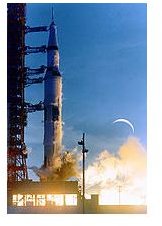
This week marks the anniversary of the Apollo 8 mission, during which men orbited the Moon for the first time in history, and the births of both Isaac Newton and Johannes Kepler. Read more in this chronology of notable events in the history of space exploration.
December 21
1966
The USSR launched Luna 13 on a mission to soft-land on the Moon.
1968
NASA launched Apollo 8, the first manned mission to orbit the Moon from the Kennedy Space Center. The astronauts would make ten orbits of the Moon on Christmas Eve, when it would take the first close-up photographs of the lunar surface
1978
The Soviet space probe Venera 12 entered the atmosphere of the planet Venus and landed on its surface, from which it would return data for approximately one hundred and ten minutes. During that time, it would record evidence of electrical discharges which would be later attributed to lightning.
1984
The USSR launched the Vega 2 space probe on a mission to perform a fly-by of Halley’s Comet, which it would perform on March 9, 1986.
1987
The Soyuz spacecraft TM-4 carried three cosmonauts on a mission to space station Mir.
1988
One year to the day after being launched into space, the former crew of the TM-4, Vladimir Titov, Anatoly Levchenko, and Musa Manarov Vladimir return to Earth.
1999
Galaxy XI, the world’s largest commercial communications satellite, was launched. It was equipped with a record sixty-four transponders.
December 22
1870
Jules Janssen made the first observations of a solar eclipse from a hot air balloon in history.
1985
NASA moved the Space Shuttle Challenger (STS 51-L) to Launch Pad 39B.
2006
The Space Shuttle Discovery sets down at the Kennedy Space Center at the conclusion of a two-week mission to the International Space Station (ISS).
December 23
1672
Italian astronomer Giovanni Cassini discovered Rhea, one of Saturn’s satellites.
1690
John Flamsteed observes Uranus without realizing it is undiscovered.
1968
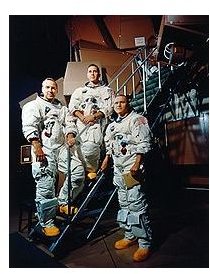
Aboard the Apollo 8, Mission Commander Frank Borman, Command Module Pilot James Lovell, and Lunar Module Pilot William Anders became the first humans to orbit the Moon. Frank Borman suffers from the first documented case of space motion sickness. The incident was later attributed to the large Command Module, which afforded the astronauts a far wider range of movement than on previous missions.
1986
Dick Rutan and Jeana Yeager made the first round-the-world flight that didn’t land for refueling aboard the Model 76 Voyager.
December 24
1910
William Hayward Pickering, who would go on to become a rocket scientist at the Jet Propulsion Laboratory, was born. He would go on to perform some of the earliest investigations into new electronic telemetry, which would become the basis of all data transmission from space.
1966
The Soviet Luna 13 successfully landed on the Moon in Oceanus Procellarum. The probe would return a series of panoramic images of the lunar surface captured by a television system. Each of the panorama required a hundred minutes to transmit back to Earth.
1968
While in orbit around the Moon, the astronauts about Apollo 8 astronauts transmit a broadcast back to Earth, during which they read from the Book of Genesis.
1979
The European Space Agency launches Technological Capsule (CAT) 1 aboard the a first a Ariane rocket. The launch is a first for both the ESA and the Ariane model.
December 25
1642
Future physicist Isaac Newton was born. He would go on to become the father of both calculus and modern physics
1758
German astronomer Johann Georg Palitzsch became the first man to sight Halley’s Comet, confirming Edmund Halley’s prediction of its coming and cementing Halley’s place in history.
2003
The European Space Agency Mars Express space probe enters into an orbit around the planet Mars, and the Beagle 2 lander enters the planet’s atmosphere. The Beagle was expected to land at about 02:45 UT, however contact was lost and never re-established.
December 26
1928
Robert H. Goddard launched a third liquid fuel rocket, which is four times the size of his previous models. The test is a success, reaching speeds of sixty miles per hour.
1973
The Soviet spacecraft Soyuz 13 returned to Earth.
Two of the Skylab 3 astronauts set a new duration record when the perform a seven hour extra-vehicular activity (EVA) or “spacewalk.”
1974
The Soviet space station Salyut 4 was launched on a mission to accommodate civilian objectives over the course of two months. Its design was similar to that of the original Salyut 1 station but with the notable addition of three large solar arrays.
December 27
1571
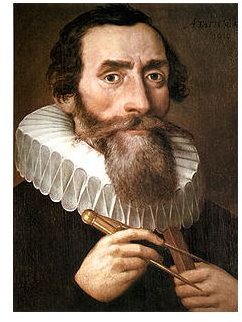
Future German astronomer Johannes Kepler was born. He would go on to prove the elliptical nature of the planets’ orbit and to formulate the three laws of planetary motion.
1968
Apollo 8 returned to Earth at the completion of its mission to the Moon. The mission performed many historical feats, including achieving a velocity sufficient to escape from Earth’s gravitational field, entering the gravitational field of another celestial body, escaping from the gravitational field of another celestial body, and returing to Earth from another celestial body.