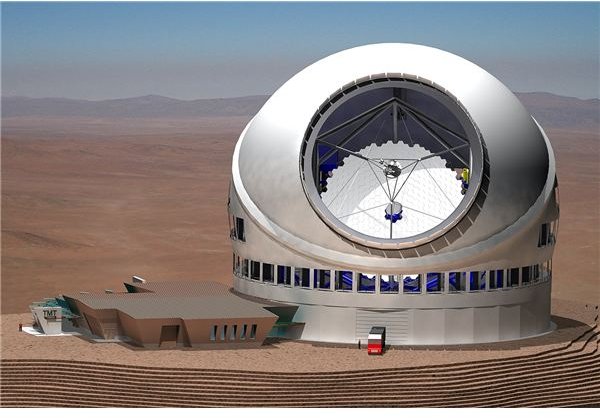
Thirty meters—almost 100 feet in diameter—one third of a football field! This telescope is nothing if not ambitious. Coupled with sophisticated adaptive optics and scientific instrumentation it will open the windows to the history of our dynamic and mysterious Universe.
What’s it All About?
“The over-arching theme for the Thirty Meter Telescope (TMT) is the history of the Universe…we are looking at understanding the origin of the Universe.” So stated Dr. Richard Ellis, Director of the Caltech Optical Observatories in a promotional video about the TMT. This is a very challenging undertaking for a very sophisticated instrument that will challenge our engineering technology.
The TMT project is a combined effort of the California Institute of Technology (Caltech), the University of California (UC) and the Association of Canadian Universities for Research in Astronomy (ACURA). The National Astronomical Observatory of Japan (NAOJ) is also participating with the TMT as a Collaborating Institution. China and India have also joined the TMT at an Observer Status level, which is the first stage of three to becoming full partners in the project.
The telescope is in development and will be located on Mauna Kea in Hawaii, after a lengthy investigation of possible sites, including the runner up - Cerro Armazones in Chile’s Atacama Desert; both locations provide extremely dry, stable air for optimum seeing conditions. Estimated costs for the the telescope exceed $300 million and the targeted date for first light is in October 2017, with first science in June 2018.
As Dr. Ellis said, the purpose of the telescope is to explore the early Universe. That will involve among other things:
-
Analysis of the “dark ages” when light first appeared and the first heavy elements were formed.
-
Galactic evolution and the large-scale structure of the early Universe.
Advertisement -
Black hole evolution throughout the history of the universe.
-
Investigation of the planet-forming process.
Advertisement
The Hardware
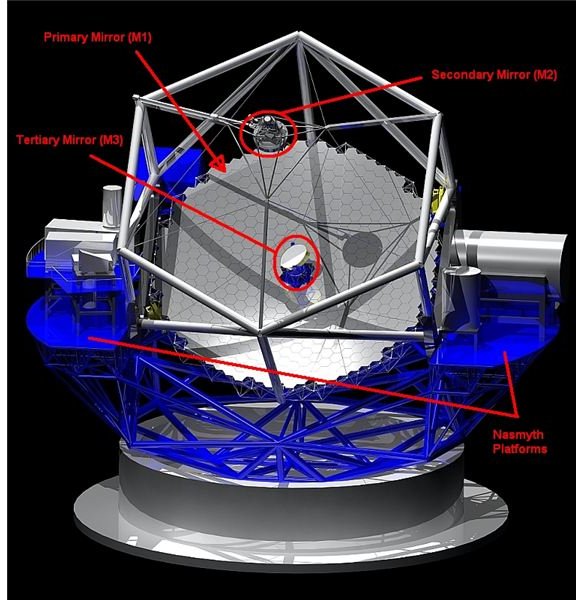
The primary mirror (M1) will consist of 492 individual hexagonal mirrors, each about 1.4 meters (56 inches) across and about 50 mm thick (about 2 inches) that will be individually controlled with adaptive optics. It is interesting to note that the gap between these mirror segments will only be about 2.5 mm (.1 inch) wide. The secondary mirror (M2) will be 3.1 meters (10 feet) in diameter and will also utilize adaptive optics. The telescope will have a third mirror (M3) positioned in the center of the primary mirror,
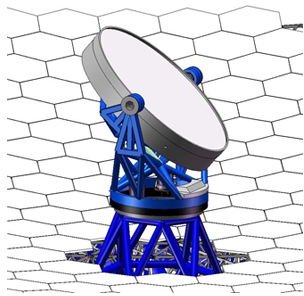
which can be precisely rotated and tilted to direct the images to the scientific instruments that will be mounted on the Nasmyth Platforms on either side of the telescope. This mirror is 3.6 meters (12 feet) long by 2.5 meters (8 feet) in width.
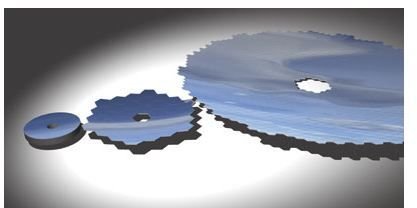
To better appreciate what the TMT will provide in the way of viewing deep space objects, consider that it has 144 times more surface area in its primary mirror than the Hubble Space Telescope (HST) has. This means it has much greater ability to see dimmer objects – 144 times fainter! TMT’s ability to resolve objects is better by a factor of 10 over the HST - images will be significantly sharper and show more detail.
Of course, since the HST is in orbit 350 miles above Earth’s surface, it doesn’t have to be concerned with our turbulent atmosphere. The TMT does, and it’s answer to that problem is NFIRAOS (pronounced: nefarious) or the Narrow-Field Infrared Adaptive Optics System. This is an advanced control system that uses six lasers and wavefront sensors to sample the atmosphere and a high speed computer to calculate how to adjust (1000 times a second) the 492 mirrors of the primary, plus the secondary mirror to keep the image in focus. This device, which weighs 17 tons and costs $28 million is being designed by National Research Council of Canada for the TMT and should be installed in 2015.
The Observatory
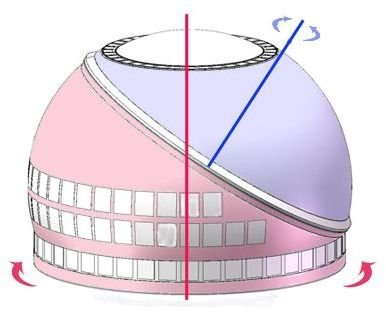
The observatory is as unique as the telescope it contains. Dispensing with the traditional sliding doors on the observatory dome, the TMT observatory will have a large circular aperture that can be positioned from 90 degrees straight up to about 25 degrees above the horizon. This is called a “calotte enclosure”, where ‘calotte’ literally means – “a close cap without brim or visor—a skullcap”. Looking at the figure below one can better understand how the structure moves. The lower section of the enclosure (in red) rotates like a conventional observatory about a vertical axis, while the section containing the circular aperture (in blue) rotates about an inclined axis. These two independent degrees of freedom allow the telescope to be pointed anywhere from zenith to just above the horizon. There are 98 vent doors around the structure that can be opened to allow for rapid thermal equalization of the enclosure and telescope with the outside atmosphere – essential for the telescope to achieve its stated resolution.
The Instruments and the Future
The telescope will be able to see from the mid-infrared, through the optical spectrum to the ultraviolet. As of this time there are three scientific instruments planned for operation by first light. They are:
-
WFOS: A wide-field, multi-object spectrograph working at optical wavelengths.
-
IRIS: An integral-field unit spectrometer with imaging capability working at near-infrared wavelengths.
Advertisement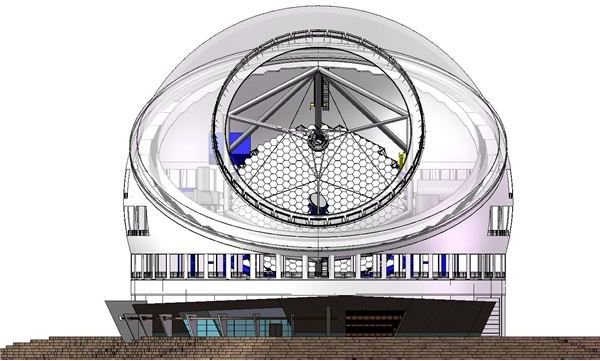
-
IRMS: A multi-slit, near-infrared spectrometer also with imaging capability.
Advertisement
The expectations are high for this amazing piece of technology. If previous telescopes are any indication, the wonders that the Thirty Meter Telescope will unveil will far exceed what its designers had ever imaged!
References
Thirty Meter Telescope: https://www.tmt.org
Introductory TMT video: https://www.tmt.org/gallery/video/tmt-overview
Images:
Illustrations for the Thirty Meter Telescope were graciously provided by TMT Observatory Corporation: https://www.tmt.org
Comparative mirror sizes: https://eands.caltech.edu/