In the world of comets, Halley’s Comet stands out for more reasons than one. Besides its visibility and relatively short orbital period, many facts about Halley’s comet have been observed by – and influenced – human societies for more than 2,000 years.
The Facts
1. Discovered by: Ancients
2. Named after: British scientist Edmond Halley , who first recognized it as a periodic comet and calculated its orbit in 1705
3. Also known as: 1P (P for periodic, 1 for being the first periodic comet identified)
4. First recorded appearance: 240 B.C., in the Chinese Records of the Grand Historian
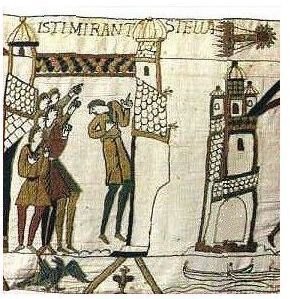
5. Other notable appearances: 1066, where the English came to view it as a harbinger of the Battle of Hastings; 1910, when the first photographs of Halley’s Comet were taken and some people feared being poisoned as Earth passed through the comet’s tail
6. Orbital period: 75.32 years
7. Orbit: Retrograde (opposite the direction of planetary orbits)
8. Aphelion: 35.08 AU
9. Perihelion: 0.586 AU
10. Semi-major axis: 17.83 AU
11. Eccentricity: 0.967
12. Inclination: 162.26 degrees
13. Last perihelion: Feb. 9, 1986
14. Next perihelion: July 28, 2061
15. Closest approach to Earth: 0.03 AU (5.1 million km, 3.2 million miles) in 837
16. Age: 4.5 billion years
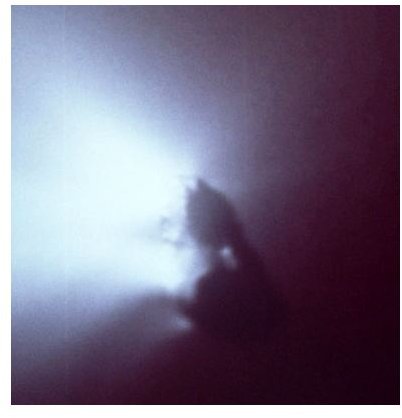
17. Shape: Peanut-like
18. Length: 15 km
19. Width: 7 to 10 km
20. Composition: Water, carbon monoxide, methane, ammonia, hydrocarbons, iron, sodium
21. Mass: 2.2 x 10^14 kg, 4.85 x 10^14 pounds
22. Density: 0.6 g/cm3, 0.022 pounds/inch3
23. Albedo: 4 percent (similar to charcoal)
24. First observed up close by: The Soviet Vega 1 probe, which began sending back images of the comet on March 4, 1986
25. Closest approach by: The European Space Agency’s Giotto probe, launched in July 1985, which came as close as 596 km (370 miles) on March 13, 1986
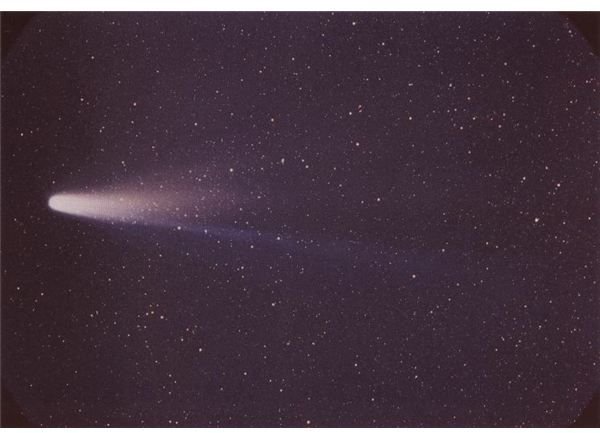
Above left: A photo of Halley’s Comet taken in 1986 as part of the International Halley Watch. (Image credit: NASA/W. Liller, https://en.wikipedia.org/wiki/Image:Lspn _comet_halley.jpg)
Above right: The 1066 appearance of Halley’s Comet was depicted on the famous Bayeux tapestry. (Image credit: https://en.wikipedia.org/wiki/Image:Tapestry _of_bayeux10.jpg)
Left: This image of the nucleus of Halley’s Comet was taken by the Giotto probe’s multicolor camera. (Image credit: European Space Agency, https://www.esa.int/esaSC/120392 _index_1_m.html#subhead6)
More Neat Facts
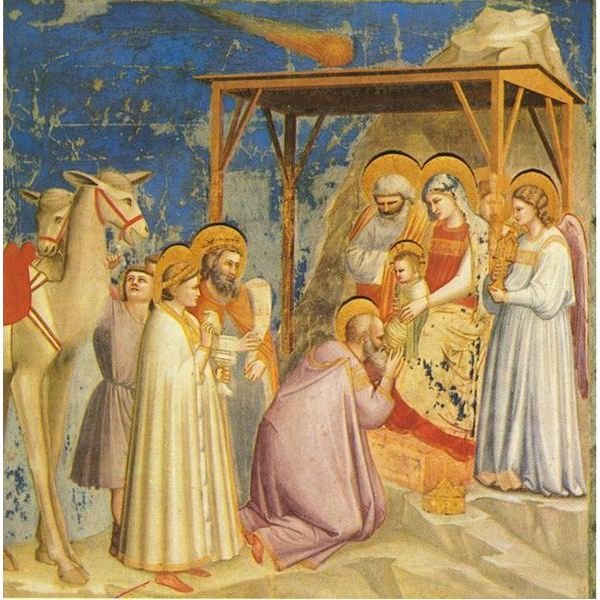
1) New technology, old namesake. The Giotto space probe that studied Halley’s Comet was named for Italian painter Giotto di Bondone, whose painting Adoration of the Magi depicts Halley’s Comet as the star of Bethlehem leading to the Nativity. (di Bondone actually saw Halley’s Comet during its 1301 appearance.)
2) Small but mighty. The Giotto probe was briefly destabilized, after being struck by small particles of dust flying off of Halley’s Comet. Scientists calculated that the mass of the particular particle that caused the problem was no more than 1 gram.
3) Unaccountable freaks. Mark Twain’s life shared an odd correspondence with the appearance of Halley’s Comet: he was born two weeks after the 1835 perihelion and died one day after the 1910 perihelion. In 1909, Twain wrote in his biography, “I came in with Halley’s comet in 1835. It’s coming again next year, and I expect to go out with it. The Almighty has said no doubt, ‘Now here are these two unaccountable freaks; they came in together, they must go out together.’ "
4) We’re saying it wrong. While most people pronounce “Halley” as rhyming either with “valley” or “daily,” Edmond Halley actually pronounced his name, “Hawley” (rhyming with “Wally”).
5) Credit where credit is due. NASA’s Jet Propulsion Laboratory identifies the discoverer of Halley’s Comet as Johann Georg Palitzsch. While Edmond Halley first recognized the comet as a periodic one, and calculated the time of its next return, he died in 1742. . .16 years before the comet’s next scheduled appearance. The first person to observe Halley’s Comet on its 1758 swing past Earth was Palitzsch, a German farmer and amateur astronomer who spotted the cosmic visitor on Christmas Day.
Above: Italian painter Giotto di Bondone’s “Adoration of the Magi,” with a comet overhead.
References
cometography.com, https://cometography.com/pcomets/001p.html
Encyclopedia Britannica, https://www.britannica.com/EBchecked/topic/252831/Halleys-Comet
infoman16.tripod.com, https://infoman16.tripod.com/Articles/halley.htm