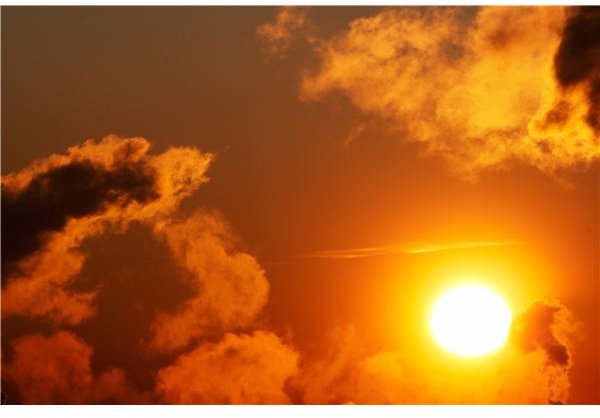
Our friendly, neighborhood star undergoes a major change every 11 years. The last occurred in 2014. Learn what happens when the sun’s magnetic poles flip and how this affects us.
Every eleven years, the entire magnetic field that surrounds our sun reverses itself, going from positive at one pole to negative and vice-versa.
The Sun, like the Earth, has its own magnetic field due to the conductive capabilities of the super-hot plasma that makes up most of the star’s mass. Yet the Sun rotates, like Earth, which causes the magnetic fields to ripple, buckle, and eventually fade to nothing, only to be born again with opposite polarity. The magnetic field will change every eleven years, and the next is predicted to occur in 2025.
How Will This Affect Us?
So what does the Sun’s magnetic fluctuation mean for people on Earth?
To the everyday man, woman, and child, the magnetic flip will occur without so much as a whisper, just as it has done every eleven years. Though the amount of power required to change the Sun’s magnetic field is beyond that of a thousand planet Earths, we will not see any physical change from our vantage point ninety-three million miles away – no explosions, no change in light, and no difference in temperature.
This does not mean it will go by without any note, however. One of ways we may notice the magnetic flip is through interference with our electrical systems. Our planet comes in and out of the Sun’s magnetic field like a plane goes in and out of turbulent air pockets. On days where we have contact with the field we could see interference with satellites, electrical systems, and cell phone towers.
A slower reception for a smart phone may be the sole aspect of the solar flip that goes noticed on Earth, unless you happen to see one of the auroa borealis lighting effects. These “northern lights” occur when particles ejected from the Sun bounce off the Earth’s magnetic field but deflect particles in the upper atmosphere, exciting ions that create the green, red, and purple lights.
A final factor of the Sun’s magnetic flip involves the movement of particles through the galaxy. As super-massive stars collapse and become supernovae, they eject ions at near the speed of light through space. These ions impact matter in space, such as satellites and even astronauts, harming matter and tissue alike.
The Sun’s new magnetic field would displace these ions so that less harm comes to people and man-made objects launched into space. Some meteorologists suggest that these ions even affect weather patterns on Earth, but it is not clear how, or how the Sun’s new magnetic polarity would change any weather on our planet by deflecting supernovae ions back out into open space.