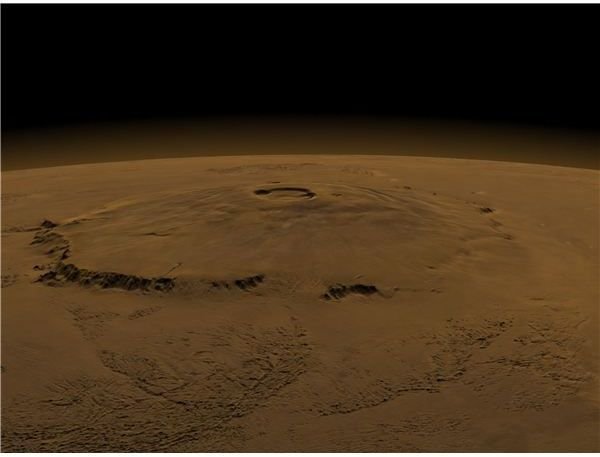
It is probably the biggest geological formation to be discovered and it is not on Earth! Read the article to find out more information about what and where is Olympus Mons, how it was formed and whether it is still active. Could we ever set foot on it?
General Characteristics
The biggest known volcanic mountain of Mars, Olympus Mons, could actually be described as one of the most magnificent geological formations known today. Its dimensions are enormous: its’ height is 25 km and it is over 550 km wide.
At the top lies a complex of six overlapping calderas forming a 60 × 80 km depression and reaching a depth of 3.2 km. The volcano’s outer edge consists of an 8 km escarpment (almost as tall as Mount Everest). The air density at the top of the mountain is extremely low compared to that of the surface (only 5-8%) and since the atmosphere of Mars is extremely thin, the summit lies in a veritable vacuum.
Formation of the Volcano and Surrounding Area
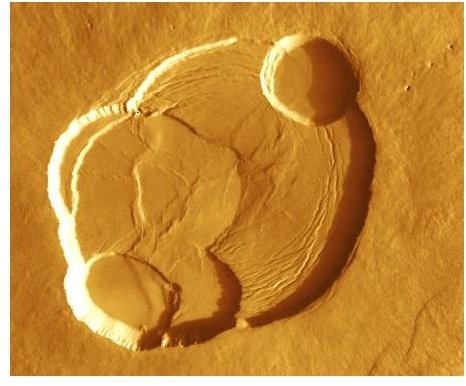
Olympus Mons was formed during the Amazonian Period of Mars (3 billion years ago to present), and it is among the youngest volcanoes on the planet. As a shield volcano , it has shallowly-sloping flanks with an average slope of 5° that were built up layer by layer through innumerable eruptions and lava flows. The size of a caldera is generally proportional to the size of the underlying magma chamber, and in this case the chamber associated with the largest caldera is believed to lie 32 km below its surface. The age of the calderas are estimated at 350 to 150 million years, as indicated by the frequency distribution of the craters on the caldera floors.
The fact that there is no tectonic activity in Mars is the reason why it is so tall and wide. The lack of tectonic plates caused it to continue to erupt at the same place and thus accumulate more and more magma on its flanks. Crater counts show that certain regions are relatively young (2 million years old), a fact that could denote that it may still be active and possibly could erupt.
It is located in Mars’ western hemisphere at the Tharsis region,
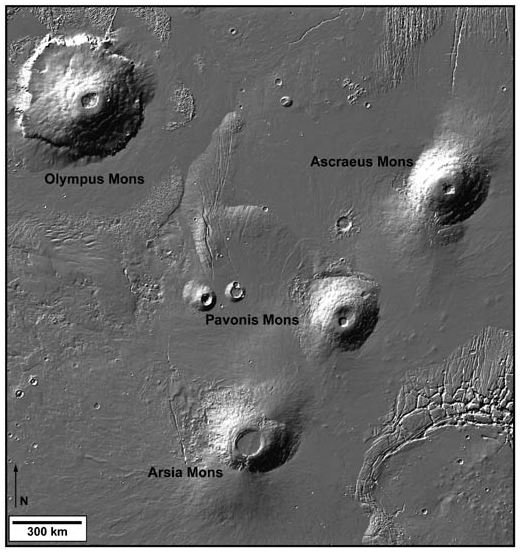
1200 km away from three neighboring shield volcanoes, collectively called the Tharsis Montes - Arsia Mons, Pavonis Mons, and Ascraeus Mons. Although the Tharsis Montes are much smaller, they are still at the top list of the largest volcanoes in our Solar System.
Interesting Facts and Comparisons
-
It is the tallest known mountain and volcano of our Solar System.
-
It is three times taller than Mount Everest and 2,6 times larger than Mauna Kea in Hawaii - the largest volcano on Earth.
Advertisement -
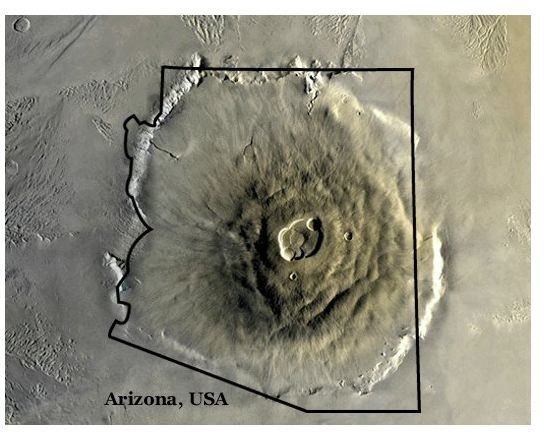
Its size can be compared to that of the Arizona State (see image)
 Advertisement
.
-
The view from the surface is not very exciting. An observer standing on any point of its flanks would be unable to see the top of the volcano.
Advertisement -
However, an observer standing at the top, would be able to see the whole crater-like caldera that stretches about 80 kilometers across.
-
The air at the top is only about 0,05% of the air density at the Earth’s surface, in contrast to the top of Mount Everest where the air density is 32%. This is not only due to the height, but also due to the low atmospheric density of Mars (only 1% of the density at the Earth’s surface).
Advertisement
Suitable for Landing?
The location is considered to be inappropriate for mission landings. This is mostly due to two reasons.
-
Firstly, the area around it is often covered with a layer of dust that inhibits any detailed investigation and sample collection from the surface. Dust particles may also cause severe mechanical damage to space probes and space rovers.
Advertisement -
Secondly, any attempt for parachute-assisted landing would probably result in a crash, since the air thickness above the volcano is not sufficient enough to slow down the descent of a spacecraft.
Sources:
- Olympus Mons on Mars by universetoday.com
- Olympus Mons - the caldera in close-up by ESA
- The Surface of Mars by starryskies.com
Image Credits: