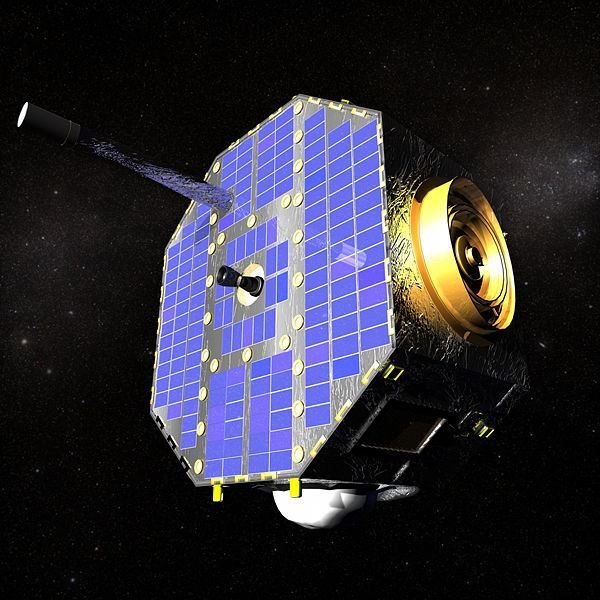
Part of NASA’s small explorer program, NASA Interstellar Boundary Explorer will help scientists to understand the role of the interstellar boundary and the global interactions between the solar winds and the interstellar medium. Read on to find out more about IBEX.
The Interstellar Boundary Explorer
The Interstellar Boundary Explorer (IBEX) is part of NASA’s small explorer program. This mission was proposed by the Southwest Research Institute (SwRI) in San Antonio to study the region between our solar system and interstellar space. The region between the interstellar space and our solar system is called an Interstellar boundary. In November 2003, NASA selected five candidates to compete for two mission slots in NASA’s Explorer program of low cost, rapidly developed scientific spacecraft. IBEX was one of five candidates selected to participate for the two-mission slots. On January 26, 2005, IBEX was chosen by NASA for one of the two slots.
(image source: NASA )
Mission Objectives
The NASA Interstellar Boundary Explorer satellite was launched into space on October 19th 2008, 1:48 P.M. EDT. it was launched from the Reagan Test Site at Kwajalein Atoll in the Marshall Island.
The sole and focused science objective of IBEX is to discover the global interaction between solar wind and the interstellar medium. The interstellar medium can be explained as a low-density material between the stars. The fact that this interaction has never been discovered before makes the mission more interesting. For the first time, the Interstellar Boundary Explorer has mapped the global interactions between the solar wind and the interstellar medium. This will help us understand more about the sun’s interaction with the galaxy. Moreover, IBEX will also study the galactic cosmic rays that pose a threat to the health and safety of human spaceflight exploring beyond earth’s orbit. The NASA Interstellar Boundary Explorer will make all these observations from a highly elliptical orbit, ensuring there is no interference from the Earth’s magnetosphere. (Source: nasa.gov )
IBEX Payload
The NASA Interstellar Boundary Explorer consists of two completely independent pixel sensors, IBEX-Hi and IBEX-Lo. These image sensors are actually energetic neutral atom (ENA) imagers, specialized to detect neutral atoms from the outer boundaries of the solar system and the galactic medium. These sensors will have a collimator which will limit the field of view. IBEX-Hi and IBEX-Lo also have an electrostatic analyzer, a conversion surface, and a detector. The conversion surface will help to convert neutral hydrogen and oxygen into ions. The electrostatic analyzer will select ions of a specific range and suppress ultraviolet light. The detector will be able to identify particle counts and the identity of each ion.
The two single pixel sensors, IBEX-Hi and IBEX-lo, will capture the images of the interstellar boundary of the solar system by measuring the location and magnitude of charge-exchange collisions occurring in all directions. This will result in generating a map of the termination shock of the solar wind.
The payload also includes a CEU (Combined Electronics Unit), which will have a control of voltages on the collimator.
Conclusion
The study by IBEX will help us discover the interstellar boundary regions which protect us from the dangerous galactic cosmic rays. It will also help us to understand the sun’s interaction with the galaxy by observing the global interactions between the solar wind and interstellar medium.
Credits
https://ibex.swri.edu/mission/payload.shtml
https://en.wikipedia.org/wiki/Interstellar_Boundary_Explorer
https://www.daviddarling.info/encyclopedia/I/IBEX.html
Image Reference:
https://www.ibex.swri.edu/multimedia/index.shtml