Three astronomical objects impact each other in different ways. The Sun overwhelms anything in the Solar System, but smaller events like the Earth’s tides are dominated by the Moon. The cycles of each of these objects affect the other objects, some dramatically, others less so.
The Earth Cycle
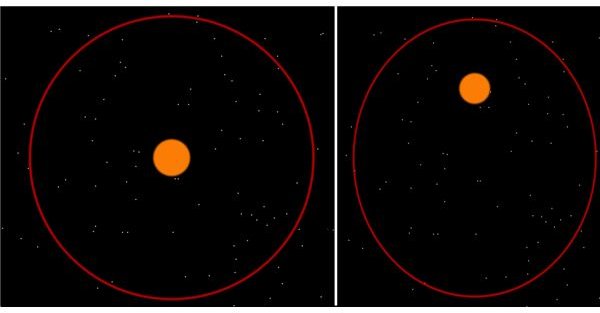
There are three parts to the Earth Cycle. The first is eccentricity. This is just the shape of the Earth’s orbit around the Sun. The orbital ellipticity varies from almost circular to elliptical—about 0 to 5%, which in turn affects the weather. The period of fluctuation is about 100,000 years.
The second cycle is the axial tilt, or the Earth’s axis of rotation, which is about 21 degrees from perpendicular relative to the ecliptic plane. In other words, the Earth tilts while rotating on it’s axis. This range is from 21.5 to 24.5 degrees. The period of fluctuation is 41,000 years.

The final cycle is the precession. This is the Earth’s axis swinging in a circle, like a spinning top. This takes about 23,000 years.

See Also: Nothing but the Facts About Earth
The Moon Cycle
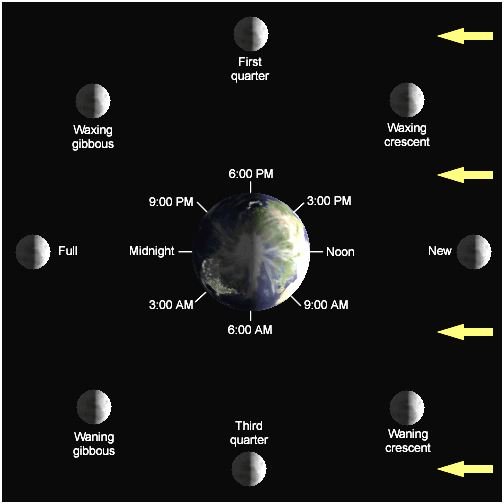
The Moon is always illuminated. But we may not always see it, that is because the time it takes to rotate on its axis is the same as the time it takes to rotate around the Earth. How the Moon appears to us depends on where it is in its orbit around the Earth. If the Earth appears between the Sun and the Moon, in other words, you have in space, the Sun then the Earth then the Moon, then we are able to see the Moon lit up. This is the Full Moon. But if the Moon is between the Sun and the Earth, that is if we have in space, the Sun then the Moon then the Earth, then we won’t see it at all. This is a New Moon, which we can see during the day time if one looks closely.
A lunar month takes place as it rotates around the Earth and the time between two full Moons is about 29.53 days on average.
There are 8 phases or cycles. The moon waxes or wanes. It waxes as it is getting larger in the sky, and wanes as it is shrinking. You can also tell if it is waxing or waning by looking at the position of the appearance of the lit part of the Moon. If it is illuminated on the right side then it is waxing; if on the left side, it is waning.
The New Moon
The moon is between the Earth and the Sun. The Sun and the new Moon rise and set at the same time.
The Waxing Crescent Moon
The waxing crescent occurs between the New Moon and the First Quarter. It lasts 6 or 7 days. To view the waxing crescent check it out in the evening.
The First Quarter Moon
The first quarter shows the end of the first fourth of the Moon’s cycle.
The Waxing Gibbous Moon
Waxing gibbous occurs between the first quarter and the full Moon, and is also 6 or 7 days long.
The Full Moon
The full moon occurs when the Moon appears on the opposite side of the Earth, away from the the Sun.
The Waning Gibbous Moon
The waning gibbous Moon is a 6 or 7 day period that occurs between the full Moon and the third quarter.
The Third Quarter Moon
On the third quarter, the Moon appears again as a half circle, but it is on the left side rather than the right.
The Waning Crescent Moon
The waning crescent is also a 6 or 7 day period that occurs between the third quarter and the new Moon.
More on Moon Phases can be read at About Moon Phases: Why They Happen and Why We See Them
The Sun Cycle
The Sun Cycle, otherwise known to astronomers as the solar magnetic activity cycle, is a change in the amount of radiation received on Earth from the Sun. It lasts for about 11 years and is one component of solar variation, the other being aperiodic fluctuations. Understanding solar variation is important because it causes changes in space weather and also affects the weather on Earth. One way to identify the cycle is by counting the frequency and placement of sunspots visible on the Sun. It modifies the Sun’s atmosphere, corona and wind and it influences how much sunlight comes from the Sun.
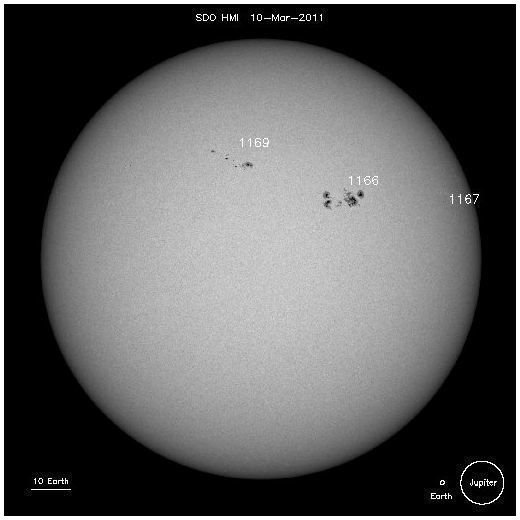
For more information about Sunspots see: Facts and Information About The Solar Max
Impact
The three cycles have impacts of different parts of Earth. The Earth cycles create weather conditions, the seasons, and how life propagates. The Moon cycles affect the tides on Earth. They affect the range of water that pushes up or down on the oceans and lakes. The Sun cycle creates sunspots and may be responsible for climate change, although there are no conclusive findings yet on that matter.
See Also: Relationship Between Solar Magnetic Activity and Climate
Source
The Earth Cycle
https://rainbow.ldeo.columbia.edu/courses/v1001/ccycle2.html
https://www.homepage.montana.edu/~geol445/hyperglac/time1/milankov.htm
Eccentricity Image: WikiMedia Commons-NASA, in the public domain
https://en.wikipedia.org/wiki/File:Eccentricity _zero.svg
https://en.wikipedia.org/wiki/File:Eccentricity _half.svg
Axial Tilt Image: WikiMedia Commons - NASA, in the public domain
https://en.wikipedia.org/wiki/File:Earth _obliquity_range.svg
Precession Image: Wikimedia commons - NASA, in the public domain
https://en.wikipedia.org/wiki/File:Earth _precession.svg
The Moon Cycle
https://www.nyctophilia.net/moon/phases.html
Lunar-Phase-Diagram, Wikimedia Commons, published under the GNU Free Documentation License, https://en.wikipedia.org/wiki/File:Lunar-Phase-Diagram.png
The Sun Cycle
https://www.iki.rssi.ru/mirrors/stern/earthmag/sunspots.htm
Sunspot Image, Published by NASA in the public domain, https://sohowww.nascom.nasa.gov/sunspots/
Impact


