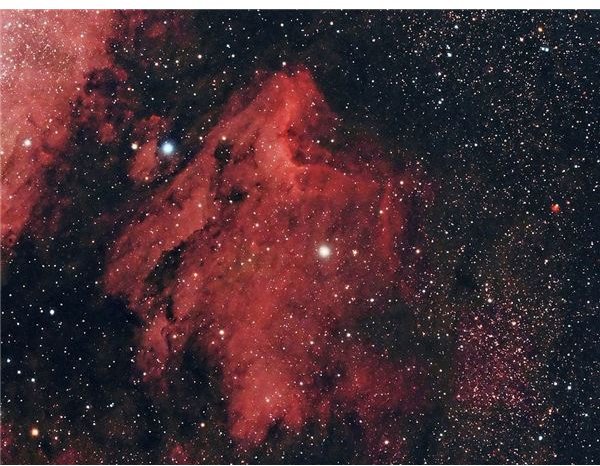
The Pelican Nebula is a region in space where new stars are born. Discovered over a hundred years ago it still fascinates space enthusiasts everywhere. Here are some facts as well as answers to some frequently asked questions about the Pelican Nebula
Facts About the Pelican Nebula
Below are some facts about the Pelican Nebula:
1. The Reverend Thomas Espin discovered the nebula in the year 1899 and announced its discovery in 1900.
2. Another designation for the nebula is IC 5070 and IC 5067. IC refers to the Index Catalogue of Nebulae, which is an index of over 5,000 galaxies, nebulae, and star clusters.
3. The right ascension (RA) of the nebula is +44° 21’ 00" and the declination is 20h 58m 0.8s. Right ascension, on the celestial sphere, is the equivalent of terrestrial longitude and declination the equivalent of latitude.
4. The Pelican nebula is located in the constellation Cygnus.
5. The nebula was so named as it seemed to resemble a Pelican.
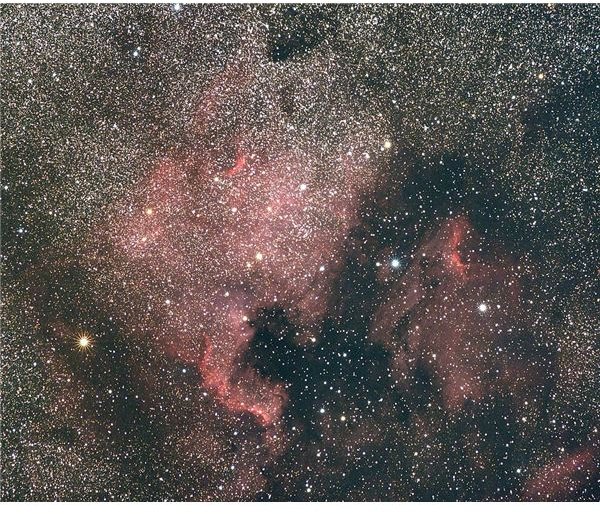
6. The North American Nebula (NGC 7000) is the larger neighbour of the Pelican.
7. A large dark molecular cloud, known as L935, of gas and dust separates the North American Nebula from the Pelican.
8. There are some 430 stars within L935.
9. The visual magnitude of the nebula is 8.0.
10. The Pelican Nebula is located some 1,800 light years from Earth.
11. The nebula lies close to the star Deneb , the brightest star in the constellation Cygnus.
12. The nebula is some 30-light-years wide.
13. Both, the Pelican Nebula and North American nebula are part of a massive Hydrogen-II emission region which is located in Cygnus and is designated as W80.
14. The two bright stars visible in most images of the nebula are 56 Cygni (lower right) and 57 Cygni (lower left). These two stars are located in front of the nebula.
Frequently Asked Questions About the Pelican Nebula
Q. What is the Pelican Nebula made up of?
A. It is an interstellar cloud, which is a collection of dust and gases, namely hydrogen and helium along with other ionized gases.
Q. Are stars forming inside of the Nebula?
A. Yes. Matter inside the nebula is constantly getting pulled together under the influence of gravity until it gets dense enough and hot enough for stars to form. The Pelican Nebula is nothing but a giant nursery for stars.
Q. What type of nebula is the Pelican?
A. The Pelican Nebula is an emission nebula, i.e. it emits its own light rather than reflecting the light of the stars within it.
Q. What is Herbig-Haro 555?
A. Herbig-Haro objects are small-scale shock regions associated with star-forming regions. Within the Pelican Nebula, Herbig-Haro 555 is located at the tip of the elephant trunk. It seems to have ejected a bipolar jets of material. This indicates the presence of a hidden protostar within the region.
Q. Why are there two separate IC designations for the nebula?
A. The widefield version encompasses the entire nebula and is designated as IC 5070, whereas a smaller region within nebula, near the neck of the Pelican, has the same name but a different designation, IC 5067, to identify it as the smaller region of the nebula.
Q. Will the nebula look the same millions of years from now?
A. No. The nebula is constantly changing under the influence of gravity as more stars are formed and the hydrogen and other gases within the nebula are reduced. So millions of years from now the shape of the nebula will look completely different.
There are countless nebula’s throughout the Universe, each with its own clusters of stars . They are quite interesting to study as they provide us with information about how stars are formed and what processes they undergo for formation.
Credits
1. https://www.daviddarling.info/encyclopedia/P/Pelican _Nebula.html
2. https://www.reference.com/browse/nebula
3. https://www.eyetotheuniverse.com/Cygnus.htm
4. https://www.docdb.net/show _object.php?id=ic_5067
5. https://www.farnham-as.co.uk/2009/10/pelican-nebula-imaged-by-chris-thayer/
Image Credits: Wikimedia Commons/Hewholooks/Gil-Estel