
According to current cosmological theories, the Universe has been expanding since the instant of the Big Bang. But what causes this expansion, and how long will it last? This article gives a brief explanation of expanding Universe theory, from the beginning of time to the far distant future.
How is the Universe Expanding?
Before considering what the expansion of the Universe is, it is helpful to know what it is not.
You might imagine that, in our expanding Universe, all of the galaxies, gas clouds and other objects are flying away from each other in all directions. This is not the case, however. Strange as it might seem, the Universe is expanding, not through any movement of its contents, but by expansion of the empty space between them.
One way to visualize this is to think of the galaxies and other objects as points drawn on a balloon, the surface of which represents the Universe. As air is blown into the balloon, the size of its surface increases, pulling the galaxies further and further apart. Alternatively, in three dimensions, imagine the Universe as a plum pudding in the oven. As the pudding bakes, it grows in size and the distances between the pieces of dried fruit increase.
A problem with both of these illustrations is that the model “Universe” is expanding into something – the air. This is not the case for the real Universe, which is not expanding into anything for the simple reason that there is nothing beyond it to expand into.
Expanding Space and the Big Bang Theory
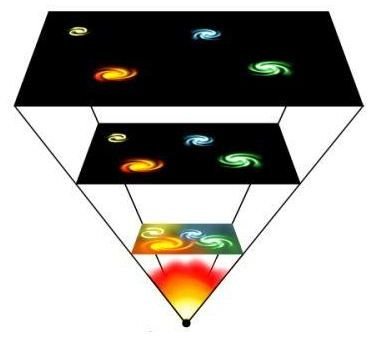
The Big Bang theory is the currently accepted model of the early history of the Universe. According to this theory, the Universe began as a region of extremely (perhaps infinitely) high temperature and density that started to expand rapidly outwards.
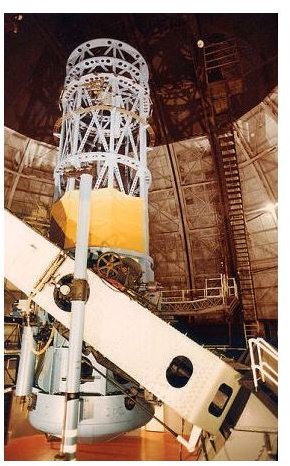
The observation in the 1920s that galaxies are moving away from each other was part of the evidence that led to the Big Bang theory. If the galaxies are moving apart now, cosmologists reasoned, they must have been closer together in the past. Extrapolating backwards, we arrive at the hot, dense conditions of the Big Bang, where all of the matter in the Universe was compressed into a single point.
What caused the Universe to begin to expand – that is, the cause of the Big Bang – is currently unknown. Some theorists suggest the trigger was a collision between two four-dimensional universes (or “branes” ) moving within a higher-dimensional space.
Evidence for the Expanding Universe
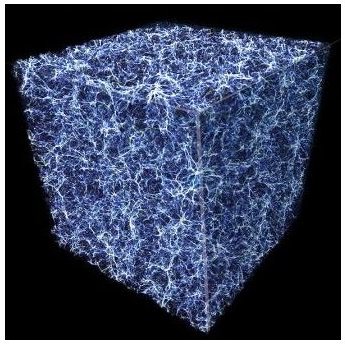
Observational evidence for the expansion of the Universe is obtained by measuring the distribution of matter in space. The expanding Universe theory predicts a Universe that is both “isotropic” and “homogeneous”; that is, it looks the same in every direction and has a similar composition everywhere. These predictions have been borne out in numerous ways.
- Measurements of the red-shifts of other galaxies show that they are moving away from us at speeds proportional to their distances, but with no fixed center to the expansion.
- Maps of the large-scale structure of the Universe, studies of gamma-ray bursts and observations of supernovae in distant galaxies all suggest that matter is distributed in a smooth, or homogeneous, manner throughout space.
- The steady cooling of the Universe since the heat of the Big Bang − the last remnant of which is observed as the cosmic microwave background − can have occurred only in a Universe that is expanding.
Cosmologists believe that the expanding Universe theory is the only model that accounts for all of these observations.
Will the Universe Expand Forever?
Theories and observations suggest that the Universe has been expanding for 13.7 billion years. But will it ever stop – or even start contracting?
It has been hypothesized that, if the total amount of matter in the Universe were above a certain level (termed the critical density), the Universe would one day stop expanding and begin to contract, eventually returning to a hot, dense condition similar to that of the Big Bang. This scenario is often called the “Big Crunch” .
However, recent observations show that, far from slowing, the expansion of the Universe is accelerating. If this continues, the matter in the Universe will become ever more thinly spread out and will carry on cooling towards absolute zero (0 K, or −273.15 °C). In this state, called “heat death” (or the “Big Freeze”), the nuclear and chemical reactions that power stars and sustain life will become impossible. This is a bleak prediction for the future, but humans should not be too alarmed – it is unlikely to occur until a time well beyond 10100 (1 followed by 100 zeros) years from now.
Image Credits
Balloon: Phaedra Wilkinson, https://www.morguefile.com/archive/display/100398
Hooker Telescope: Andrew Dunn, https://commons.wikimedia.org/wiki/File:100inchHooker.jpg
Dark Matter: NASA/ESA/E. Hallman, https://commons.wikimedia.org/wiki/File:Structure _of_the_Universe.jpg
Big Crunch: Ævar Arnfjörð Bjarmason, https://commons.wikimedia.org/wiki/File:Big _crunch.png
Sources
https://map.gsfc.nasa.gov/universe/bb _tests_exp.html
https://www.astro.ucla.edu/~wright/nocenter.html
https://www.lbl.gov/supernova/
https://www.scientificamerican.com/article.cfm?id=misconceptions-about-the-2005-03&page=2
https://www.sdss.org/news/releases/20000413.qso.q.html
Jones MH, Lambourne RJA. An Introduction to Galaxies and Cosmology. Cambridge: Cambridge University Press, 2004.