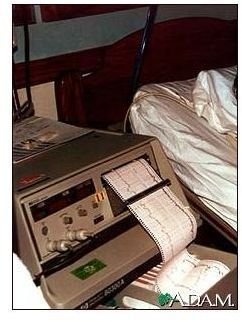
Learn about the fetal nonstress test (NST). Know why it is done, who should have one, and what it means to have a nonreactive nonstress test.
Nonstress Test
A nonstress test is a noninvasive procedure that monitors the fetus’s heart rate, making sure he or she is getting enough oxygen. It is called “nonstress” because stress is not placed on the fetus while testing. The nonstress test is simple and painless. The mother lies on her left side and two belts are placed around her stomach. One belt has a device that records the fetal heart rate (FHR) and the other records contractions (if any). When the fetus moves or kicks, the fetal heart rate should increase by at least 15 bpm (beats per minute) for at least 15 seconds. If this happens at least two times during a 20 minute period, the test is said to be reactive (normal). If the fetus does not move or the heart rate does not increase while moving, the nonstress test is said to be nonreactive.
Nonreactive Nonstress Test
A nonreactive nonstress test does not necessarily mean it is abnormal. Many times, the fetus is asleep during the procedure. To encourage movement, the mother may be given something to eat or drink to awaken the fetus or the person performing the test may use a “buzzer” to stimulate movement. However, a nonreactive test could indicate the fetus is not getting enough oxygen. Low levels of oxygen are often caused by problems with the umbilical cord or placenta. The health care provider may want to perform additional tests (such as a contraction stress test or a biophysical profile ) to determine if the fetus is in any immediate danger. If there is a problem, the doctor may decide to induce labor or perform a Cesarean section (C-section).
Who Needs to Have a Nonstress Test?
A nonstress test can be done as early as 24 weeks of gestation but results can be inaccurate because the fetus is not developed enough to respond appropriately. Therefore, it is generally done when the fetus is at least 28 weeks old. According to studies, about half of the tests performed on women who are 24-28 weeks pregnant have abnormal results and about 15 percent of the tests on women who are 28-32 weeks pregnant have abnormal results.
Reasons for having a nonstress test include:
- decreased fetal movement
- post date
- multiple pregnancy
- insulin dependent diabetes
- high blood pressure
- kidney disease
- heart problems
- IUGR (intrauterine growth retardation)
- oligohydramnios (not enough amniotic fluid)
- polyhydramnios (excessive amniotic fluid)
- history of losing a baby during the second half of the pregnancy.
Depending on the reason, some women may need to be tested once or more every week until the baby is born.
Sources Used
American Pregnancy: Fetal Non-Stress Test (NST) - https://www.americanpregnancy.org/prenataltesting/non-stresstest.html
Baby Center: Nonstress test - https://www.babycenter.com/0 _nonstress-test_1272943.bc
Healthy Me: Nonstress Test (Fetal) - https://www.ahealthyme.com/topic/nonstress
Photo Credit
Image courtesy of the National Library of Medicine (NLM).