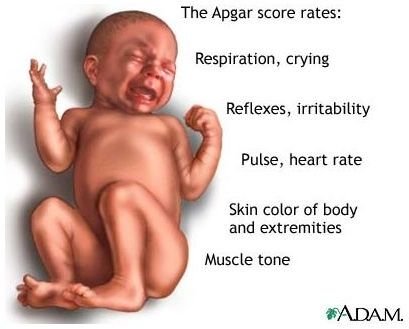
The infant Apgar score can let health care providers know how well the newborn is adjusting to life outside of the uterus. Learn about this test and common causes of low Apgar scores.
Infant Apgar Score
Major physiologic changes occur during the first seconds of the newborn’s life so it is imperative that the health care provider make astute observations during this time. The Apgar score is one of the methods used to assess the infant’s adjustment to extrauterine life. It helps determine if medical attention is needed to stabilize breathing or heart function.
The Apgar score is based on observation of:
- heart rate
- respiratory effort
- muscle tone
- reflex irritability
- color.
Each item is given a score of 0, 1, or 2.
Heart rate
- 0 = absent
- 1 = < 100 beats per minute (bpm)
- 2 = > 100 bpm
Respiratory effort
- 0 = absent
- 1 = slow or irregular
- 2 = good crying
Muscle tone
- 0 = limp
- 1 = some muscle tone
- 2 = active motion
Reflex irritability (response to stimulation)
- 0 = no response
- 1 = grimace
- 2 = cough, sneeze, or vigorous cry
Color
- 0 = blue or pale
- 1 = pink body, blue extremities
- 2 = completely pink
Evaluations of all five categories are made at 1 and 5 minutes after birth (and may be repeated until the infant’s condition stabilizes).
A score of 8 or higher indicates the infant is in good condition. An Apgar score of 10 is unusual. Very few newborns are completely pink at 1 minute after birth and most continue to have some blueness of the extremities (acrocyanosis) at 5 minutes.
If the score is lower than 8, it indicates the infant needs assistance. If it is below 5, immediate assistance is needed.
Common Causes of Low Apgar Scores
Common causes include:
• Precipitous delivery. Hypoxia (oxygen deficiency) can occur from a fast birth due to strong contractions or trauma to the baby’s head.
• Nuchal cord. If the cord is wrapped around the fetal neck (one or more times) and obstructs blood flow, hypoxia can occur.
• Prolapsed cord. When the cord becomes trapped in the birth canal before the fetus is delivered, hypoxia can occur from obstructed blood flow.
• Placenta previa or abruptio placentae. Both can cause low infant Apgar scores because the placenta separates from the uterus before delivery, interrupting blood flow.
• Meconium aspiration. The fetus can have a bowel movement (meconium) in utero when distressed and may inhale some into their lungs, thus causing respiratory problems.
• Maternal analgesics and/or anesthetics. Narcotic drugs (normally given within 4 hours before birth) that pass from mom to fetus can suppress their ability to breathe.
• Preterm infants. Immature lungs and hypoglycemia are a couple of problems that can occur with preterm infants.
• Other common causes of low Apgar scores include maternal and fetal factors, such as maternal hemorrhage or fetal heart problem.
References
Medline Plus: APGAR
Woods, Dave. International Association for Maternal and Neonatal Health (IAMANEH): Neonatal resuscitation -
birth.com.au: What causes baby to respond slowly and be given low Apgar score ?
Photo Credit
Image courtesy of the National Library of Medicine (NLM).