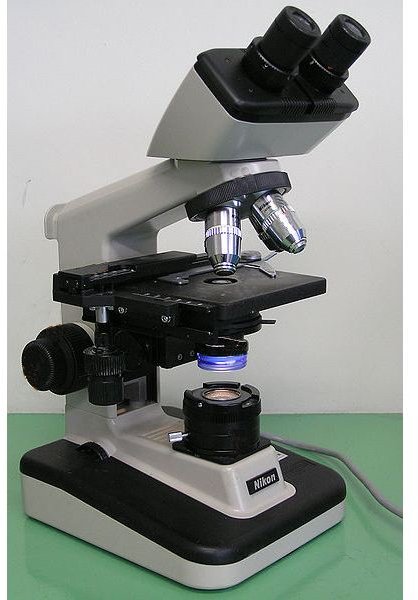
Learning how to use a compound microscope may seem daunting at first, but really is quite easy. Taking a short amount of time to learn the various parts of the microscope will have you making use of all the functions with confidence.
What Is a Compound Microscope?
A compound microscope is a microscope that allows for a very high range of magnification through the use of multiple objective lenses. These lenses can be rotated while viewing a specimen to obtain several different degrees of magnificat
ion. Learning how to use a compound microscope may look a bit daunting to a newcomer, but the process is not overly difficult.
Placing the Slide
The initial process of using a compound microscope involves placing a slide, a thin glass chip with a sample on it, onto the “stage” which is located directly beneath the objective lenses. The stage has metal clips that will hold the specimen safely while you are examining it, while still allowing for small movements to be made by hand. Some of the more advanced microscopes will have a mechanical system integrated into the stage that allow for smaller and more delicate maneuvers to be performed that would not be possible with the human fingers. A specimen should be lined up as close to the center of the lens as possible. The “aperture” is a clear glass window located in the middle of the stage that allows light to shine onto the slide.
Learning the Light
The light, located on the bottom of the microscope, is called the “illuminator”. The illuminator is housed in the base of the microscope and shines light up into the slide to allow for ease of viewing. A “condenser”, located beneath the stage, captures the light and focuses it on to the slide. Some condensers contain knobs that allow the condenser to be moved up and down to adjust the focus of the light. The “iris diaphragm” is a round disc beneath the stage that allows the amount of light coming in to be dimmed or brightened through a rotatable series of openings. Not every compound microscope has a condenser or iris diaphragm, but those that do, have a larger level of control of the light levels coming through the specimen. Practicing with these two parts will allow for the maximum amount of clarity from your light source.
Adjusting the View
Once the slide is in place simply look through the eyepiece to examine the specimen. At the bottom of the microscope body will be the series of “objective lenses” that were mentioned before. These can be rotated to adjust the magnification. When a new lens is in place the figure will undoubtedly be blurry. This is easily remedied through two knobs on the side of the microscope. A “coarse” knob used to make big adjustments in focus, and a “fine” knob, which is often located on top of the coarse knob, that makes smaller adjustments. The focusing process is somewhat akin to an eye exam in which the perfect level of clarity is finally achieved. If the image is too bright or dark, you can make use of the iris diaphragm to ensure the optimal light level reaches the specimen.
Practice Makes Perfect
Practicing with these various elements will ensure you know how to use a compound microscope in no time. You’ll soon find there is a whole microscopic world out there to discover and explore!
References
Microscope.com - https://www.microscope.com/compound-microscope-parts-t-7.html
Lab Essentials, Inc. - https://www.labessentials.com/Microscopes _Compound_Basics.htm
Microscope Forum - https://www.microimaging.ca/parts.htm
Image: https://upload.wikimedia.org/wikipedia/commons/b/b1/Optical _microscope_nikon_alphaphot_%2B.jpg