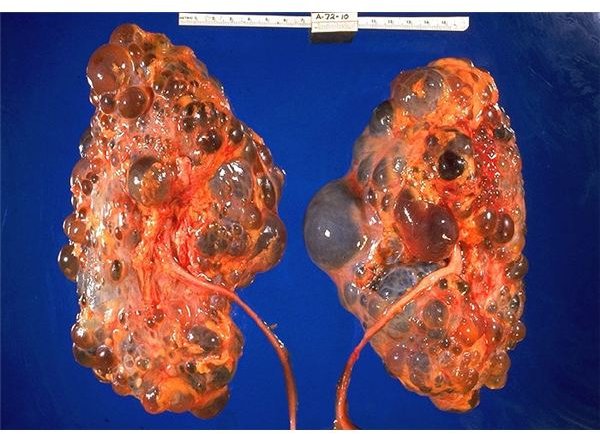
Polycystic kidney disease (PKD) is one of the most common inherited genetic disorders and there are two main types - autosomal dominant PKD and autosomal recessive PKD. They are characterised by fluid-filled cysts in both kidneys and are a common cause of kidney failure.
Polycystic Kidney Disease Symptoms
PKD is a condition where many fluid-filled cysts appear in both kidneys, eventually replacing some of the kidney tissue. As this happens the kidneys grow in size, but are less able to remove waste, concentrate urine or carry out any of their other functions. Sometimes it takes years for the symptoms to appear and on average for most people with PKD the first symptoms appear between the ages of 30 and 50. These include: -
- Blood in the urine
- Headaches
- Pain in the abdomen and/or lower back
- High blood pressure
- Recurring kidney infections
Cysts can also develop in the pancreas, spleen, liver and intestines.
Autosomal Dominant Polycystic Kidney Disease
Polycystic kidney disease is caused by mutated genes . The most common and serious kind is autosomal dominant polycystic kidney disease (ADPKD) which affects up to 90% of cases. For 85 % of ADPKD cases the fault is due to mutations on the PKD-1 gene on chromosome 16. The gene codes for a member of the polycystin protein family that’s involved in renal tubular development. The other 5% of ADPKD cases are caused by mutations on the PKD-2 gene on chromosome 4. It encodes a protein called TRPP1 that may help to regulate intracellular calcium homeostasis as well as being involved in renal tubular development.
The autosomal dominant pattern of inheritance means that it only needs one parent to pass on the mutated gene, giving a child a 50% chance of inheriting the disease.
Autosomal Recessive Polycystic Kidney Disease
Autosomal recessive polycystic kidney disease (ARPKD) is a rare form of the genetic disorder and is caused by mutations on the PKHD1 gene on chromosome 6. There may be other genes involved, but they have not been identified yet. ARPKD tends to occur more in children than in adults and the first symptoms can appear before birth. Severity of the condition varies and some individuals may not show symptoms until later on in childhood or even early adulthood.
The autosomal recessive pattern of inheritance means that the chance of a child having ARPKD if both parents are unaffected carriers is 25%.
Polycystic kidney disease can also appear spontaneously without any prior family history of the disorder.
Genetic Testing
Genetic testing can reveal whether an individual has mutations on PKD-1 or PKD-2 genes. The test can only reveal whether the mutations are present; it cannot predict the severity of symptoms, and it must also be remembered that at the moment there is no specific preventative measure or cure for the disease. However, a test can be useful as a person who knows of a mutation might be able to slow the damage by keeping blood pressure at safe levels, and by dealing promptly with any infections.
As always, health professionals strongly advise that anyone undergoing a genetic test should receive counseling to help them understand all the possible implications of the results.
Photo Credit
Released into the public domain by the US Dept of Health and Human Services