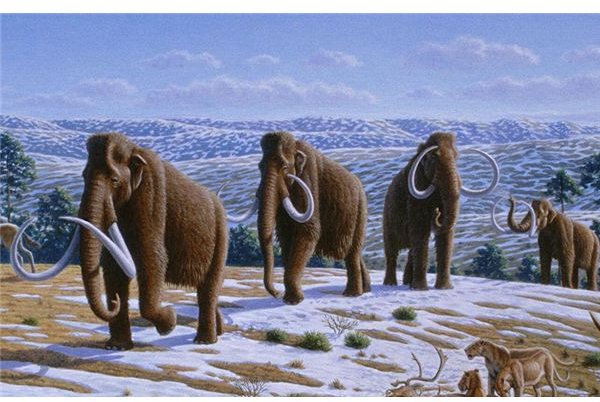
You have a few million dollars, your own laboratory, and a burning desire to bring an extinct species (such as a woolly mammoth) back from the dead. There aren’t any manuals, guide books or diagrams, so just how do you do it?
When Did Woolly Mammoths Live on Earth?
Woolly mammoths used to lumber around on this rock up until around 12,000 years ago. The cause of their demise is much debated and includes over hunting by humans, climate change, infectious disease, or a comet strike. They are probably the best known of all ice age animals and they lived in Asia, Europe, and North America.
Cloning Extinct Animals
To bring an extinct animal back from the dead the scientist will need to follow this quick guide -
Step One - Have access to a good quality genome sequence belonging to the species you wish to resurrect. Mammoths survived in arctic conditions and were well adapted to cold climates. These freezing conditions also turned out to be excellent preservatives, and several reasonably intact mammoths have been recovered from the permafrost. Scientists at Penn State University have been able to sequence more than 80 per cent of the mammoth’s genome . It’s a start, but it’s not a perfect sample and time and moisture have been its enemy. Even well-preserved ancient DNA will be seriously degraded.
Step Two - Know how many chromosomes the extinct animal possessed, and how the DNA was packaged inside those chromosomes. That’s another difficult one, but educated guesses could be made by looking at closely related extant species.
Step Three - After packaging chromosomes into a synthetic nucleus pop it into an egg of a closely related species and then place inside a surrogate mother. Cross your fingers and hope it develops into an embryo. However, the hurdles with this step are trying to find a compatible species and then extracting eggs. Plus some species are proving to be too difficult to clone, such as birds and reptiles.
There is another way of bringing an extinct animal back from the dead
Step Four - You could modify the genomes of extant species such that the resulting animal is similar to the extinct animal you want to resurrect. This has been achieved with the Quagga, an extinct subspecies of the Plains Zebra, where selective breeding has created an animal that resembles it. But the idea that you could manipulate DNA to give rise to an extinct species still lies in the realms of science fiction.
The Future of Extinction
Currently extinction is permanent. Once a species ceases to be that’s it. They’re gone for good, and all the technological power that we have at present will not change that. However, who knows what lies around the corner? It may be a woolly mammoth or a sabre-toothed tiger . Technology has a wonderful way of confounding expectations.