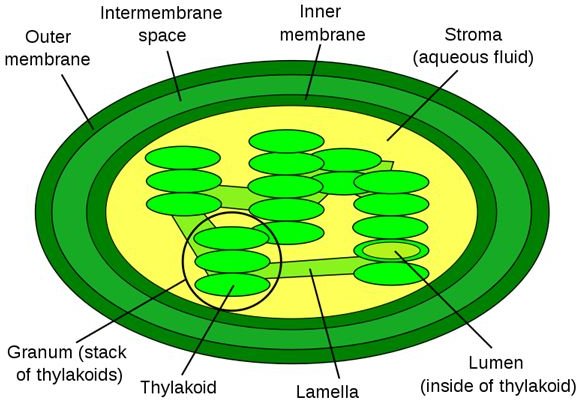
Chloroplasts are the energy powerhouses of plant cells. They absorb sunlight and along with water and carbon dioxide convert the whole lot into plant fuel - sugars. The by-product of this process is oxygen, which comes in handy for humans.
Chloroplasts in a Plant Cell
Chloroplasts are the parts of the plant cell where photosynthesis is carried out- a series of chemical reactions that converts light energy into chemical energy. There are two principle reactions - the light reaction which takes place in the part of the chloroplast structure known as the thylakoid membranes. Here, the light that the plant has absorbed splits water into hydrogen and oxygen and produces the carrier molecules that are used in the next set of reactions - the dark reaction (also known as the Calvin Cycle). This takes place in the stroma of chloroplasts and results in the production of glucose.
Chloroplast Structure
There can be as many as 50 chloroplasts in each plant cell. They are energy converters, equivalent to the mitochondria in animal cells.
The chloroplast structure is contained by a double membrane layer. A permeable outer membrane and an inner membrane that regulates the passage of molecules that are needed by the chloroplast and come from elsewhere in the plant cell. There are also thylakoid membranes which contain chlorophyll, the green pigment that gives leaves their colour and absorb the light energy used in photosynthesis. There are also other photosynthetic pigments housed inside these structures. The thylakoids are usually arranged in stacks called grana.
The stroma is the enzyme-filled watery substance that pervades the chloroplast structure and is the site of the Calvin cycle, the second set of reactions involved in photosynthesis, where carbon dioxide is converted into sugars.
The Chloroplast Genome
Chloroplasts have their own DNA . This discovery was made in 1963. Chloroplast DNA is a large circular molecule of approximately 120,000-160,000 base pairs and containing roughly 120 genes. That they have their own DNA could mean that way way back in evolutionary time, chloroplasts started out as free living organisms that formed a union with larger cells - this is known as the endosymbiotic theory and also includes mitochondria, which have their own DNA too.#mce_temp_url#