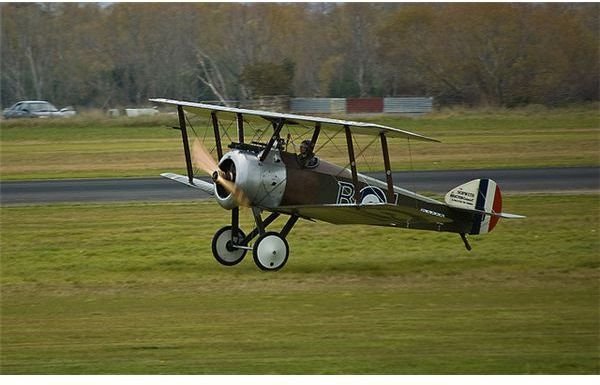
The Sopwith Camel may be the most famous airplane of WWI. It was dangerous to enemy pilots and almost equally dangerous to pilots learning to fly the maneuverable but quirky Camel.
Historic Sopwith Camel
The Sopwith Camel is one of the most historic aircraft of World War I and the early history of combat aviation. Officially called the Sopwith Camel F.1, the plane and its pilots are credited with 1,294 combat kills. This makes the Camel the most successful combat aircraft of the war.
The Camel was also notoriously dangerous and the dangerous flying characteristics of the plane killed many novice pilots. In total, 413 Sopwith Camel pilots died in combat and another 385 were killed in non-combat related accidents.
Sopwith Camel History
The Sopwith Camel was developed from the Sopwith Pup designed by Herbert Smith. The aircraft was produced by the Sopwith Aviation Company and entered service in May 1917. The first combat kill by a Camel was on June 4, 1917. A total of 5,734 Camels were built.
The Camel was extremely maneuverable due to the fact that the majority of the weight was in a 7 foot section of the aircraft from the engine to the pilot. With the concentrated center of gravity, a pilot could almost rotate the aircraft around the axis of the wing, making very sharp turns and loops. The rotary engines of the era developed tremendous torque which resulted in the dangerous handling characteristics. If a pilot was not maintaining enough speed to overcome the torque with the flight controls the Camel would flip into a spin.
Here are some of the combat statistics of the Camel:
- The first kill on June 4, 1917 was by Canadian pilot, Alexander Shook who was an ace with 12 kills in WWI.
- Another Canadian ace, Roy Brown shot to the famous Red Baron, Manfred von Richtofen.
- The top Camel ace was Canadian pilot Donald Roderick MacLaren with 54 kills.
- The Camel had a total of 261 aces including pilots from the United Kingdom, Canada, Australia, New Zealand and the United States.
- The top Camel ace from the U.S. was Kenneth Russell Unger with 14 victories.
Sopwith Camel Specifications
The Camel was a bi-plane aircraft with the wings staggered, the upper wing forward of the lower wing. A wooden frame was covered with aluminum at the engine cowling, further back the cockpit exterior was plywood and the remainder of the aircraft was covered in fabric. Forward weight bias was enhanced by having the pilot and cockpit tucked under the upper wing. Overall dimensions were a wingspan 28 feet and the length is 18 feet 8 inches. The plane has an empty weight of 889 pounds and maximum of 1,567 pounds.
For power the Camel was was fitted with several different rotary engines producing 110, 130, 150 and 170 horsepower. Armament was two machine guns mounted in front of the pilot and synchronized the fire through the spinning propeller. The guns could be two Vickers .303 caliber machine guns, two Lewis guns in the same caliber or one of each. Four 20 pound bombs could be mounted on the aircraft.
Performance ratings of a Sopwith Camel had a maximum speed of 118 mph and a ceiling of 18,000 feet. It took a Camel approximately 10 minutes to climb to 10,000 feet. Flight time was up to 2.5 hours.
References
Aviation History website: https://www.aviation-history.com/index.html
The Aerodrome: https://www.theaerodrome.com/
Photo Credit: PhillipC on Flikr, Creative Commons attribution