Like traditional runways, helipads and heliports require the maintenance of many regulations for safety and security of the aircraft and ground-based facilities. Federal aviation regulations on helicopter landing zones are not as intricate as their fixed-wing counterparts, but they are important.
Dimensions of the Landing Zone
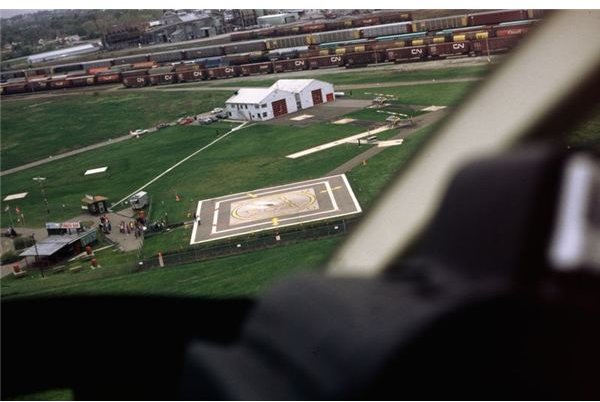
Federal aviation regulations on helicopter landing zones required certain dimensions be used when building and maintaining helipads and heliports. The landing area for the helicopter itself needs to be at least 20 feet wide and long in a square formation. A safety area of 35 feet on each side must be maintained with no buildings or obstructions. In order for the helicopter to conduct a proper landing and takeoff approach, the zone must also provide a 300 foot strip on either side of the landing area.
Above right: Heliport Landing Zone. (Supplied by Zwergelstern at Wikimedia Commons; GNU Free Documentation License; https://upload.wikimedia.org/wikipedia/commons/d/de/Heliport _Niagara_Falls_Ontario.jpg)
Equipment Necessary for Helipads and Heliports
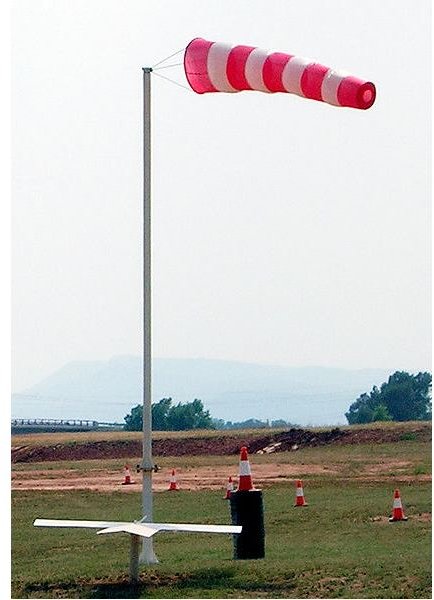
According to federal aviation regulations on helicopter landing zones, there is certain equipment that must be installed at the location for safety. Every landing zone needs to have a wind indicator that is visible to the pilot in order to allow him or her to better conduct a proper approach. Helipads also need emergency equipment located within reasonable accessible reach to people on the ground, notably a general evacuation and rescue kit and a fire extinguisher. Warning signs are also required near the landing zone to inform people of the purpose of the area and to prevent people from smoking.
Above left: Wind Sock. (Supplied by Joanjoc at Wikimedia Commons; Public Domain; https://upload.wikimedia.org/wikipedia/commons/5/57/Anemoscopi.JPG)
Required Markings to Enable Safe Helicopter Landings
Generally speaking, there is little regulation regarding exact markings required for a heliports, although mandates require some form of identification. According to federal aviation regulations on helicopter landing zones, the location in which the helicopter lands should include area markings and any local or state requirements. The majority of heliports are labeled with a number inside of a circle to reference the maximum weight limit of the landing zone, particularly important when a helicopter is landing on a building. For example, a 15 within a circle delineates 15,000 pounds. Hospitals usually use a large “H” designating the landing zone.
Landing Zone Lighting
Just like a traditional airport , helicopter landing zones require certain standards for lighting that enable craft to conduct a proper approach and touch down. Heliports need to have a circle or square of lighting located around the surface of the landing area, designating the exact area in which the helicopter should touch down. These lights used to be officially mandated the color yellow, however, the International Civil Aviation Organization and Federal Aviation Administration now recommend green lights. Both organizations also recommend using LED lights rather than incandescent due to the lifespan of the bulbs. In addition, the landing zone is required to light up the wind cone and also provide general flood lights to help illuminate the surrounding area on the ground.
Federal Adminstrative Requirements
As with any government agency, in order to build or maintain a heliport or helipad, certain administrative requirements must be filed with appropriate agencies. Paperwork and approval is required for environmental, population and zoning concerns. In addition, any changes or additions must be approved by regulatory agencies.
In all, federal aviation regulations on helicopter landing zones are mandated and enforced in an effort to keep both helicopters and the people on the ground safe. The regulations have successfully kept helicopter crashes to a minimum over the years.
Resources
“Helicopter Landing Areas” Interagency Helicopter Operations Guide: https://www.nifc.gov/ihog/chapters/2006chapter08.pdf
“Airports and Heliports” California Department of Transportation: https://www.dot.ca.gov/hq/planning/aeronaut/documents/Regs _pub.pdf