The airline industry is constantly challenged with the prospect of strikes from airborne animals such as birds and bats. In order to combat this eventuality, bird avoidance technology for airplanes has been implemented both in the design of airplanes and on the ground to prevent problems.
Design Features to Prevent Bird Strikes
In an effort to prevent crashes caused by bird strikes, many design elements on the planes themselves help to mitigate the likelihood of problems. Bird avoidance technology for airplanes is a major issue for the airline industry as incidents can became serious almost immediately. By changing the design of the plane itself, a blueprint for safety can be created, helping prevent crashes and keeping the bird population safe as well.
One of the major challenges with bird strikes is the engine itself. Older model airplanes can crash even after being hit by a single bird. However, modern engines are designed to essentially “eat” the bird to prevent problems. In order to pass flight safety parameters, the engines must be able to handle the strike of a bird or bat weighing up to four pounds (1.8 kg). Nevertheless, this design element is limited to a single incident, hits by whole flocks of birds will still cause a disruption in the engine’s service.
Additional countermeasures on the plane can help prevent strikes as well. Research has shown that lighting on the front of the plane causes birds to avoid impact with the vehicle. Apparently, birds will avoid collisions with airplanes if they can see the craft.
Precautionary Measures at Airports
The vast majority of bird strikes occur during takeoff and landing at airports around the world. As such, the airline industry has implemented a number of preventative measures to help control the population of birds around these facilities. Unfortunately, there is no “single bullet” that can prevent the establishment of bird colonies around airports, especially since they are usually built in open areas. Since the 1990s, an effort to establish newer airports in areas away from wetlands has helped mitigate the likelihood of strikes. As does control of the environment around the airport, such as the destruction of food sources and large trees.
Technical prevention also plays a dramatic role in preventing flocks of birds from taking up residence around the facilities. Airports often use certain sounds, lights and pyrotechnics to scare away birds. Other measures use simple traditional concepts to scare off the animals. Border collies are placed around most airports to chase off birds and trained sharpshooters with shotguns can even be used to shoot at large flocks. Sometimes, falconers are hired to threaten the animals with larger birds.
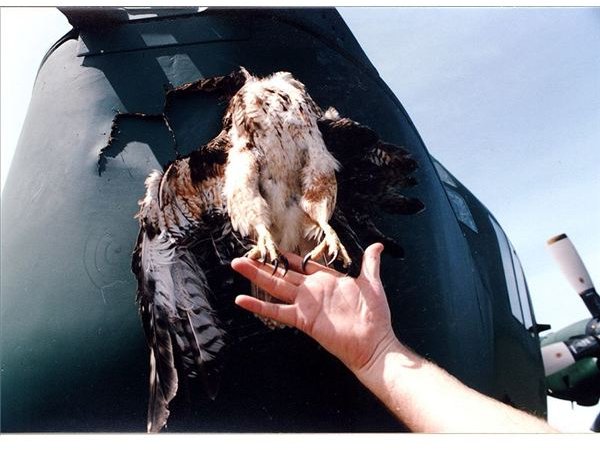
Above left: Bird in a nosecone. (Supplied by the US Air Force; Public Domain; https://upload.wikimedia.org/wikipedia/commons/2/2e/C-130 _and_Hawk_in_nosecone_outside.jpg)
Preventing Crashes with Bird Avoidance Technology
The most basic principle of bird avoidance technology for airplanes is simply the act of controlling a plane’s flight path. Pilots routinely climb to elevations of 3,000 feet or more to prevent impact since the height is generally out of range for most birds. Additionally, models for tracking bird activity can be beneficial in forecasting the areas with flocks of birds. In the United States, the Avian Hazard Advisory System is used to issue warnings to pilots and ground crew of the location of large flocks and flight patterns of migrating birds using both radar and historical data. This allows aircraft to choose different flight paths in an effort to avoid a collision.
Resources
“Bird Strike Avoidance Technology” Discovery News (https://news.discovery.com/tech/wide-angle-bird-avoidance-tech.html )
“Technology for the Birds” Birdstrike Control Program (https://www.birdstrikecontrol.com/news/flight _safety/technology-for-the-birds/)
Additional Links
How Bird Strikes Can Cause Crashes