This is an article covering a brief history of hot air and gas balloons. Read on to learn who built them, how and when:
First Hot Air Balloons
Many people think that the first manned flight was conducted by the Wright Brothers, but the fact is the first human flight took place in 1783 with a hot air balloon constructed by another two brothers: Joseph-Michel and Jacques-Etienne Montgolfier.
Even though the Portuguese community claims that their own Bartolomeu de Gusmão was the first man to fly, aviation historians only credit him with the first documented balloon flight in Europe. Using the same technique the Chinese used for their Kongming Lanterns we talked about in the first article of this series, Bartolomeu de Gusmão lifted a small balloon of paper full of hot air about four meters in front of king John V on August 8, 1709.
Bartolomeu also attempted to lift himself from Saint George Castle in Lisbon but all he did is fall about one kilometer away.
Returning to the Montgolfier brothers we mentioned earlier, they came from a family of paper manufacturers and came up with the invention by noticing ash rising in paper fires. After a public demonstration of their invention on June 4, 1783, the Montgolfier brothers experimented with unmanned balloons and animal flights.
The First Hot Air Balloon Flight
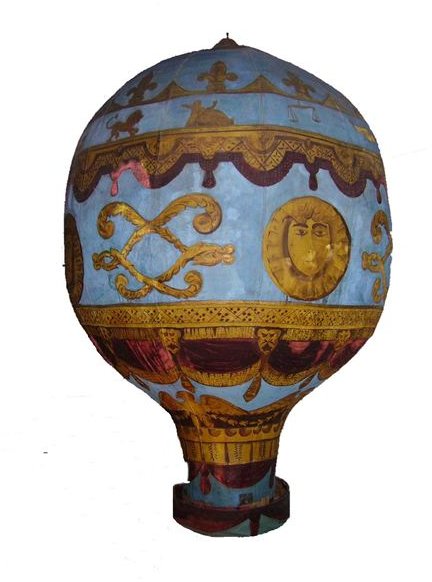
The first balloon flight with humans on board took place on October 19, 1783. The hot air balloon buit by the Montgolfier brothers was essentially composed of cloth bags that were sometimes lined with paper and a smoky fire built on a grill attached to the bottom.
The Montgolfier brothers also conducted the first free flight with human passengers on 21 November 1783 in their home city of Annonay, France.
Also in France, only a few days later in Paris, Professor Jacques Charles and Nicholas Louis Robert made the first gas balloon flight. Their balloon was built based on Henry Cavendish work, the British scientist that discovered hydrogen and its properties and it reached the height of 600 meters above the ground and covered 43 km in two hours before landing in the small town Nesle on December 1, 1783.
Another French inventor was the first to cross the English Channel: Jean-Pierre Blanchard traveled from Dover Castle in England to Guines in France in two and a half hours on 7 January 1785.
Steerable Balloons
The balloons previously mentioned were not steerable, that is, they flew were the wind took them. Throughout the XIX century, scientists focused their attention toward developing balloons that could be steered.
The man to achieve the first powered, controlled, sustained flight with a machine lighter than air is considered to be Henri Giffard. He flew 25 km in France with a steam engine driven craft in 1852.
The first fully controllable free-flight was made with La France, a 52 m long, 1,900 m3, electric powered airship powered by an 8-1/2 horsepower electric motor and developed by Charles Renard and Arthur Krebs. La France flew 8 km in 23 minutes in 1884.
However, balloons were generally short-lived and extremely frail. Routine, controlled flights would not come to pass until the advent of the internal combustion engine.
The man who first took advantage of the internal combustion engine on a balloon was Alberto Santos-Dumont, from Brazil. His airship, “Number 6” flew over Paris and steered it to circle the Eiffel Tower and then returned to his takeoff point, the Parc Saint Cloud in less than half an hour.
In our next article we will cover the first attempts at flying with a machine heavier than air.
References
Image Source
Montgolfier Balloon. (Supplied by Mike Young at Wikimedia Commons; Public Domain;https://upload.wikimedia.org/wikipedia/commons/9/9a/Montgolfier_Balloon.JPG)
This post is part of the series: The History Of Aviation
This is a series that will explain how flight evolved throughout the past century.