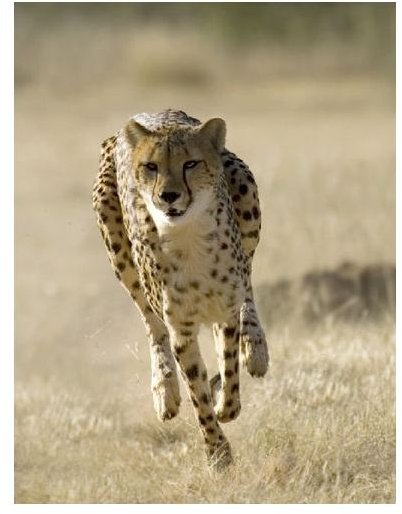
This wonderful cat can’t roar but it can run faster than any other animal. Find interesting wild cheetah facts, including how fast they can run, what they eat, how many cubs they have, and how long they live.
The Cheetah
This amazing cat, which is built more like a greyhound than a cat, is the fastest land animal in the world. It can reach a speed of 70 mph and can go from 0 to 60 mph in 3 seconds, accelerating faster than most cars. About 100 years ago, there were over 100,000 cheetahs in the wild. Today, about 12,000 remain. The majority live in Africa and small populations live in Iran. More interesting wild cheetah facts can be found below.
Description
The cheetah stands about 2 to 3 feet tall. The body length is 3 1/2 to 4 1/2 feet, tail length is 2 to 2 1/2 feet, and weight is 77 to 143 pounds. Cheetahs are slender with long legs and small heads. Their beautiful coat is golden in color and covered with small black spots. The males are about 10 pounds heavier than females.
Behavior
Females are solitary cats. They only associate with other cheetahs when they mate and they live alone when they are not raising cubs. Males, on the other hand, will often live in small groups with brothers from the same litter. These permanent groups are called coalitions.
Habitat
Cheetahs can be found living in open and partially open savannas where they rely on tall grass to camouflage them. They do not live in wetlands or forest areas.
Diet
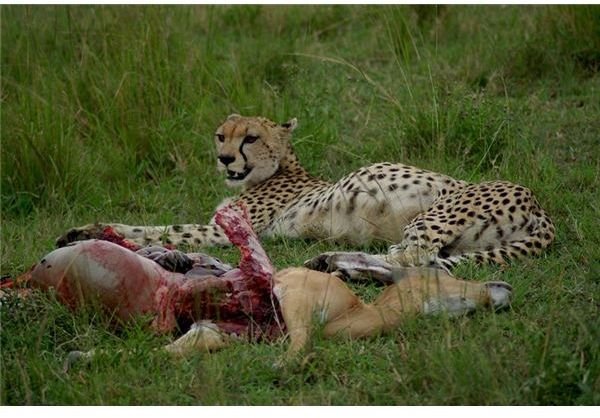
The cheetah’s diet consists mostly of hoofed animals under 90 pounds, including gazelles, impalas, wildebeest calves, and smaller prey such as hares and birds. They hunt during the day to avoid lions and leopards. They stalk their prey and when the moment is right, they chase it to the ground and bite into its throat. The chase usually lasts about 20 to 60 seconds and about half of their chases are successful. After killing their prey, they normally carry it off to a safe place to eat before other animals steal it. Cheetahs do not drink much, about once every 3 to 4 days.
Reproduction
Mating takes place throughout the year but often occurs during the dry season, allowing the cubs to be born at the onset of the wet season. The gestation period lasts about 3 months and the litter size can range from 2 to 4 cubs. At 5 to 6 weeks of age, they can follow their mother and begin eating her kills. The cubs are weaned at 3 months old and are ready to leave their mother when they are 1 1/2 to 2 years old.
More Information
The following are more interesting wild cheetah facts:
• Cheetahs can not roar like other big cats but they can purr like domestic cats.
• They use their tails like a rudder of a boat to help them turn while running.
• Cheetahs live about 8 to 10 years in the wild and about 17 years in captivity.
References
https://animals.nationalgeographic.com/animals/mammals/cheetah/
https://www.defenders.org/wildlife _and_habitat/wildlife/cheetah.php
https://nationalzoo.si.edu/Animals/AfricanSavanna/fact-cheetah.cfm
Photo Credit
Cheetah running image courtesy of https://commons.wikimedia.org/wiki/File:Cheetah-GO!.jpg
Cheetah with impala image courtesy of https://commons.wikimedia.org/wiki/File:Cheetah _with_impala_kill.jpg