The ‘Big Three’, or the three natural resources industries use most, are coal, oil and gas. In this article, the size of the reserves will be discussed, along with how long these three resources can keep supporting the population and meeting the global demand.
Industrial users consume roughly 40% of the total world energy consumption. When considering which resources are being used, one thinks of the ‘Big Three’, coal, oil and gas. These are the three natural resources industries use most and they also constitute about 85% of the total global energy usage.
About 77% of the global coal production, 10% of the global oil production and 38% of the global gas production are used by industries.
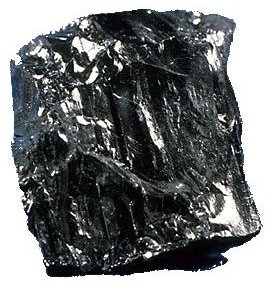
Coal
In 2007, 132.7 quadrillion BTU (British thermal unit: unit of energy equal to about 1055,05585 joules) of coal was produced globally. Over half of this came from Asia. Due to the global recession and the decommission of several mines in China, it is expected that the total coal production in 2010 will be a little lower.
The total recoverable reserves of coal are estimated to be around 909 billion tons. This is estimated to be enough for roughly the next one hundred years. Yet, this are only estimates. Since industrial activity is increasing, certainly in the Asian region, with the strongly growing economies of China and India, this estimate might turn out to be too optimistic.
So, in order to anticipate future scarcity, it might be a good idea to start conserving coal. It seems that this understanding is finally being grasped by policymakers as well. Earlier this year, the Environmental Protection Agency declared new and more strict rules for the obtainment of mining permits.
Major producers: China, USA, European Union, India and Australia.
Major exporters: Australia, Indonesia, Russia, USA and Colombia.
Major importers: Japan, South Korea, India, Taiwan and Germany.
Figure 1: Coal
Oil
In early 2010, the proven world oil reserves were estimated at 1.345 billion barrels (which is about 1 percent higher than in 2009). Proved reserves of crude oil are the estimated quantities that, according to geological and engineering data, can be recovered in future years from known reservoirs, assuming existing technology and current economic and operating conditions. More than half of the total reserves are located in the Middle East.
When considering the amount of oil reserves, one has to keep in mind that besides the proven oil reserves, there are also unproven oil reserves, meaning that these are, under current economical and technological conditions, unlikely to be recovered. The estimates of proven oil reserves show that there is enough oil to last for about 50 – 150 years, at the current production level.
However, it is reasonable to assume that the consumption level will rise, with the emerging economies in Eastern Asia and the still growing demand from the West. So, preservation efforts might not be a bad idea. In order to achieve this, alternatives have to be developed, which is indeed happening. From biofuel to safer nuclear power , alternatives are being developed globally.
Major producers: Saudi-Arabia, Russia, U.S.A, Iran and China.
Major exporters: Saudi-Arabia, Russia, Norway, Iran and the United Arab Emirates.
Major importers: U.S.A., Japan, China, Germany and South Korea.
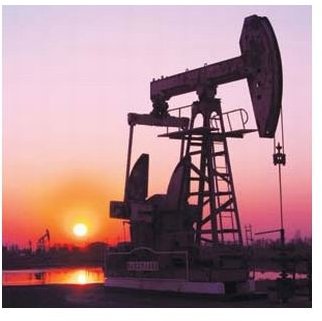
Figure 2: Oil Pump
Gas
In early 2010, the world’s total proven gas reserves were estimated at 6.609 trillion cubic feet, which is 6 percent higher than in 2009. Three quarters of these reserves can be found in the Middle East and Eurasia. Over half of the reserves are located in Russia, Iran and Qatar.
Despite this increase in reserves, the high rates of increase in gas consumption over the past decades lead to estimates of 60 years for which there will be enough gas, at the current production level.
Since it is not unreasonable to assume that the consumption of gas will increase, alternatives should be researched, which is happening. These range from alternative resources, such as solar energy , wind energy , biofuel, and so on, to new technologies to extract or recycle gas.
Major producers: Russia, U.S.A, Canada, India and Iran.
Major exporters: Russia, Canada, Norway, Algeria and the Netherlands.
Major importers: U.S.A., Japan, Germany, Italy and Ukraine.

Figure 3: Compressed Natural Gas
Industry fueled by the ‘Big Three’, but for how long?
So, it can be roughly stated that if everything remains as it is, these three natural resources industries most often used can keep the economy going for about a century. However, because the human population is still rising and the global economy is still growing, this might be a very optimistic estimate.
Considering this, it is a good idea to pursue alternative routes to produce energy. Solar energy, wind energy, biofuels, safe nuclear power, and so on. Not only for our own health and well-being, but also for the environment and the survival of future generations.
Image Sources
Figure 1: https://commons.wikimedia.org/wiki/File:Coal_anthracite.jpg
Figure 2: https://topnews.net.nz/content/27731-oil-price-dropped-because-recovery-fears
Figure 3: https://top-10-list.org/2009/06/06/top-10-renewable-source-energy/
References
Bentley, R.W. (2002). Global oil & gas depletion: an overview. Energy Policy. 30, 189 – 205.
U.S. Environmental Protection Agency: https://www.epa.gov/lawsregs/
U.S. Energy Information Administration Independent Statistics and Analysis: https://www.eia.doe.gov/oiaf/ieo/index.html
U.S. Geological Survey: https://pubs.usgs.gov/fs/fs-0028-01/fs-0028-01.htm
International Energy Agency: Key World Energy Statistics: https://www.iea.org/textbase/nppdf/free/2006/key2006.pdf