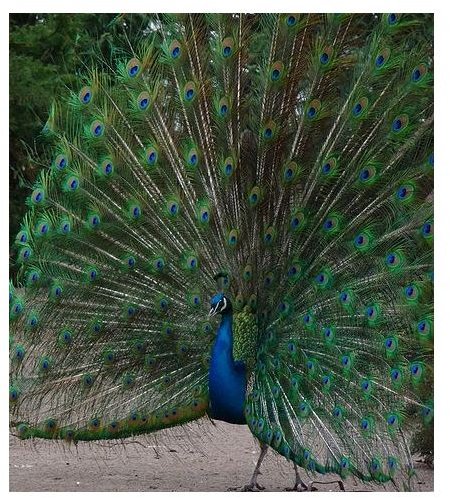
Find interesting peacock information in this article. Learn where they live, what they eat, how they behave, and so many more facts about peacocks.
Where Peacocks Live
Peacocks are actually peafowls. Males are called peacocks and females are called peahens. Baby peafowls are called peachicks.
There are two familiar species of peafowl: Indian Peafowl (Pavo cristatus or blue peacock) and Green Peafowl (Pavo muticus or green peacock). The Indian Peafowl resides in the Indian subcontinent and is the national bird of the Republic of India. The Green Peafowl is native to Asian countries and is listed as vulnerable to extinction.
Description
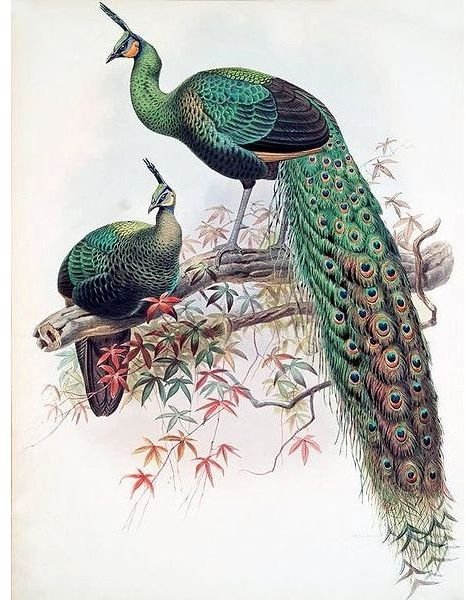
The male peacock is one of the largest flying birds. Their total length can reach near 8 feet; about 3 feet for the body and about 5 feet for the tail (train). Peacocks weigh about 9-13 pounds. Females are not as colorful as the males and they have a much smaller tail. This allows them to blend into the scenery when caring for their young.
Habitat
Their preferred habitat is foothills and lowland with brush and scattered trees for them to roost in. They can be found living in open forest, bushland, and sometimes the rainforest.
Behavior
Peacocks do not get along well with other domestic birds. However, they do gather in groups (called parties) with other peacocks. At night, they roost in the tops of trees to protect themselves from predators.
Diet
Peacocks are ground feeders. They eat plant parts, flower petals, seed heads, ticks, ants, termites, locusts, mice, scorpions, and small reptiles and amphibians.
Reproduction
The male’s beautiful tail is used to attract females to mate with. To get her attention, he will open it wide into a splendid fan and do a complex dance. The tail vibrates, making a rattling sound while they show off their shimmering colors. It is believed that the female peacock chooses her mate with the most impressive tail. They admire the eye markings on their tails and are said to mate with the male who has more “eyes”.
Males normally have a harem of 2-5 peahens. Each hen will lay 3-5 eggs. After the eggs hatch (about 28 days), the peachicks are able to walk and eat on their own within hours. They can fly when they are about a week old.
Fast Facts
- Despite their large size, the peacock can fly quite well (but only for very short distances).
- It takes the male 3 years to develop its full plumage.
- People in India have kept peacocks as tame birds for over 3,000 years.
- Predators include leopards and tigers .
- The lifespan of a peacock is 20 years in the wild and 40 years in captivity.
Resources
Peacock: https://animals.nationalgeographic.com/animals/birds/peacock/
Peacock Factfile: https://www.sch.im/wlp/pages/peacock%202.htm
Photo Credit
Male Peacock image courtesy of CC-BY-SA-3.0 / 4028mdk09 at Wikimedia.
Male and Female Peacock image courtesy of Elliot, Daniel Giraud, 1835-1915 (in the public domain).