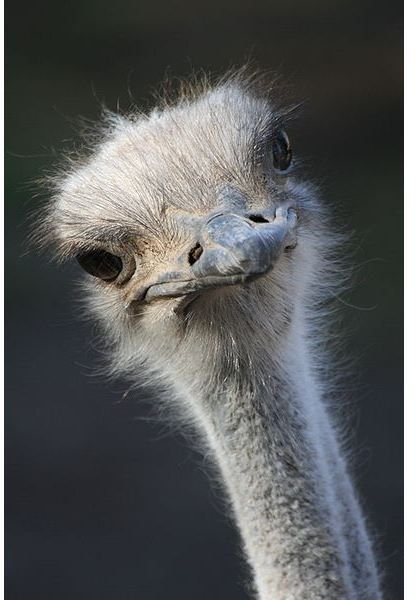
The ostrich is a fascinating creature that has been around for millions of years. Find ostrich facts that can be enjoyed by both kids and adults. Learn about their behavior, diet, and so much more.
Background
According to skeletons and fossils, the ostrich has been around for over 120 million years. Before the mid-20th century, ostriches could be found in Africa, the Arabian peninsula, and southwestern Asia. Today, they can only be found in south and central Africa (a small amount can be found in Australia - introduced by settlers). The ostrich is the largest bird on earth and (like the emu, rhea and cassowary) does not fly. Below are more fun and interesting ostrich facts.
Description
Even though ostriches do not fly, they have powerful wings. They use their wings for courtship rituals and aggressive display. On hot days, they will fan themselves with their wings and on cold days, they will cover their thighs with their wings to keep warm.
The ostrich is about 6-9 feet tall and weighs between 150-350 pounds. The male is primarily jet black in color whereas the female is more of an earthy gray-brown color. Ostriches are the only birds to have only 2 toes on each foot and they have the largest eyes of any land animal (each measuring about 2 inches across - bigger than their brain).
Habitat
Ostriches prefer flat land where rainfall is minimal (open country, dry savannah, and desert areas).
Behavior
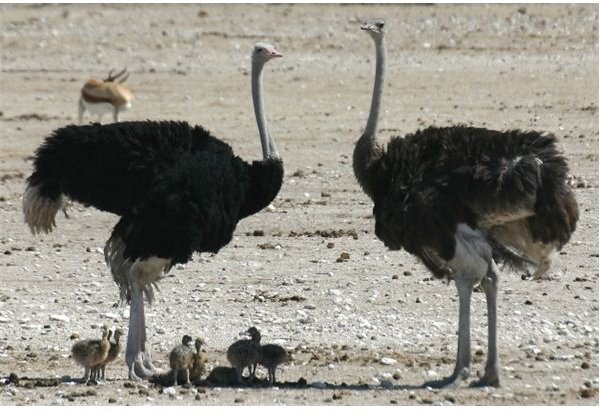
Ostriches live in small groups called herds that usually consist of less than a dozen birds. However, they can be seen in larger groups when grazing (up to 50) along with other grazing animals.
When frightened, the first instinct an ostrich has is to run. They can reach speeds up to 43 mph, making them the fastest 2-legged animal in the world. The ostrich is strong and is capable of killing a human or predator (like a lion) with a single kick.
Contrary to popular belief, it is a fact that ostriches do not bury their heads in the sand. They lay their head on the ground to become less visible when trouble approaches.
Diet
Ostriches mostly eat vegetation, including leaves, fruit, roots, and seeds. Occasionally, they will eat insects, lizards, and animal remains left by carnivores. To help with digestion, they will ingest stones. Most of the water they get comes from the plants they eat.
Reproduction
Ostriches in captivity reach maturity at 2-3 years of age. The dominant male in the group will mate with the dominant female of the group (and sometimes with other hens in the group). All of the hens in the group will place their eggs in the nest belonging to the dominant hen (where she and the male will take turns incubating the eggs - the female during the day and the male during the night). The incubation period lasts about 40 days.
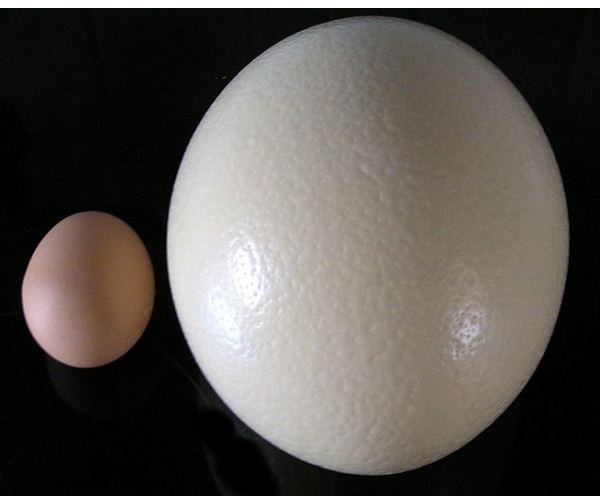
The female will lay between 40 to 100 eggs a year. One ostrich egg weighs about 3 1/2 - 5 pounds and is equivalent in volume to 24 chicken eggs. It is the largest of all eggs and it is the smallest egg in relation to the bird’s size. The female is able to recognize which eggs belong to her.
The chicks grow approximately 10 inches a month and will weigh about 100 pounds in one year.
More Information
The following are more interesting ostrich facts:
- It takes 1 1/2 hours to hard boil an ostrich egg.
- Ostrich meat is heart healthy. It is low in calories, low in cholesterol, and almost fat free.
- The immune system of an adult ostrich is one of the most advanced among mankind.
- There are over 2 million ostriches worldwide.
- Their lifespan is 30-40 years in the wild and 30-70 years in captivity.
Resources
Ostrich (Struthio camelus): https://animals.nationalgeographic.com/animals/birds/ostrich/
Quick Ostrich Facts: https://www.ostrich.com/general/quickfacts.html
Interesting Facts from the American Ostrich Association: https://www.ostriches.org/faq.html
Photo Credit
Ostrich - https://commons.wikimedia.org/wiki/File:OstrichHead.JPG
Ostriches with Babies - https://commons.wikimedia.org/wiki/File:Struthio _camelus.jpg
Chicken & Ostrich Eggs - https://commons.wikimedia.org/wiki/File:Straussenei _BMK.jpg