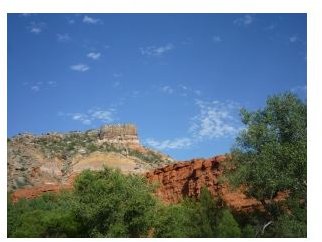
There are many types of soil, from the organically rich to the minerally deficient. Each soil has different chemical properties that will ultimately determine its use. Learn about the chemical properties of red soil and why they determine its appearance and use.
There are several, different types of soil. Red soil is a type of soil that develops in warm, temperate, and moist climates. This soil usually appears under deciduous forests. It is commonly a poor soil, with little organic or organic-mineral materials. Instead, chemical properties make red soil very poor for growing and very difficult to use for agricultural purposes.
Components of Soil
- Inorganic material: Inorganic components of soil derive from the rocks that originated the soil. Fragmentation and weathering are the main soil forming processes. Also, some biological activity (lichens and mosses) can contribute to soil formation and inorganic composition.
- Organic material: The organic parts of soil come from microbial action on dead plants (litter) or animals.
- Biological entities: Bacteria, fungi, algae, protozoa , nematodes, and earthworms are all part of soil. Air and water occupy the space between the soil’s inorganic and organic particles.
Chemical Properties of Red Soil
Red soil is red because of the presence of a particular chemical compound present in them. The mineral iron (chemically represented as Fe) can form two distinct oxides upon reaction with oxygen: ferrous oxide (FeO, one atom of Fe, one of oxygen) and ferric oxide (2 atoms of Fe and 3 of oxygen). Red soil is rich in the purple reddish ferric (Fe203) oxide.
Red soil ie seen as the result of continuous weathering of minerals in a humid climate without new soil formation. The soil is continually lixiviated (washed down) so it is stripped down of minerals and organic matter. The only mineral that survives this lixivation process is the ferric oxide which is highly insoluble in water.
The Food and Agriculture Organization of the United Nations (FAO) has developed a classification system for soil. The World Soil Classification, or World Soil Map, offers a good guide to understanding the various types of soil that exist in the world. Under this classification system, red soil is grouped under the general term of Acrisols
Acrisols are groups of red and yellow colored soil that result from the accumulation of the chemical property, iron oxide (colloquially known as rust) which is highly insoluble in water. Other nutrients such as calcium (Ca) and potassium (K) are usually deficient in acrisols and red soil. Agriculture is difficult (and in some cases almost impossible) in red soil due to the mineral deficiencies of them. Without external supplementation (fertilization), acrisols and red soil (with lime ‘minerals’ and organic matter and phosphates) are easily exhausted.
The presence of red soil in an area denotes the existence of long processes of weathering and exhaustion. In a sense, red soil can be seen as eroded soil that needs attention and much more soil management so they can be continued to be used properly.
Sources:
Red soil. (2010). In Encyclopædia Britannica Online: https://www.britannica.com/EBchecked/topic/1385166/red-soil
World reference base for soil resources https://www.fao.org/docrep/W8594E/w8594e00.htm#
Image Credit:
Picture taken by dlbdesigns available free at www.sxc.hu