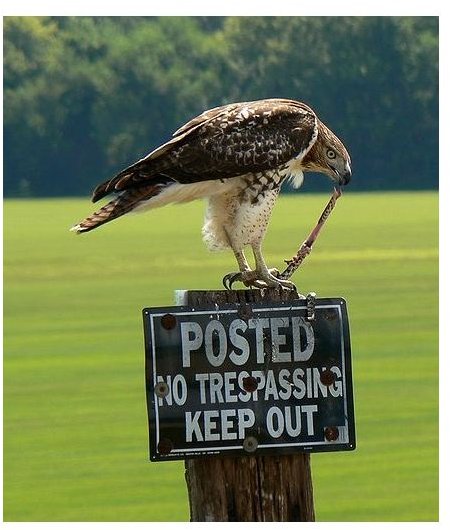
A red-tailed hawk perching on a telephone pole along the roadside of an open field is a sight that can be seen in all states across the North American continent. Find fun facts and information on this fascinating bird of prey, including its habitat, diet, and more.
Description
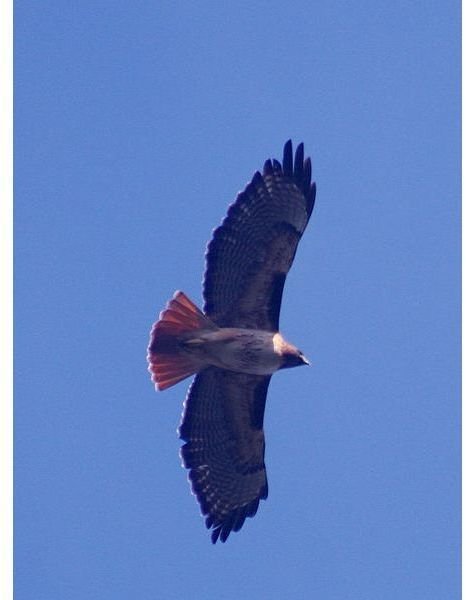
Information on the red-tailed hawk, also known as buzzard hawk, shows it is the most common hawk species in North America. It is well known for its reddish-brown tail but it is a fact that not all 14 subspecies have this characteristic.
The average body length of a red-tailed hawk is 18-22 inches. Most weigh between 1 1/2 - 3 1/4 pounds and have a wingspan measuring 3 1/2 - 4 1/2 feet.
Habitat
Red-tailed hawks can be found in most of North America, Central America, and the West Indies. Although they prefer open areas such as deserts and fields, they have adapted to a variety of habitats including rainforests, mountains, and urban areas.
Diet
Red-tailed hawks are carnivores (meat eaters). They eat mostly small to medium-sized mammals, including mice, ground squirrels, rabbits, and opossums . They are also known to feed on reptiles, birds, and sometimes large insects and fish.
There are a couple of ways red-tailed hawks catch their prey. One way is the sit-and-wait approach. They will sit on a high perch (like a tree) until they spot their prey. When spotted, they will swoop down and seize it with their sharp claws. Another way is the flying approach. They will soar gracefully in the sky and will either grab their prey on the ground or snatch a bird in the air. They are also known to steal prey from other raptors (called pirating) and eat fresh carrion (dead animals).
Reproduction
Red-tailed hawks perform spectacular courtship flights involving diving, “barrel rolls”, and shrill screams. They are monogamous and pairs will usually mate until the death of one partner.
Red-tailed hawks have large nests which can be found high above the ground such as in tall trees or cacti, on cliffs, or on man-made structures. Both the male and female build the nest using sticks, bark, twigs, and other fine material.
Females lay 1-5 eggs each year. Males and females will incubate the eggs for 4-5 weeks and take part in caring for the young until they leave the nest in about 6 weeks. The young become sexually mature when they are about 1-2 years of age.
More Information
More interesting red-tailed hawk facts:
• They have great eyesight and can spot a small rodent on the ground from 100 feet in the air.
• To teach the young to hunt, the parents will drop live prey for them to chase and catch.
• In the wild, half of all red-tailed hawks do not live through the first year of their life. Those that do survive the first year will live about 12 years. In captivity, they can live up to 29 years.
Sources Used
https://animals.nationalgeographic.com/animals/birds/red-tailed-hawk.html
https://www.peregrinefund.org/Explore _Raptors/hawks/redtail.html
https://www.sandiegozoo.org/animalbytes/t-red _tailed_hawk.html
Photo Credit
Red tailed hawk eating a snake image courtesy of https://commons.wikimedia.org/wiki/File:Red _tailed_hawk_and_snake_b_8.9.2008.jpg
Red tailed hawk in flight image courtesy of https://commons.wikimedia.org/wiki/File:Red-tailed _hawk_in_flight.jpg