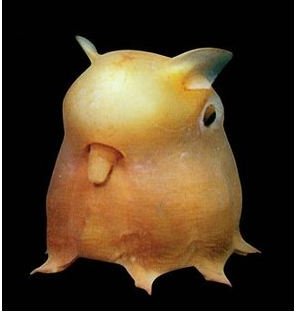
Learn about the Dumbo octopus, an unique octopod with fins. Find interesting information about this small octopus, including how it got its name, where it lives, and so much more.
The Dumbo Octopus
Little information is known about this adorable little octopus that lives deep in the ocean’s water.
Description
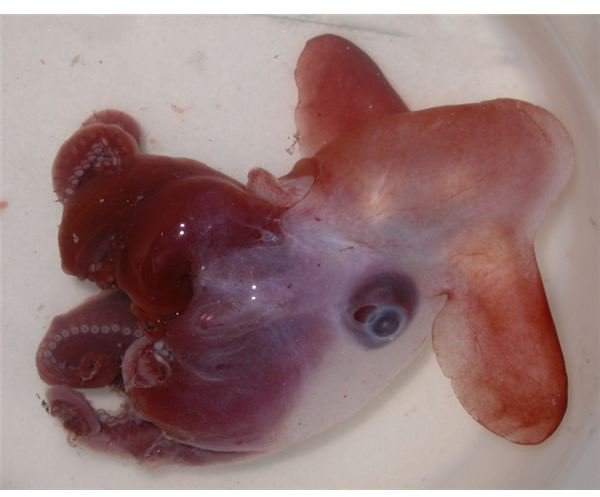
The Dumbo octopus got its name from its ear-like fins on top of its head-like body which resemble the ears of Walt Disney’s character Dumbo, the flying elephant.
It is an octopod, meaning it has 8 arms. The arms connect with each other, close to the tips, by “webbing”. It can grow up to 8 inches and has a soft body (semi-gelatinous), allowing it to live in deep water. The male and female octopus vary in size and in pattern of suction pads. Click on images to enlarge.
Scientific Classification
Class: Cephalopoda
Family: Opisthoteuthidae
Genus: Grimpoteuthis
Species: There are 14 known species of the Dumbo octopus.
Habitat
Dumbo octopuses appear to live on the floor (or just above it) of every ocean in the world. Typically, they live from 100 to 5,000 meters below sea level though they have been found living as deep as 7,000 meters, the deepest depth of any octopus. Learn about the deep ocean (the abyssal zone) .
Some species appear to sit on the ocean’s floor and hover above it while others seem to be completely pelagic (open water only).
Behavior
The Dumbo octopus swims by flapping its fins, by expanding and contracting its webbed arms, or by shooting water through its funnel. It can use all of these techniques simultaneously or use each one separately. They are good swimmers and are capable of making a quick escape when needed.
Diet
The bottom-dwelling octopuses will feast mainly on crustaceans, worms, and bivalves. The ones that hover above the bottom eat pelagic copepods (small crustaceans, about 1-2 millimeters long). They are also known to occasionally eat small fish. The Dumbo octopus differs from its other kind in that it mainly swallows its prey whole.
Reproduction
Multiple eggs at various developmental stages have been found in dissected females, meaning they presumably lay eggs all year long instead of having a breeding season.
The male Dumbo octopus has an enlarged segment on one of his arms which is used to transfer spermatophores (packets of sperm) into the female’s mantle cavity. Once transferred, the packets will rupture so the sperm can fertilize the eggs. The female will then lay the eggs underneath rocks and shells and leave them to fend for themselves.
The eggs are usually quite large in size and when hatched, the young are believed to be quite advanced.
Conservation Status
Although there is little information available about the Dumbo octopus, they are not considered an endangered species.
References
https://www.bbc.co.uk/nature/blueplanet/factfiles/molluscs/dumbo _octopus_bg.shtml
https://web.mac.com/biomescenter/Biomescenter.com _annex/essay:_dumbo_octopus.html
https://www.nefsc.noaa.gov/press _release/2009/MediaAdv/MA0908/index.html
Photo Credit
First image from “The Deep: The Extraordinary Creatures of the Abyss” by Claire Nouvian / Monterey Bay Aquarium Research Institute
Second image courtesy of Mike Vecchione, NOAA