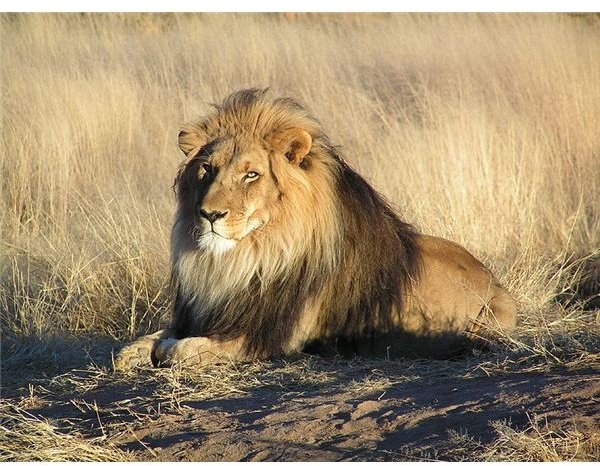
The first thing that a male African lion does when he takes over a pride is to kill all the cubs of his predecessor. This maximizes his own reproductive success.
Survival of Species is a Misconception
Some people think that survival of the species is a driving goal of evolution. It makes a certain intuitive sense, doesn’t it? Species want to survive, therefore the individuals of that species should act in ways to ensure that it does. This seems especially true to us humans, because we have the mental faculties to contemplate how our actions as a species affect the world we live in, and all the possible consequences.
But that’s not how evolution actually works. A species is not in and of itself motivated to do things. Individuals have motivations - and what motivates the individuals is their own reproductive success. The rest of the species, it turns out, is irrelevant.
Take the behavioral ecology of the African lion for example. The first thing a male African lion does, upon taking over a pride by driving out the previous resident male lion, is to kill any and all cubs under two years old. Why?
African Lion Social Behavior
The basic social unit among African lions is the pride. A lion pride consists of several related females, one male (or two brothers) unrelated to the females, and their cubs. Female lions form the core of the pride, which passes down in generation from mothers to daughters. Females usually stay with the pride they are born into for their entire lives, about fifteen years. Females do most of the hunting, working together to bring down large herbivores like wildebeest and zebras for the whole pride to eat. They typically produce cubs every few years throughout adulthood.
Male lions are driven from their birth prides as adolescents. They wander around alone until they become strong enough to take over another pride by driving out its resident male. They then have a few years to mate with the female lions and defend the pride from other males, before a younger, stronger male drives them out in turn. Male lions in the wild tend not to live longer than ten years.
Reproductive Time
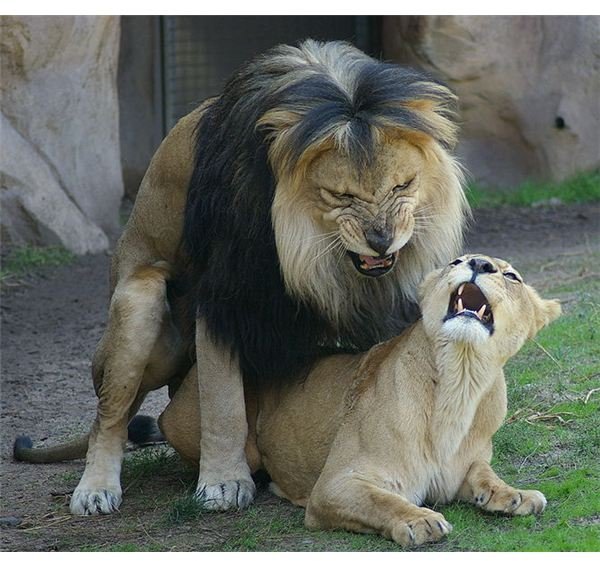
Female lions have a reproductive timespan of at least ten years. Male lions typically have less than five years during the time they are in a pride. Female lions with cubs don’t come back into heat until their cubs have either matured, which can take up to two years, or they have died.
It’s to the advantage of the male lion to kill all of his predecessor’s cubs so that the females will become available to him as soon as possible, so that he will have at least one opportunity to reproduce before another male lion comes along, and his own cubs will have a greater chance of surviving to adulthood. It’s less of a disaster for a female lion to lose a given litter of cubs, because she will have opportunities to produce more.
Evolution Is Driven By Individual Reproductive Success
The male African lion is mainly concerned with his own reproductive success, and his behavior towards others of his species reflects that. The success of his mates doesn’t matter, except insofar as they bear and nurture his cubs, because he will kill their other, unrelated cubs. The success of other unrelated male lions definitely doesn’t matter. Strong male lions who can take and hold a pride for a longer period of time will reproduce more than weaker males, and males who kill their predecessor’s cubs will reproduce more than those who don’t. In short, other members of his species are to be eliminated, not preserved, if they’re in the way of his own offspring’s success.
Evolution is driven not by species survival, but by individual reproductive success.