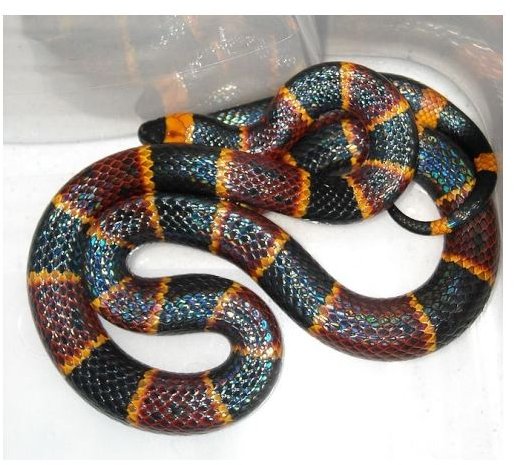
Learn about this beautiful but deadly snake. Find fun and interesting facts about coral snakes, including their behavior, habitat, and diet.
The Coral Snake
“Red on yellow, kill a fellow” and " red on black, friend of Jack" are a couple of folk rhymes to distinguish between the venomous coral snake (in North America) and similar non-venomous snakes. Below are more fun facts about coral snakes.
Description
The average length of a coral snake is 20-30 inches. Their colors are brilliant, consisting of large red and black bands and small yellow bands. The size of their head is small, making it difficult for someone to grab them from behind, and the size of their fangs are small, making it more difficult (compared to snakes with large fangs) to deliver venom in its victim (especially through thick leather clothing).
Behavior
Coral snakes are most active at night and usually stay hidden during the day hours. In general, coral snakes are not aggressive. If confronted by humans, they normally flee.
Coral snake bites in the U.S. are minimal and most occur from unintentional actions, such as accidentally grabbing them (for example, while gardening) or stepping on them.
If bitten, pain associated with the bite is usually mild. However, their venom is highly toxic and can paralyze the respiratory system within hours.
According to National Geographic, no deaths from coral snake bites have been reported in the U.S. since an antivenin was released in 1967.
Habitat
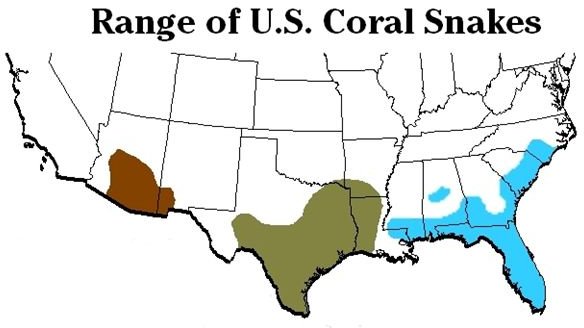
Coral snakes live in a variety of habitats, including palmetto and scrub areas, wooded areas, and swamps. Often, they will venture into residential areas.
Coral snakes spend most of their time underground in places like holes dug by other animals. They can also be found in hidden places such as underneath rotting leaves or in tree stumps.
Distribution Map_: Brown-Arizona coral snake, Green-Texas coral snake, Blue-Eastern coral snake_
Diet
Coral snakes are ophiophagous, meaning they hunt and eat snakes (including other coral snakes). They also feed on insects, lizards, mice, frogs, and small birds. After they paralyze their prey, they swallow them whole.
Reproduction
In North America, the coral snake is the only venomous snake to lay eggs.
The female lays 3-5 eggs in the summer and in 2-3 months the eggs will hatch. After birth, baby snakes are about 7 inches in length, have the same color pattern as the adult, and are fully venomous.
More Information
The following are more interesting facts about the coral snake:
• The coral snake is a member of the cobra family.
• The fangs in coral snakes (and cobras) can not be moved up against the roof of their mouth when not in use like other venomous snakes .
• The average life span of the coral snake in the wild is unknown. In captivity, they can live up to 7 years.
Photo Credit
Eastern Coral Snake image courtesy of https://en.wikipedia.org/wiki/File:Coral _009.jpg
Distribution image courtesy of https://en.wikipedia.org/wiki/File:USA _Coral_Snake_Range.png (in the public domain)