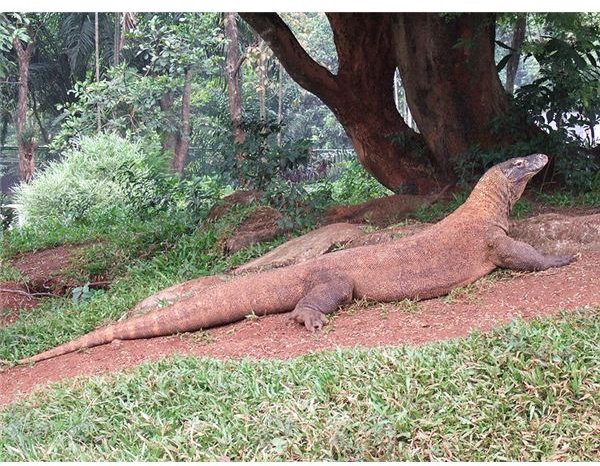
The Komodo dragon, a giant lizard found only on a few small islands, is a deadly predator, yet its bite is weaker than that of a housecat. Find out what threat this species poses to humans—and the threat of extinction that it faces itself.
A Unique Lizard
The Komodo dragon (Varanus komodoensis) is a member of the monitor lizard family and is the largest extant lizard species in the world. Found only on five islands in Indonesia, it grows to a length up to 10 feet (3 meters) and a weight up to 150 pounds (70 kg). Komodos are primarily carrion eaters, but are also capable of killing their own prey.
Large size is not the only amazing characteristic of the Komodo dragon. They are one of the few vertebrates capable of parthenogenesis, or reproduction without mating. Two female dragons in captivity have been documented to have produced viable offspring (all female) without a male. DNA fingerprinting proved that their offspring (all female, since they are virtual clones of their mothers) were conceived through parthenogenesis. One of these mothers later reproduced sexually after mating with a male, so Komodo dragons apparently can switch between sexual and asexual reproduction.
Largest Venomous Creature Alive
Though it feeds on large prey (including humans on occasion), the Komodo dragon has long been known to have a skull unsuited to killing by force. In 2008, an analysis of its skull anatomy showed that its bite is weaker than that of a pet cat . Instead, these predators hold and pull on their prey, using muscles at the back of the skull instead of jaw muscles. This action is facilitated by recurved, serrated teeth similar to those of “raptor” dinosaurs (dromaeosaurs).
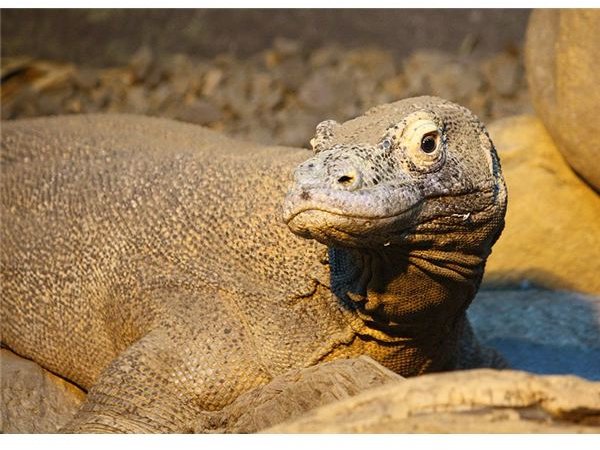
The dragon’s strategy is to hold the prey with its powerful front claws while ripping and swallowing large chunks of flesh. If the prey escapes, it usually dies within a few days, and the dragons (which feed in groups) eat the remains. The saliva of wild Komodo dragons is known to contain virulent bacteria, and scientists long speculated that escaped prey died from bacterial infection. It is now known that Komodo dragons have venom glands, and biologists now believe that prey is killed by the effects of this venom. The discovery of venom glands means that Komodo dragons are the largest living venomous animals in the world.
The Endangered Komodo Dragon
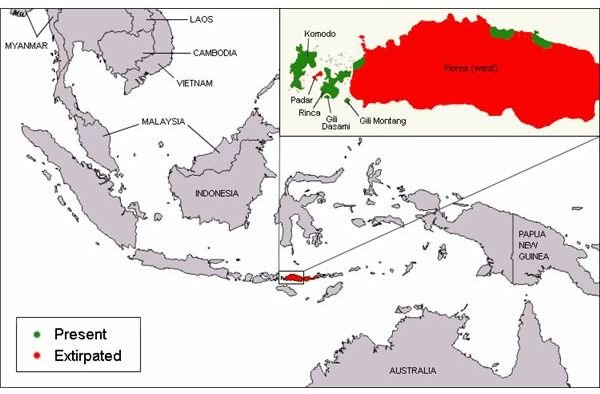
Although the Komodo dragon is infamous for killing humans, it actually poses little danger, as attacks on humans are extremely rare. Komodo dragons are listed as “vulnerable” on the IUCN Red List, meaning that without intervention, it will probably soon become truly endangered. These lizards have a limited range and a small wild population (no more than 4000 individuals). They depend on large prey, so loss of prey species poses a threat to them.
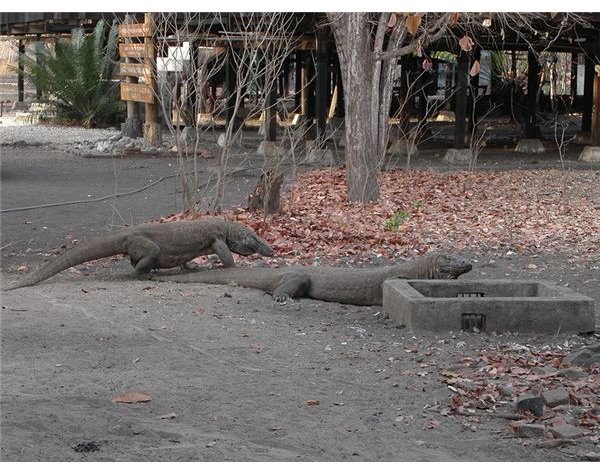
Indonesia’s Komodo National Park (KNP) includes three major islands and several smaller ones. Much of the Komodo dragon’s range is within the park boundaries. One of the goals of KNP is conservation of this unique species. With this protection, the Komodo dragon has a good chance of avoiding the threat of extinction, despite its vulnerable status.
References
- Komodo National Park official website
- National Geographic News
- Watts, Phillip C., et al. “Parthenogenesis in Komodo dragons .” Nature 21 December 2006; 444, pp. 1021-1022.
Images
-
Top right: Komodo dragon at Ragunan Zoo , Jakarta, Indonesia. Photo by “Midori” (Wikimedia Commons). (CC) Some rights reserved.
-
Center: Komodo dragon at Louisville Zoo , Kentucky. Photo by Tricia Shears. (CC) Some rights reserved.
Advertisement -
Bottom left: Komodo dragon range , both current and historical. The area of its range is much smaller than it was at one time. Image by “Tommyknocker” (Wikipedia).
-
Bottom right: Komodo dragons on Komodo Island , part of Komodo National Park. Photo by “Ravn” (Wikimedia Commons). (CC) Some rights reserved.
Advertisement