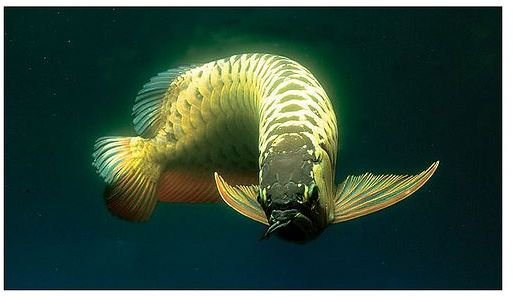
The Asian arowana, resembling the mythical Chinese dragon, is one of the most striking freshwater fishes on the planet. Discover the story behind these coveted but endangered creatures.
The Chinese dragon fish (Scleropages formosus), also called the Asian arowana and Asian bonytongue, is virtually unknown in the West, but it is beloved in Far Eastern cultures. With shining metallic scales, flowing wing-like pectoral fins, and a long flexible body, this freshwater fish bears a striking resemblance to the iconic Chinese dragon. Prized in Asia as aquarium specimens, Asian arowanas are also notable for being endangered, listed on CITES Appendix I. The geological record shows them to be living fossils, virtually unchanged since they appeared about 140 million years ago, during the heydey of the dinosaurs.
At right: Gold crossback arowana.
.
Asian Arowana Types
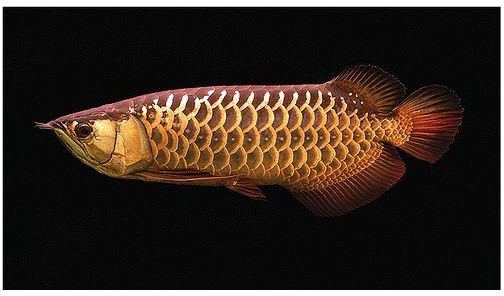
An adult Asian arowana grows to a length of about three feet. Their pectoral fins are large and elongated, spreading out like wings. The mouth gapes wide, allowing the animal to swallow large prey, and the scales are very large, up to about an inch in diameter. The body is elongated and muscular, making this fish a powerful jumper.
Asian arowanas are scattered among the mainland and tropical archipelago of the Southeast Asia, including Vietnam, Thailand, Malaysia, and Indonesia. They are obligate freshwater fish that cannot travel between islands, so the populations on each island and the mainland population are isolated from each other. Each of these populations has a unique appearance:
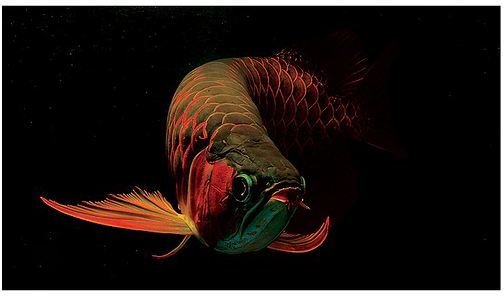
- The super red arowana has bright red metallic scales on its sides, red fins, and a red tail, but is dark brown as seen from above.
- The red-tailed golden (RTG) arowana has brilliant gold metallic scales on its sides, red fins, and a red tail, but is dark from above like the super red arowana.
- The golden crossback arowana has gold metallic scales and a striking bright metallic gold pattern on its back, which is created by the golden color on the scale edges.
Other strains include the silver Asian arowana and green arowana.
Above left: Super red arowana.
Conservation Status
Asian arowanas are protected by the CITES treaty’s most restrictive controls on international trade. In the U.S., ownership of one of these fish is completely prohibited under the Endangered Species Act (except for public zoos and aquariums, which can obtain permits). The primary threat is habitat loss in its native rainforest blackwater river home, complicated by the fact that there are numerous distinct, isolated populations in a number of countries. A second major factor affecting conservation is illegal collection for the aquarium trade. Considered lucky and good feng shui in East Asian cultures, a single red or gold crossback arowana can command thousands of U.S. dollars.
CITES has authorized a small number of fish farms in Southeast Asia to breed Asian arowanas for the pet trade. Each captive-bred fish sold is documented by a certificate and implanted with an RFID microchip. Captive breeding has caused a new conservation concern: hybridization between strains, which some researchers consider to be entirely separate species. Hybrids do not match any wild population and are unsuitable for reintroduction into their native habitat.
Taxonomic Classification
Kingdom: Animalia
Phylum: Chordata
Class: Actinopterygii
Subclass: Neopterygii
Infraclass: Teleostei
Order: Osteoglossiformes
Family: Osteoglossidae
Genus: Scleropages
Photos by amrn86 on Flickr. (CC) Some rights reserved.