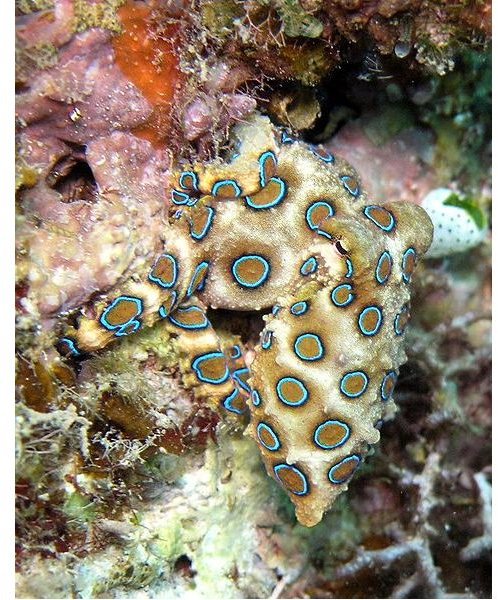
Learn about one of the tiniest but deadliest creatures in the sea.
One of the deadliest creatures on the planet, also happens to be one of the tiniest. Weighing barely at ounce and at the size of a golf ball, blue-ringed octopus carries enough lethal venom to kill human beings within mere minutes.
Description:
There are two species of the blue-ringed octopus, the largest of which is the Hapalochlaena lunulata which can reach 8 inches across when all of its tentacles are spread out. The more common of the two species is the smaller Hapalochlaena maculosa. This is the species most often seen and it weighs only one ounce.
With a tan to light yellow-brownish coloring, the blue-ringed octopus can easily be camouflaged on the sea floor. The bright blue rings or which the octopus gets its name, become clearly visible when provoked, ready to attack.
Habitat and Diet:
The blue-ringed octopus can be found in the pacific ocean ranging from Japan to Australia and feed upon a diet consisting mostly of crabs and shrimp. Occasionally, when within range, the blue-ringed octopus may also feed upon small fish by injecting its neurotoxin into the water where it gets into the prey’s system and paralysis the fish so that the octopus can begin consuming it.
Poison and Treatment:
To spite its very tiny size, at any given time the blue-ringed octopus carries enough venom within its body to kill 26 adult human beings at a time.
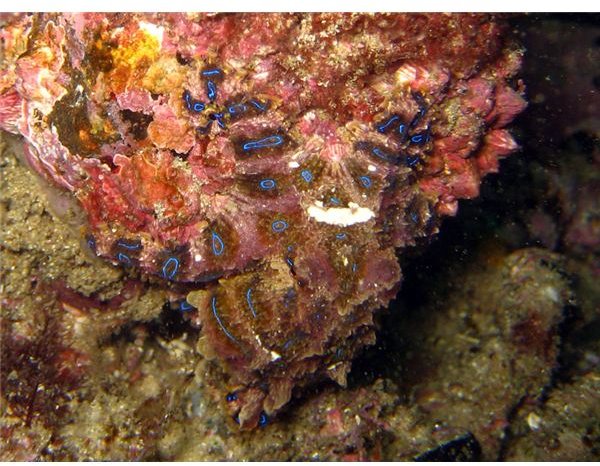
The venom works quickly, killing within minutes and there is no known cure for the poison. If medical care is given quickly enough to start artificial respiration and possible heart massage to keep a person breathing long enough for the poison to work itself out of a victims system, there is a chance to save the patient; however, given how quickly the venom works, time is of the essence.
The blue-ringed octopus carries two types of venom, one which is used for its prey when hunting; this particular venom poses little risks to humans. The second, deadlier venom, is the defensive mechanism to help protect the octopus from predators. Typically, this small and deadly creature only uses its defensive venom when provoked, therefore, humans are generally only attacked when they step on the small creature or begin harassing it trying to pick it up, etc.
Reproduction:
Female blue-ringed octopus will produce only once in her lifetime, laying around 50 eggs in a single match that take roughly six months to hatch. She will die after the new eggs have hatched. After hatching it will take them a year to mature at which time they will reach breeding age.
Scientific Classification:
Kingdom: Animalia
Phylum: Mollusca
Class: Cephalopoda
Order: Octopoda
Family: Octopodidae
Subfamily: Octopdinae
Genus: Hapalochlaena