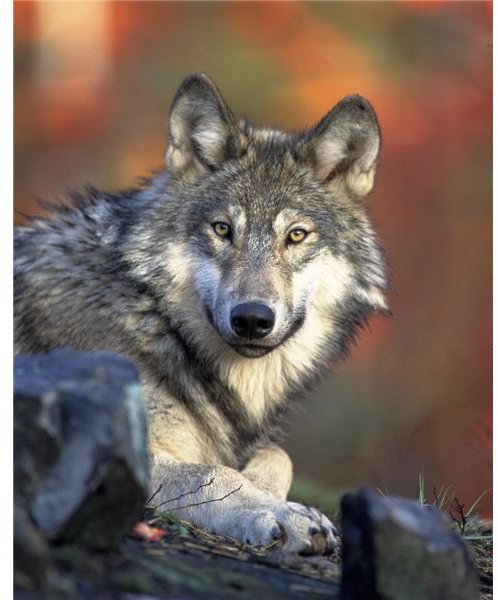
This species spotlight focuses on the beautiful Gray Wolf. The ancestor of man’s best friend and the subject of many legends.
Description
Contrary to the name, Gray Wolves do not always have gray fur. They can also have brown, red, white or black fur. They are the largest species of wild canine, weighing as much as 130 pounds and reaching a length of up to 6.5 feet long. Gray Wolves are social animals. They live in packs and form deep bonds with their fellow pack members. Sometimes a wolf will sacrifice their life to protect their family pack from harm. Pack members communicate through body language, scent, barking, howling, growling and whining. Each pack has an alpha pair, which is the dominant male and female. The alpha pair are monogamous and are usually the only pair that will mate in the pack. The whole pack participates in raising the pups of the alpha pair. Pups take ten months to fully mature. The alpha pair act as leaders of the pack. They choose territory, when and where to travel, and lead the pack in hunting prey.
Images
Habitat and Diet
From arctic tundra, thick forests, to grasslands, the Gray Wolf can survive in a diverse range of habitats. They currently inhabit a few areas in the United States, Mexico, Canada, Europe and the eastern Soviet Union.
The hunting habits of the Gray Wolf provide a valuable service for the environment by reducing and preventing over population of prey animals. Gray Wolves are carnivores and hunt small prey such as mice and rabbits and large prey such as bison. Gray Wolf packs work together to hunt large prey. They pick the weak or the old for an easier catch. By hunting the weak and the old, they not only provide population control, they strengthen the prey species by eliminating the weak.
Conservation
The biggest threat to the Gray Wolf is humans. Loss of habitat due to human activities has forced the Gray Wolf out of many areas. Competition for food (Gray Wolves are often blamed for the loss of livestock) has resulted in wolves being poisoned and hunted by humans. Hunting for sport and for the fur of the wolves has decreased their populations. The Gray Wolf once inhabited more areas than any other mammal. Now they are extinct in many areas. Conservation efforts have brought the Gray Wolf populations to a more stable status in some areas and saved the species from possible extinction. The ICUN lists the species as “least concern” due to a halt in population decline in many areas. Conservation efforts and reintroduction has stabilized and increased populations in some areas, such as Michigan and Yellowstone National Park.
Although the population status of the Gray Wolf has improved, they still need protection. Habitat loss, shortage of food and hunting are still issues that the species faces.
Scientific Classification
Scientific Name: Canis lupus
Kingdom: Animalia
Phylum: Chordata
Class: Mammalia
Order: Carnivora
Family: Canidae
Genus: Canis