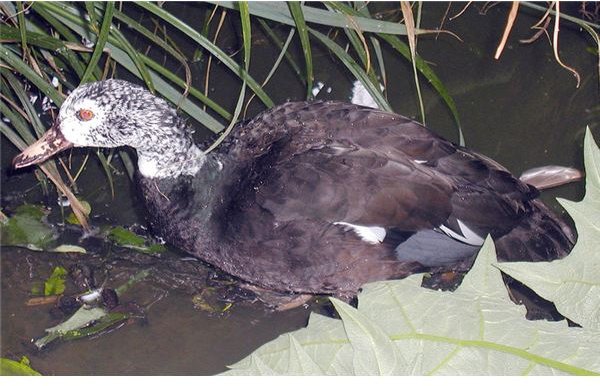
There were large populations of White Winged Ducks in the early 1900s. Today, they are one of the most endangered waterfowl species in the world and their numbers are continuing to decline. Read more about this unique and rarely seen duck.
Identification
White Winged Ducks are not easily spotted in the wild because they spend their days hidden in trees. Nighttime is when they come out to hunt and mate. Their loud nighttime calls echo through the forest and can sound like a ghost when heard from a distance. The unnerving ghost like sound of their calls has attributed to them being given the nickname Deo Hans which means Spirit Duck in Assamese, the language of the Assam people of northeastern India.
White Winged Ducks are large waterfowl that can reach twenty-five to thirty-one inches long. They are mostly dark brown in color. Their identifying features that distinguish them from other ducks are the white feathers found on their head, neck and wings. They have white heads and necks that are heavily spotted with brown. They have white feathers on the underside of their wings that are easily seen when the bird is in flight. Only the tips of the wings show white feathers when the bird is not in flight.
Images
Habitat and Diet
Moist and heavily forested areas in Bangladesh, Cambodia, India, Indonesia, Lao People’s Democratic Republic, Myanmar, Thailand and Vietnam are the native habitats for White Winged Ducks. White Winged Ducks prefer areas with shallow and slow moving fresh water sources where they can hunt for crustaceans, insects, fish, frogs, larvae and worms. They also feed on aquatic plants and seeds.
Scientific Classification
Kingdom: Animalia
Phylum: Chordata
Class: Aves
Order: Anseriformes
Family: Anatidae
Genus: Cairina
Scientific Name: Cairina scutulata
Conservation
Deforestation is the main threat that White Winged Ducks face. Other contributing factors are pollution and hunting. The ducks and their eggs are hunted and collected by humans for food. Because White Winged Ducks live in heavily forested areas and hide during the day, it is difficult to get an accurate number of the species in the wild. They are currently classified on the ICUN’s redlist as an endangered species with an estimated 800 left in the wild as of the year 2002.
Conservation efforts in the native lands include protection of habitats and enforcement of hunting regulations. Surveys of current populations are being conducted to try and determine an accurate number of White Winged Ducks left and to identify their habitat. Preventing deforestation in their habitats is extremely important. Each pair of White Winged Ducks need approximately 250 acres of habitat in order to breed.
Captive breeding programs for White Winged Ducks have had success in increasing the captive population, but little success in benefiting the wild population. A few of the captive bred ducks were able to be released into the wild, but it is a rare occasion that a release in the wild is possible.