A combination of solar energy and the earth’s rotation is responsible for creating earth’s wind systems. It is these wind systems that power the ocean waves, starting with small capillary waves, progressing to gravity waves, with their size dependent on the wind speed and duration over the surface.
Introduction
Ocean waves are powered by the action of the wind passing over the surface of the earth’s oceans. As we know, the winds are created by the action of the rotation of the earth along with the energy of the sun that combines in making ocean waves.
This is an article about the power of ocean waves, and here we will investigate in more detail what causes ocean waves. We will begin with an examination of the creation of wind.
The Creation of the Earth’s Winds
In our northern hemisphere, the wind system starts at the equator, where a difference of pressure is formed by the hot air rising up and accumulating, before sinking down to the surface and being forced in a west to east direction by the coriolis effect (a force created by the rotation of the earth). This also pushes the air both towards the equator and the North Pole. The wind heading toward the equator is deflected to the west or right, and the wind going towards the North Pole is also deflected to the right, but towards the east.
This provides the Easterlies (wind blowing from the east) and Westerly’s (wind blowing from the west respectively), that most of us are familiar with. The wind is driven by a pressure gradient that is caused by a difference in the air pressure over a distance.
Web References:
- gomberkite - creation of the wind
- csep10 - the Coriolis Effect
An Investigation into What Causes Ocean Waves
As we have seen, ocean waves are powered by the earth’s wind systems.
The ocean waves are formed as the wind blows across the ocean surface creating small capillary waves similar to ripples.
As the wind strength increases, so do the size of the capillary waves, with the surface of the sea becoming rough. These bigger capillary waves present a larger surface area for the wind to act on, enabling the wind to transfer more of its energy to the waves.
This action transforms them from capillary to gravity waves that adopt the classic shape of the progressive wave, which is the ideal shape for wave proliferation.
The size of the waves depend upon the wind speed, duration, and the distance of water that the wind blows across (fetch), therefore the harder the wind blows and the longer the fetch, the more powerful the waves become.
Waves blowing across the North Atlantic are usually pushed along by strong Westerlies over a long fetch. By the time the waves arrive at the northwest Scottish coast they are very powerful, with their energy being efficiently extracted and used to power various large capacity wave-power devices, such as the Pelamis.
Web Reference: Tw-Z - formation of waves
The Progressive Wave Characteristics
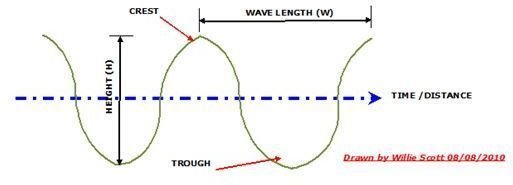
The progressive wave characteristics are as follows:
- Wave Crests – the peak of the wave
- Wave Troughs – the lowest part of a wave
- Wave Height (H)– the vertical distance between a crest and a trough
- Wave length (L) – the horizontal distance between a crest or trough
- Wave Period (T) – the time interlude between the passage of successive crests
- Wave Speed (celerity) – how fast ocean waves travel (C=L/T)
- Wave Steepness (S) - S= H/L
Reference: z/waves - wave characteristics
Waves on the Shoreline
As the waves approach the shoreline and land masses, the bottoms of the wave troughs begin to scrape along the seabed. This has the effect of slowing the bottom portion of the waves due to friction; the top section continues at the former speed, causing the wave to tilt forward.
The process continues until the wave reaches a steepness of more than 1 in 7, when it collapses down into itself due to gravity. This collapsing of the waves is what forms the breakers we see, sometimes in the form of a long rolling wave rushing up a sloping beach, where the waves expend their remaining energy.
There are other waves on the shoreline that are not created by the wind. These are very shallow inshore waves that are caused by the diurnal motion of the tides, being best observed during the changing of the tide period.
Reference: z/waves - breakers and shallow water waves