Passive solar design often involves estimating the percentage of heating load that a passive solar heating system of given size will provide for a given house. For passive solar homes, the area of south-facing windows is the primary measure of passive solar heating system size.
Introduction
In most locations it isn’t economical to design passive solar homes with 100% of the heating load provided by passive solar means. An estimate of the percentage of the building heating load provided by a given size passive solar heating system is often part of passive solar design calculations. The single parameter that best characterizes the size of a passive solar heating system is the area of south-facing glazing. The other passive solar component that must be sized is the mass available for solar heat storage, and that is usually based on the area of south-facing glazing.
The approach for passive solar design in this article will be to choose a preliminary value for the area of south-facing glazing for a given house and location using some rules of thumb. Then an estimate of the passive solar contribution to meeting heating requirements will be calculated and the process will be repeated if necessary.
Preliminary Sizing of a Passive Solar Heating System
Anderson and Wells1 provide some rules of thumb for preliminary sizing of a passive solar heating system for a given house at a given
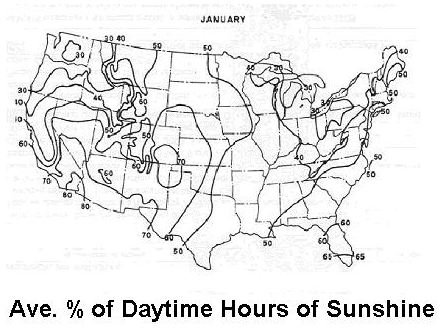
location. The first rule of thumb is that the average percentage of daytime hours of sunshine during the heating season at the site of interest is approximately the optimum passive solar percentage of building heating load. U.S. maps showing average daytime hours of sunshine for each month are available in Appendix 3 of the Anderson and Wells book (see References section for download information.) A copy of the map for January is given at the right. The maps show about 50% sunshine hours for Nov, Dec, Jan, and Feb for much of the United States. The percentage is lower in the northwestern U.S. and higher in the southwestern U.S.
Anderson and Wells’ second rule of thumb is that south-facing glazing will, on the average, supply about the amount of heat over a heating season that is in a barrel of fuel oil, about 60,000 Btu for each ft2 of glazing. The figure could be as low as 30,000 Btu/ft2 in very cloudy areas and it could be as much as 120,000 Btu/ft2 in the sunny southwestern U.S.
Example Preliminary Sizing
Problem Statement: Using the above rules of thumb, choose a preliminary value of south-facing glazing area for passive solar heating of a 2000 ft2 house in Albuquerque, NM with an estimated annual heating load of 4.93 x 10⁷ Btu. (NOTE: Details for estimating this heating load for a 2000 ft2 house in Albuquerque from utility bill information is in the article, ‘Estimation of Heat Loss/Heating Needs from Your Utility Bills .’)
Solution: From the ‘% sunshine’ maps in the Anderson and Wells book, the average % sunshine in Albuquerque, NM is 60 to 65% for Nov, Dec, Jan, and Feb, which is most of the heating season. Thus a target of 60% passive solar heating is a reasonable starting point. Based on the second rule of thumb, 120,000 Btu/ft2 will be used as an estimate of the passive solar heat input.
Estimated passive solar heat input = (0.6)(4.93 x 10⁷) Btu = 2.96 x 10⁷ Btu
South-facing glazing required = 2.96 x 10⁷ Btu/120,000 Btu/ft2 = 247 ft2
Example Passive Solar Design Calculation
Problem Statement: Estimate the percentage of heating load that would be provided by 247 ft2 of south-facing glazing for each month of the heating season, for the 2000 ft2 house in Albuquerque, NM that was described in the previous example. Data for heating degree days and rate of solar radiation transmitted through south-facing, double-paned glazing can come from NREL’s Solar Radiation Data Manual for Building, as described in the [second article](/tools/Dr. Harlan Bengtson is a registered professional engineer with 30 years of university teaching experience in engineering science and civil engineering. He holds a PhD in Chemical Engineering. Read more: http:/www.brighthub.com/environment/renewable-energy/articles/70564.aspx#ixzz0nFeWTerV) and the fourth article in this series. Use a heat loss rate of 5.6 Btu/oF-day/ft2 for the house, as calculated in the third article of this series.
Solution: The data and calculations are summarized in the table below taken from the Excel spreadsheet used to make the calculations. The second and third columns are the data from the NREL data manual. The fourth column is the monthly heating degree-days from column 2 times 5.6 Btu/oF-day/ft2 times the 2000 ft2 floor area of the house. The fifth column is the transmitted solar insolation from column 3 times 247 ft2 glazing times the number of days in the month. The % solar column is simply the fifth column divided by the fourth column expressed as %.
……………………………………………Solar Input………..Heating Load……..Solar Heat
Month……..Heating oF-days………Btu/day/ft2…………….Btus……………for month, Btu………% Solar
Jan…………………955……………………..1220……………..10,696,000………….9,341,540……………..87%
Feb………………..700……………………..1110……………….7,840,000………….7,676,760……………..97%
Mar………………..561……………………….800……………….6,283,200………….6,125,600……………..97%
Apr………………..301……………………….490……………….3,371,200…………..3,630,900……………107%
May………………..89………………………..360………………….996,800…………..2,756,520……………276%
Jun………………….0
Jul…………………..0
Aug…………………0
Sep……………….18………………………650…………………….201,600…………3,315,000……………1644%
Oct……………….259…………………….1040………………….2,900,800………..5,480,000……………..189%
Nov……………….621…………………….1200………………….6,955,200………..6,120,000……………….88%
Dec……………….921……………………1200…………………10,315,200………..6,324,000……………….61%
As shown in the table, the calculations show that the 247 ft2 of south-facing glazing would provide a high percentage of the heating load for this house in Albuquerque through passive solar heating. The process could be repeated for less glazing in order to zero in on the size for a passive solar heating system to provide 60 - 65% of the heating load.
References
1. Anderson, B. & Wells, M., Passive Solar Energy: The Homeowners Guide to Natural Heating and Cooling, Andover MA, Brickhouse Publishing Co. 1981. (available for free download at: https://www.builditsolar.com/Projects/SolarHomes/PasSolEnergyBk/PSEbook.htm )
2. Solar Radiation Data Manual for Buildings, published by the National Renewable Energy Laboratory (NREL). (available for free download at https://rredc.nrel.gov/solar/pubs/bluebook/ )
About the Author
Dr. Harlan Bengtson is a registered professional engineer with 30 years of university teaching experience in engineering science and civil engineering . He holds a PhD in Chemical Engineering.
This post is part of the series: Passive Solar Design Calculations
Passive solar heating systems use components of a building, building orientation, and building design to provide passive solar heat. Calculations involving heating degree days, building heat loss rate and solar insolation data can predict the performance of a passive solar heating system.
- Principles of Passive Solar Heating Systems and How They Work
- Heating Degree Days for Passive Solar Heating Systems in the U.S.
- Estimation of Heat Loss/Heating Needs from Your Utility Bills
- Solar Insolation Data for Passive Solar Heating at Your Location in the U.S.
- Estimating Passive Solar Heating System Performance