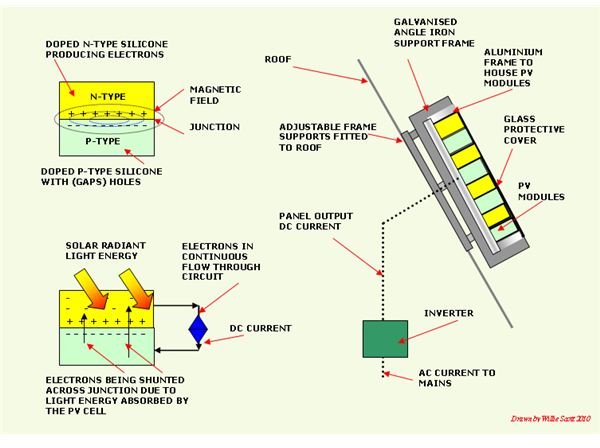
There are two categories of solar panels; both using solar energy for different purposes. A water heating solar panel uses solar energy to heat water; a photovoltaic (PV) panel uses the light in solar radiance to create a DC current. Both may be fitted to the roof of a dwelling for domestic use.
Photovoltaic Panels
As water heating solar panel was described in the previous article, this article will examine the operation of a photovoltaic solar panel (PV). We saw in the previous article that the suns energy was collected and used to heat water. A PV solar panel uses the suns radiance to produce a DC current
The panel is made up of numerous PV cells which are connected together in modules and the modules interconnected to produce the required electrical output. The modules are held in a framework, a glass cover being fitted to protect the delicate modular cells.
The PV cells are constructed from two plates, a P-positive and an N - negative.
The plates can be made from various semi-conducting silicones such as monocrystalline and polycrystalline silicone and, the most recent addition, an amorphous silicon alloy which is usedas a new concept in PV technology.
In this article we shall examine the components of a typical monocrystalline silicon PV cell starting with a look at how it works….
Operation of a Silicon Monocrystalline PV Panel
The atoms in a pure crystal silicon nucleus contain positive charged protons, around which are layers of negatively charged electrons. The outer layer of the electrons is not completely full, so nearby atoms share these electrons, which bond them together in a lattice within the crystal.
If the crystal is doped with an impurity having more electrons in its outer layer, it will produce more negatively charged electrons which are free to move around. This is known as an N – type silicon.
If the crystal is doped with an impurity having less electrons in its outer layer there will be a shortage of electrons, and the spaces left in the outer layer are called holes. These are also free to move around, and this is known as a P – type silicon.
In a PV cell the two doped silicone crystals are joined and electrons from the N-type silicone are attracted to the P-type silicone and move towards the holes in the P-type silicone. They stop at the junction at which an electric field is created.
So now we have a row of negatively charged electrons facing a row of positive charged holes, separated and preventing further movement by the magnetic field at their junction.
If light is absorbed by the cell, the electrons are shunted across the junction. Now, if joined by an electric circuit, the electrons flowing across the junction from N to P will be returned from where they came from via the circuit in a continuous flow, setting up a DC current.
These separate cells are joined together to form a module, and the number of modules for the required electric output fitted into an aluminum frame, which is bolted securely to the galvanized angle support frame. An isolating gasket should be fitted between the aluminum frame and the galvanized support frame to prevent galvanic corrosion.
Output of Power to the Dwelling
The power produced by the PV panel can either be left as DC and used to charge a battery bank or, fed through an inverter converting the current from 12V DC to 240V AC, unfortunately consuming some of the power you have produced from the solar PV panel. However, you can arrange with your energy supplier to return any surplus power back to the grid. You will receive payment for this, and the meter will run backwards recording the kWh of electricity you have returned.
Orientation and Installation of the PV Panel
The panel should face due south, at an angle to the horizontal equal to the location latitude. The optimum electrical power output can be achieved by setting the angle to suit the sun’s orientation during winter, spring, summer and autumn as was the case in the solar heating panels. This entails resetting the panel four times and is only feasible if there is good safe access to the panel. A rotating device can also be fitted to the panel which tracks the sun, ensuring maximum absorption of light.
The Support Frame
This is a rigid angle iron galvanized frame which is securely bolted to the location. As noted above it should be adjustable to allow it to fit the panel and to be set to the correct orientation.
Payback Period
These are notoriously complicated, so I have used the basic data below to work out an average figure for fluctuating fuel prices.
A. Annual electricity usage of 5000kWh at 18p/kw =£900
B. Purchase and installation of typical 1.8Wp =£11500
C. Output from PV panel =1600kWh
D. Savings from PV panel =£288 (1600 X 0.18)
E. Average profit from returning power to grid =£45
F. Feed-in Tariff (in lieu of Gov. grant) =£657
Payback period = B/D+E+F
= 11500
990
= 11.61 years
CO2 Savings/year (Tonnes)
PV kWh X CO2 produced by mains electricity (kgCO2/kWh)= 1600X 0.9/1000
= 1.44T
Results Summary
- Payback Period using Feed-in tariff only = 11.6 years
- CO2 Savings on Electricity = 1.44 T/year