There are different types of solar thermal power stations where the energy from the sun is collected by an arrangement of mirrors. These rotate or tilt to follow the suns arcing movement. The heat energy generated is used to raise steam and run steam turbines which drive electric power generators.
Introduction to Solar Thermal Power Stations
This is a new series on renewable energy and in this the first article we shall look at some of the different methods of supplying solar energy to the power stations.
- Parabolic Trough Collectors – probably the best known and most popular.
- Solar Central Receiver- also known as a solar power tower.
- Solar Parabolic Dish- this device is more suitable to domestic use than power plants.
These devices all have one thing in common- they capture and concentrate the solar energy using an arrangement of mirrors. These mirrors can rotate or tilt to follow the sun’s path providing energy to heat water and raising steam to drive a steam turbine. The turbine drives a power generator producing green electricity to the national power grid.
In this article we shall examine the operation of a Parabolic Trough Collector and a Solar Central Receiver used to supply heat to a thermal power station.
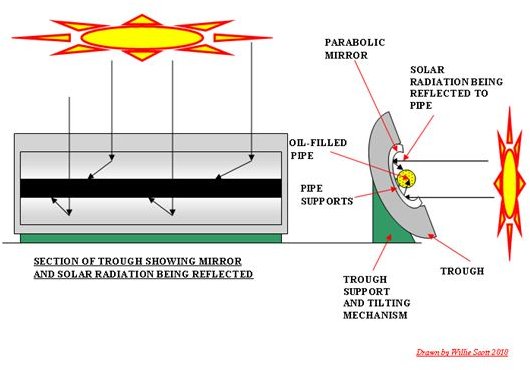
Parabolic Power Trough
This is the most popular type of solar energy converting devise, but also the most land consuming. However this is not usually a problem as the troughs are normally located in arid desserts where there is almost constant sunshine. So much so, in fact, that some of the troughs have to be taken off-line as there is too much heat energy input.
The Troughs
The troughs are laid on the flat ground in a North-South orientation, and have a tracking system that follows the path of the sun from East to West to ensure the optimum amount of solar energy is directed to the mirrors.
Parabolic Mirror
The trough contains the parabolic mirror, running along the full length of the trough. The mirrors reflect the solar heat directly onto a pipe which also runs the length of the trough.
The Heat Absorber
These are black painted high pressure pipes about 100mm diameter, which are filled with a heating medium in our case we shall use oil. They are run along the length of the troughs and into headers. This very hot oil (over 700 Deg F) is continually circulated through the piping system and a heat exchanger.
Steam Generating System
Fresh water is also circulated through the exchanger, the very hot oil transferring its heat to the water. The resultant water vapor is piped to a pressure vessel where it flashes off to high pressure steam.
This steam is then fed to a steam turbine which drives the power generator in the normal thermal power plant manner.
The steam exits the LP turbine into a vacuum condenser from where the condensate is pumped back into the fresh water system in a continuous loop.
Solar Central Receiver
This type of solar energy device is also known as a solar power tower and uses much less land than the solar trough system described earlier.
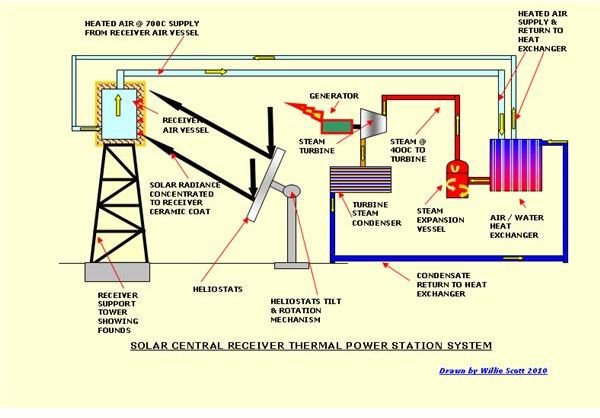
The system consists of an arrangement of mirrors which concentrate their reflection of solar energy on a tank holding a heating medium.
The Tower
The tower can be constructed from tubular steel members in an open lattice assembly, or concrete/steel design. They can be over 100m high and need to be well fixed onto concrete foundations.
The Heliostats (Mirrors)
The mirrors are flat as opposed to the curved mirrors normally associated with solar power. They are now arranged in groups on a common support arm so that a single controller can be used to adjust the orientation to follow the movement of the sun.
In some of the older types of arrangements, the mirrors were mounted on the ground as single units which necessitated the use of individual controllers.
The Absorber
The absorber in this case is a circular vessel enclosed in a solar radiation collecting material (ceramic honeycombed) into which the solar energy reflected from the mirrors is concentrated, heating the air inside the tank.
The Heating Medium
Several types of vapors and liquids can be used as heating mediums. A successful type is molten salt, which as well as supplying instant heat, can store the heat for use at night.
We shall use ambient air (a relatively new innovation) as the heating medium in our example of the technology. The air is heated to above 700 Deg C and ducted to an exchanger where it transfers its heat to water.
Steam Generating System
The heated air is drawn from the absorber by a fan and discharged through a heat exchanger. The heated air transfers its heat to the water which flashes off into superheated steam (400DegC) in an expander pressure vessel. The steam is used to drive a conventional steam turbine power generator.
The steam exits the LP stage of the turbine into the condenser where the resultant condensate pumped back into the heat exchanger water inlet in a closed circuit.
Different Types of Solar Thermal Power Plants
Internet Sites Visited
https://www.solarpaces.org/CSP_Technology/docs/solar_trough.pdf