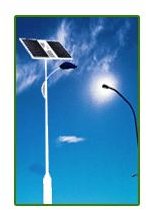
The solar street lights work on the principle of the photovoltaic cell or solar cell. The solar cell converts solar energy to the electrical energy which is stored in the battery. The solar lamp draws the current from this battery and it requires no other wiring.
Working of Solar Street Lights
The solar street lights use solar energy, a form of the renewable energy. These days it is common to see the solar street lamps along the sides of roads. The solar street lights comprise of the photovoltaic cells , which absorb the solar energy during daytime. The photovoltaic cells convert solar energy into electrical energy, which is stored in the battery. At the nighttime the lamp starts automatically and it consumes the electricity already stored in the battery. During the day time the battery gets recharged and the process keeps on repeating every day.
Models of Solar Street Lights
-
Sodium Vapor Lights: The sodium street lights use sodium in excited state to discharge the light. These lights comprise of the solar panels that absorb the solar energy during daytime, which is converted into electricity and stored in the batteries. At nighttime the sodium lamps consume electricity from rechargeable battery. There is no wiring required for these lamps, there are no electricity bills to be paid, they are very safe and can light the streets from 4 to 12 hours depending on the size of the solar panels and battery. The sodium solar street lights can be used for lighting streets, public places, residential areas, parks, plaza etc.
Advertisement -
Solar LED lights: LED stands for light emitting diode. LED comprises of the chemical compound that gives of the light when direct current (DC) from the battery passes through it. Solar LEDs are available from number of companies in different sizes, shapes and styles. The life of LED is usually very high extending up to 50,000 hours. The LEDs require very little current hence the solar panels of smaller sizes are required for the solar lights with LED lamps.
-
Solar lights using induction technology: In this technique the lamps used in the solar lights do not contain the filament or the electrodes that tend to get damaged faster, thus ensuring very high life of the lamp. The life of the lamp in solar street lights based on induction technology can be more than 10, 0000 hours, which is almost 100 times the life of the incandescent lamps. These results in lower maintenance and electrical costs and fewer disturbances caused to the traffic on the road. Since these lights are based in induction technology, they generate lesser heat, thus permitting the use of aluminum reflectors that increases the intensity of the light produced by the lamp.
Advertisement
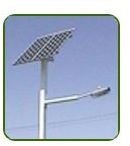
Models of Solar Street Lights from Solar Street Lights

Reference
Related Readings
Applications of Solar Energy: Part-3: Solar Photovoltaic Cells
Applications of Solar Energy: Part-2: Solar Cooker
Applications of Solar Energy: Part-1: Solar Water Heater
Renewable Energy Sources: Solar Energy: Part-1
Sources of Energy: Renewable and Non-Renewable Sources
What is Energy?