
The most common types of energy harvesting are photonic, thermal, and vibrational. How are they used, and what are the drawbacks involved?
Photonic
Common photonic harvesters rely on solar energy drawn with the use of photovoltaics.
Photovoltaics convert sunlight into electricity, and are commonly made from semiconductors. They may be solar cells or panels. A tiny, inexpensive solar cell can generate 150 watts of energy at noontime, so they can be relatively powerful and plentiful sources of energy.
The most obvious drawback of photonic harvesting is that sunlight is not on 24 hours a day, which affects the amount of voltage generated. Voltage is also affected by waning light from dusk or creeping light from the dawn, both of whihc change the angle of incidence of the light which hits the device. Susceptibility to pollutants such as dust that blocks light from the cells may further impede their efficiency. The fragility of photovoltaic devices is still yet another concern.
Thermal
Unless objects are at absolute zero, they have thermal activity. Differences in temperature between objects produce thermal gradients that can be used to generate electricity nearly everywhere on Earth. Of course it is not feasible nor practical to use any object in existence to do this, as factors such as durability, cost, and efficiency would need to be factored in.
Thermoelectric devices used for energy harvesting convert thermal activity into electricity are constructed from semiconductors. They don’t require generators or pumps or fluids, and don’t require copius amounts of materials to build. The main requirements for operation are a heat source and a heat sink.
Because thermoelectric elements produce DC power, a further requirement is that of a DC-DC converter to ensure stability of the potential produced by the power source. One of their drawbacks is that they are not as efficient as Stirling engines .
Vibrational
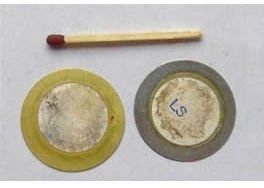
Vibrational devices feed off motion produced as a by-product in order to generate power, and so are natural AC power sources. Because they are AC, they require rectifying and regulatory circuits. Sources include the human gait, trains , motors, engines, and radio frequencies.
The two most common methods to generate power are that of electromagnetic induction and piezoelectricity.
Electromagnetic induction is harvested using motors, with the difference being that the magnet inside the coils moves back and forth instead of just spinning.
Piezoelectric materials produce voltages under pressure changes brought about by sound waves or touch or mechanical strain. Crystals made from this substance form diaphragms or are linked to them, and they can function as speakers or microphones. For energy harvesting, piezoelectric generators are usually cantilevers with masses attached to a free end.
Vibrational harvesting devices are useful monitoring equipment and machinery in industrial environments without the use of batteries or cables. However, this method is not good to use in devices where mobility is a requirement, due to concerns with stability and interference that will impact features such as velocity and noise. They are also best used where the input is at a consistent, predictable frequency.
Caveats
While energy harvesting takes advantage of sources that are more environmentally friendly than that of fossil fuels, they are in fact not clean, and are not environmentally neutral. Pollutants in their construction and operation are still a prominent concern. Photovoltaic devices require toxic, non-recyclable materials, some of which are expensive to obtain and convert into usable form. Windmills have been known to kill birds and bats , affect local climate , are sometimes viewed as eyesores, are more expensive than fossil fuels, and may require large amounts of land to produce an adequate amount of energy. Also, the efficiency of energy harvesting devices compared to that of fossil fuels may be inferior by an appreciable amount.
All of the drawbacks may be summed up in one phrase - the first and second laws of thermodynamics strike again!
References
Sentilla Energy Harvesting White Paper (1 KB PDF)
New Mexico Solar Energy Association Primer
Windmills and the Danger to Birds
Image Credits
Sunshine by Wallyir
Piezoelectric by F Dominec
Resources
Cutting Edge Energy Harvesting Research Lab
This post is part of the series: Energy Harvesting
Energy harvesting can be extremely beneficial to mankind. Find out what it’s all about!