In gardening, beauty comes from variety being present or displayed. Cacti are in tens and thousands of variety, but when a gardener creates an additional variety, and then he derives immense pleasure. This is possible by grafting, read through to understand.
Grafting, one piece of a cactus stem to a rooted stem of another gives immense pleasure for the cactus gardener, when he sees another variety created by him. Grafting can be used to rescue a weak or dying plant or to speed up the growth of seedlings to the flowering stage. Additionally, this art give the gardener a chance to create new plants not found anywhere in nature.
Stock and Scion
The plant on which the graft is to be made is called the “stock”. The plant, which is being grafted, is called the “scion”. Normally cacti which grow wildly are selected for stock. This enables the scion to grow at a faster rate. It also helps the gardener to reduce his intensive attention after this graft is made.
How to Graft
For each plant there is an inner ring of vascular tissue that can be easily seen. A careful match is essential to get the best result while grafting. The nutritious sap flows from the stock to the scion through the inner ring. Normally the scion should be of the same diameter or smaller than that of stock. The best time for grafting is when plants start growing, better done in early summer.
To get a healthy graft, use a knife sterilized with denatured alcohol. Plants must be joined quickly applying a slight pressure to force out air bubbles, which may cause the surface to dry. The graft has to be secured with weight strings, rubber bands stretched over and under the graft, toothpicks or spines from any cactus, depending upon the method of grafting.
The grafted plant must be kept dry and in a shady place for 15 to 20 days. After this period, check if the scion moves from the stock when a slight pressure is applied on it, the weighted strings, rubber bands etc can be removed if the scion does not move. The grafted cactus can be watered without wetting the graft surface after 15 to 20 days. The cactus can slowly be exposed to direct sunlight for a short period over a day, slowly increase exposing to sunlight depending upon the growth of scion. The grafted cactus can be kept in open garden once when the graft starts growing well.
The fast growing cacti like Peruvian apple cactus, Acanthocereus pentagonus, Hylocereus gatesil, Opuntia maxima, Cereus peruvianus, Selenicereus macdonaldiae, Harrisia jusbertii and Hylocereus guatamalensis are few of the common variety of cacti used as stock in grafting.
Grafting Methods
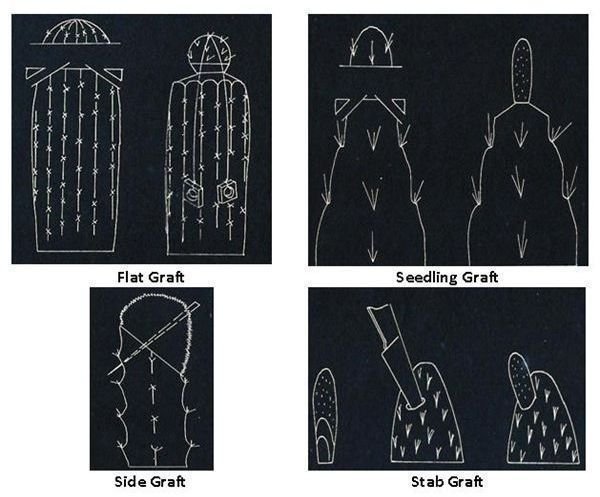
Grafting is generally by four methods each named according to the way the cut in the stock is made. They are (1) The flat graft or seedling graft, (2) The side graft, (3) The cleft graft and (4) The stat graft.
Flat graft is the simplest method because matching a good portion of the inner vascular rings in each piece is relatively easy with flat surfaces. To make a flat graft, slice off a healthy scion then bevel the cut end. Remove the top of the stock and bevel this downward so that the scion will stay snugly together once the inner ring of both is matched. Put the strings weighted the hardware nut or any other small weights or put a rubber band. Leave the plant dry and out of direct sun light until both start growing together.
In the case of seedling grafting, the seedling if can be taken out of the pot and the root is sliced off. This seedling is then placed on the stock matching the inner ring, slight pressure applied to squeeze the air out, secured with weighted string or rubber band.
The side graft, cleft graft and the stat graft are all done with the same care but positioning the scion is on side or in a cleat or inside a stab on the stock. In all the cases the inner vascular ring of the scion should be matched and if required can be fastened by cactus spine.
Variety by Grafting
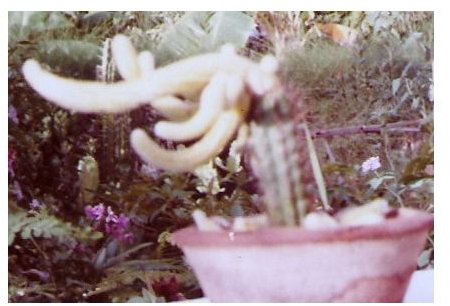
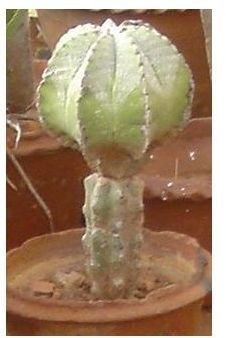
Grafting is simple and needs little care. As there are tens of thousands of variety of cacti, a good selection of stock and scion gives a large number of combination of grafted cacti. The photos show the kind of different and unique varieties of cacti, which are created by grafting.
About the Author
Dr V T Sathyanathan is a boiler consultant with 35 years of experience in various areas of high pressure boiler trouble shooting. He holds a PhD in coal combustion in boilers. Interested in Bosai & Cacti, has about 70 bonsais and 30 Cacti to his collection. The oldest one is 55 years of age and the youngest is 3 years. He takes classes for Graduate and Post-Graduate horticulture students on Bonsai & Cacti.
Related Reading
Cacti Garden for Limited Space - In the modern world, living with large space for gardening has become a luxury, in many ways beyond the reach of common man. Plant lovers still like to have them around in their house. An idea of cactus garden even on a window sill is possible. A few tips on this are bought out. I love my cacti.
Grafing Methods & Examples of Grafted Cacti