Thin clients have the advantage of higher security, lower maintenance, centralized administration and reduced cost. Companies that have a PC network already in place have options that allow them to convert PCs into thin client devices to take advantage of a new thin client network.
Windows-Based Thin Client Conversion
Commercial products are available that are intended to lock down Windows so that it functions as a thin client, enabling companies to switch from a traditional PC environment to thin computing without purchasing additional hardware.
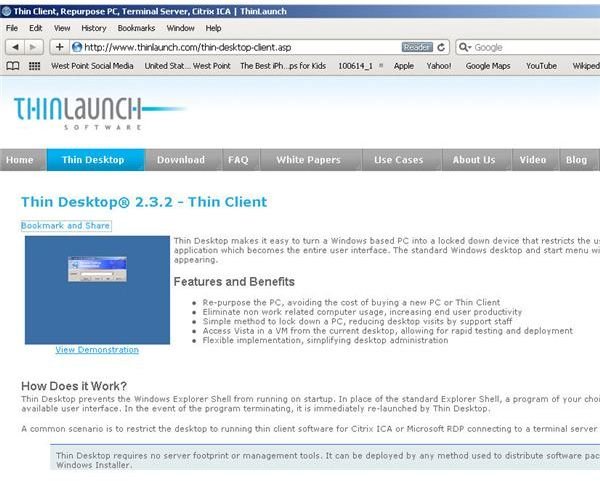
ThinLaunch limits all access to Windows except for the one program that is designated to run on the client. This application loads on top of Windows and prevents the user of the computer from accessing drives, network resources, and other applications without authorization. ThinLaunch accomplishes this by replacing the Windows shell with the program you want the client to run. Although this could be any application, many users will opt to run Microsoft RDP, Citrix ICA, or other thin client applications that will force the computer to use centralized assets. ThinLaunch does not provide pricing on its Web site, but it does have a 30 day trial available that you can use to try the product.
Operating System Replacement
Another approach used to convert PCs into thin clients is to replace the entire operating system. This prevents users from hacking Windows through unauthorized methods to gain access to the system. A thin client operating system used to convert a PC to a thin client is usually Linux-based and does not permit any root access to the device.
A good example of a thin client operating system is Devon IT , a product that markets the VDI Blaster software suite that is used to convert existing PCs into thin clients, saving companies the cost of purchasing new hardware . This software can be configured to leave the original operating system intact in case the need arises to return the device back to its standard configuration. Also, the software can be installed on a USB drive for testing and configuration purposes so you don’t get into trouble if you made a mistake with your original configuration.
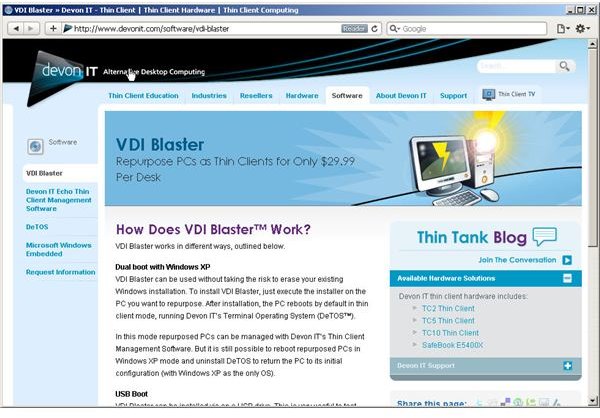
At the time of this writing, the Devon IT VDI Blaster software sells for $29.99 for each computer being converted to a thin client, an option many small businesses are considering .
Finally, ThinStation , is an open source solution to convert a PC into a thin client. This software supports just about every thin client connectivity protocol you can think of including Windows terminal services, Citrix ICA, telnet, VMS, and SSH without requiring any changes on the server.
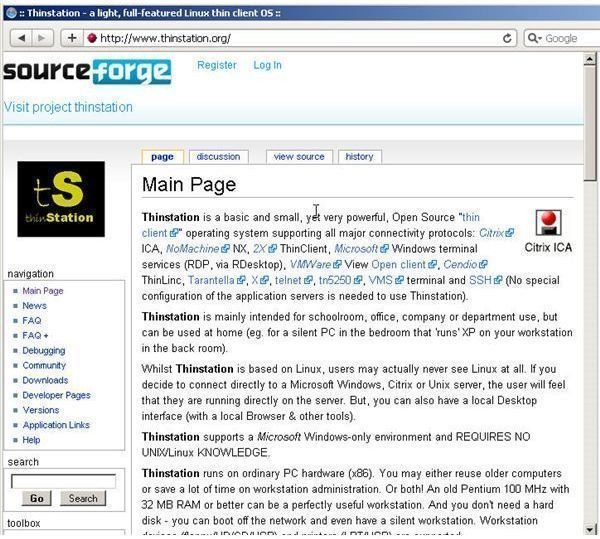
Use of ThinStation is easy and requires no Linux knowledge (although it is a product based on Linux). The minimum requirement for a PC running ThinStation is a Pentium 100 MHz with at least 32 MB of memory, so chances are most of your computers will run this thin client solution without any problem.
ThinStation supports completely diskless operation, meaning that it can boot directly from Ethernet if you want it to. An optional component allows users to configure a desktop interface to make it easier to configure.
ThinStation is free, making it perfect for use at home , school, or at the office.
Image Credits: Screenshots taken by Bruce Tyson.